In this interview, AZoM speaks with Nicholas Lancaster, Application Scientist, and Dr. Krystelle Mafina, Product Leader for Thermal Analysis, at PerkinElmer, about how FTIR spectroscopy and thermal analysis techniques are advancing the characterization of polymer-based advanced materials. They discuss the analysis of CASE chemicals, the benefits of various infrared sampling techniques, and how hyphenated approaches are helping researchers gain deeper insight into material composition, performance, curing behavior, and degradation mechanisms.
Can you please introduce yourselves and your roles at PerkinElmer?
Nicholas Lancaster: I am an Application Scientist within the R&D team at PerkinElmer. My background is in materials characterization using FTIR and UV/Vis spectroscopy, thermal analysis, chromatography, and mass spectrometry. I joined PerkinElmer in 2014 as a Field Application Scientist in South Africa and now work from the UK, developing laboratory workflow solutions for a variety of industries, including renewable energy, lubricants, and advanced materials.
Dr. Krystelle Mafina: I am the Product Leader for Thermal Analysis at PerkinElmer. My role focuses on supporting and advancing our thermal analysis portfolio and helping customers apply these techniques to solve complex materials challenges. My background is in materials science and biomaterials, and I am particularly interested in how complementary analytical techniques can provide a more complete understanding of material behavior and performance.
What are polymer-based advanced materials, and why are they challenging to characterize?
Nicholas Lancaster: Many polymer-based advanced materials fall into what we call CASE chemicals, which stands for coatings, adhesives, sealants, and elastomers. These materials are used in a large range of applications, either individually or as part of complex composite structures.
The challenge is that these materials often contain multiple components, including pigments, fillers, binders, additives, and polymers. Understanding how these components interact, how they change during processing, and how they perform over time requires a combination of analytical techniques that examine both chemical composition and physical behavior.
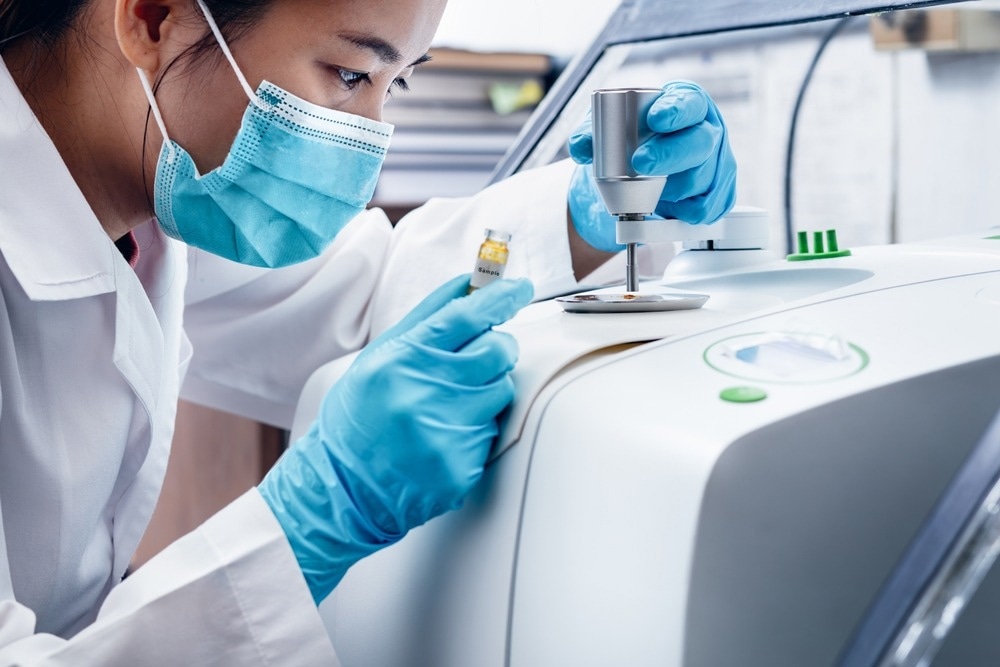
Image Credit: S. Singha/Shutterstock.com
How does FTIR spectroscopy support the characterization of CASE chemicals?
Nicholas Lancaster: FTIR spectroscopy is one of the most powerful tools available for polymer characterization because it provides a molecular fingerprint of a material. Infrared radiation measures molecular vibrations, allowing us to identify functional groups and characterize complex chemical systems.
For CASE chemicals, FTIR can be used for material identification, quality control, formulation verification, and failure analysis. It allows us to differentiate between similar materials, compare unknown samples against reference libraries, and monitor chemical changes that occur during drying, curing, or degradation.
What are the advantages of the different FTIR sampling techniques?
Nicholas Lancaster: The choice of sampling technique depends largely on the material being analyzed.
Attenuated total reflectance, or ATR, is generally the simplest and most versatile technique because it requires minimal sample preparation and can be used on liquids, powders, coatings, and solid materials.
Diffuse reflectance is particularly useful for textured surfaces and powdered materials where light is scattered in multiple directions, whereas specular reflectance is ideal for smooth, uniform coatings, laminates, and thin films where reflected light can provide detailed surface information.
Together, these techniques allow us to analyze an extremely broad range of advanced materials without extensive sample preparation.
How can FTIR be used to study paints, coatings, and adhesive systems?
Nicholas Lancaster: Paints and coatings are excellent examples of how FTIR can reveal subtle formulation differences. We can distinguish between water-based and solvent-based systems, identify pigments and binders, and monitor changes that occur as coatings dry.
For adhesives, FTIR becomes particularly valuable when studying curing processes. By collecting spectra continuously over time, we can observe chemical changes as bonds form and curing progresses. Fast kinetic measurements can capture up to 100 spectra per second, allowing us to monitor both slow and fast curing reactions in real time.
Why is thermal analysis an important complement to spectroscopic techniques?
Dr. Krystelle Mafina: While spectroscopy tells us what a material is made of, thermal analysis helps us understand how that material behaves when exposed to temperature.
Many critical material properties are temperature-dependent. Researchers often need to understand glass transition temperatures, melting behavior, crystallinity, thermal stability, degradation pathways, stiffness, or thermal expansion. Thermal analysis provides direct insight into these properties and helps determine whether a material will perform as expected under real-world conditions.
What information can techniques such as DSC, TGA, DMA, and TMA provide?
Dr. Krystelle Mafina: Each technique offers a different perspective on material performance.
Differential scanning calorimetry, or DSC, is commonly used to measure glass transitions, crystallization, and melting behavior. Thermogravimetric analysis, or TGA, tracks weight changes during heating and is particularly useful for studying thermal stability and decomposition.
Dynamic mechanical analysis, DMA, measures properties such as stiffness, modulus, and viscoelastic behavior, while Thermomechanical analysis, TMA, provides information about dimensional changes and thermal expansion.
Together, these techniques provide a comprehensive understanding of the physical and mechanical characteristics of advanced polymer system.
What are the advantages of hyphenated techniques such as TGA-FTIR?
Dr. Krystelle Mafina: Hyphenated techniques allow us to combine complementary analytical information within a single experiment.
For example, in TGA-FTIR, we monitor weight loss as a material decomposes while simultaneously identifying the gases evolved during decomposition. This allows us to determine not only when a material breaks down but also exactly what chemical species are being released.
This level of insight is extremely valuable when investigating unknown materials, studying degradation mechanisms, or evaluating product performance and safety.
How is TG-GC/MS and pyrolysis GC/MS advancing polymer characterization?
Dr. Krystelle Mafina: These techniques are particularly powerful when analyzing complex polymer systems.
TG-GC/MS combines thermal decomposition with gas chromatography and mass spectrometry, enabling us to identify decomposition products with very high confidence. Pyrolysis GC/MS extends these capabilities further by breaking materials into characteristic fragments that can be used to identify polymer types, additives, and formulation components.
These approaches are increasingly being used in areas such as reverse engineering, failure analysis, environmental studies, and the characterization of highly complex polymer formulations.
How do FTIR and thermal analysis work together to provide a complete understanding of polymer-based advanced materials?
Nicholas Lancaster: FTIR provides detailed chemical information about what a material contains.
Dr. Krystelle Mafina: Thermal analysis tells us how that material behaves under changing environmental conditions.
Nicholas Lancaster: When these techniques are combined, researchers gain a much deeper understanding than either technique could provide individually.
Dr. Krystelle Mafina: Whether the goal is product development, quality control, sustainability research, or troubleshooting manufacturing challenges, combining spectroscopy with thermal analysis provides a powerful toolkit for understanding advanced materials from both a chemical and physical perspective.
About Nicholas Lancaster
Nic is an application scientist in the R&D team at PerkinElmer. With a background in materials characterization using FTIR & UV/Vis spectroscopy, thermal analysis as well as chromatography and mass spectrometry he has been a part of PerkinElmer since 2014. He joined PerkinElmer as a Field Application Scientist (FAS) in South Africa, and now works from the UK developing laboratory workflow solutions for a range of end markets including renewable energy, lubricants, and advanced materials.
About Dr. Krystelle Mafina
Krystelle is a product leader at PerkinElmer, overseeing the thermal analysis (TEA) business. She holds a PhD in Biomedical Biomaterials Science and is a Chartered Engineer (CEng) and Chartered Scientist (CSci) with a strong background in materials science. A member of the Institute of Materials, Minerals, and Mining (IOM3) since 2009; a committee member since 2019, Krystelle is committed to continuous professional development and was recently made 'Fellow' of the institute. Her blend of scientific knowledge and industry experience makes her a valuable contributor to PerkinElmer and the wider scientific community.
This information has been sourced, reviewed, and adapted from materials provided by PerkinElmer.
For more information on this source, please visit PerkinElmer.
Disclaimer: The views expressed here are those of the interviewee and do not necessarily represent the views of AZoM.com Limited (T/A) AZoNetwork, the owner and operator of this website. This disclaimer forms part of the Terms and Conditions of use of this website.