By placing iodine beside sulfur inside porous carbon, researchers tested whether a redox-active network could overcome one of the toughest kinetic bottlenecks in solid-state conversion batteries.
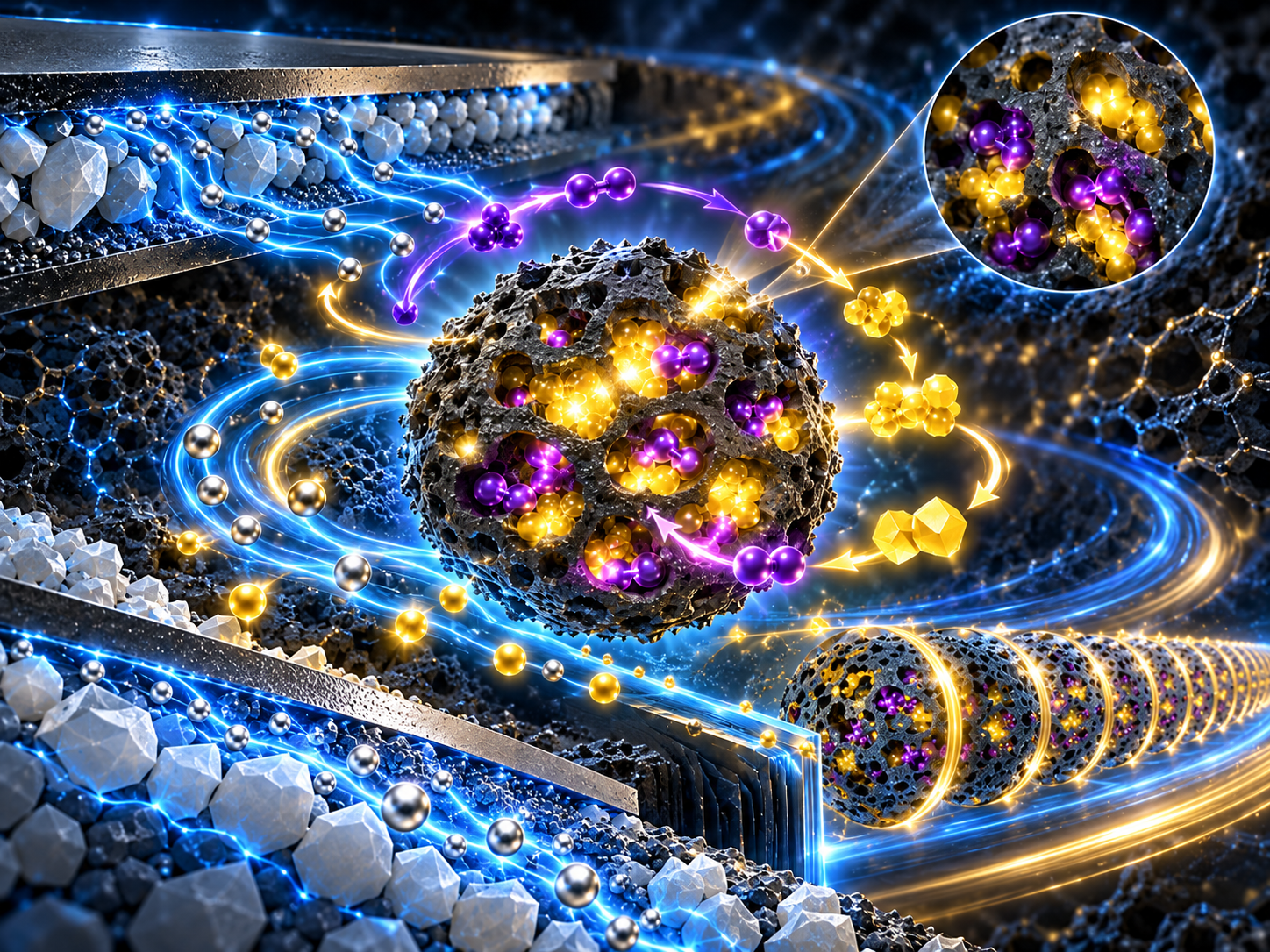
Paper: Fast-charging and durable all-solid-state lithium-sulfur batteries enabled by pre-embedded solid-solid redox mediator. AI-generated abstract conceptual image created using ChatGPT/OpenAI
*Important notice: This news reports on an unedited version of an accepted paper and is awaiting final editing. Therefore, the paper should not be regarded as conclusive or treated as established information.
A recent Nature Communications study reports a pre-embedded solid-solid redox mediation strategy to improve the charging speed and cycling stability of solid-state lithium–sulfur batteries.
The approach combines sulfur and iodine in mesoporous carbon to form an amorphous nanocomposite that accelerates sulfur conversion via reversible iodine redox reactions. The work describes a materials-engineering route for reducing interfacial constraints in solid-state conversion electrodes.
Overcoming Slow Sulfur Reactions in Solid-State Batteries
Solid-state lithium–sulfur batteries promise high specific energy, high thermal safety, and low-cost energy storage. Conventional lithium–sulfur batteries use liquid electrolytes; solid-state systems can suppress the polysulfide shuttle that causes active-material loss. However, slow sulfur redox reactions and poor contact between solid electrode components still limit performance.
During battery operation, sulfur converts into lithium sulfide (Li2S) during discharge and returns to sulfur during charging. Both materials conduct electrons and lithium ions poorly, which slows these reactions. Sulfur conversion occurs at multiphase boundaries, where the active material, conductive carbon, and solid electrolyte meet.
The limited number of these interfaces restricts reaction rates, particularly during fast charging. Repeated volume changes also disrupt conductive pathways and weaken interfacial contact during cycling.
Previous studies have improved electrode conductivity and added redox-active materials to accelerate sulfur conversion. But separate solid mediators provide limited contact with sulfur-containing reaction products.
To overcome this limitation, the researchers developed a pre-embedded solid-solid redox mediation (PE-SSRM) strategy. By mixing sulfur and iodine at the nanoscale within porous carbon, they increased the density of mediation sites and enabled iodine to assist sulfur conversion through reversible redox reactions.
Engineering an Amorphous Sulfur–Iodine Nanocomposite
The researchers synthesized a sulfur–iodine composite with a nominal S8I2 stoichiometry by heating elemental sulfur and iodine at 80 °C and allowing the mixture to cool naturally. They then mixed the composite with mesoporous Ketjen black carbon and heated it at 100 °C. The porous carbon confined sulfur and iodine within nanoscale spaces, producing an amorphous nanocomposite designated S8I2/KB.
X-ray diffraction, transmission electron microscopy, and selected-area electron diffraction showed an amorphous S8I2/KB phase; the unconfined S8I2 remained phase-separated and crystalline. Elemental mapping also revealed a relatively uniform nanoscale distribution of sulfur and iodine. This arrangement increased the density of potential mediation sites and provided the structural basis for redox mediation.
The team incorporated S8I2/KB into positive electrodes containing conductive carbon and sulfide-based solid electrolytes. They evaluated three catholytes: Li5.5PS4.5Cl1.5, Li3PS4, and Li7P3S11. Electrodes containing pure sulfur and a mechanically milled lithium sulfide–lithium iodide mixture served as reference systems.
Researchers used X-ray absorption near-edge structure spectroscopy, time-of-flight secondary-ion mass spectrometry, and electrochemical impedance spectroscopy to investigate iodine redox activity and interfacial changes. They paired these analyses with long-term cycling tests and evaluations at higher active-material loadings.
Together, these methods helped clarify how the nanocomposite structure influenced sulfur conversion and battery performance.
Accelerated Sulfur Conversion and Long-Term Cycling Stability
The S8I2/KB electrode showed better high-rate charging performance than the pure-sulfur reference. It delivered a specific capacity of 1,132.5 mAh g-¹S/I at 1C, above the calculated theoretical capacity of 945 mAh g-¹S/I.
The authors note that above-theoretical capacities during the preceding low-rate activation cycles include a contribution from catholyte redox. At higher charging rates, the cell delivered 851.9 mAh g-¹S/I at 10C and 474.7 mAh g-¹S/I at 24C. By comparison, the pure-sulfur electrode delivered only 341.0 and 128.2 mAh g-¹sulfur at 10C and 24C, respectively.
The figures are not strictly like-for-like because the two electrodes were discharged at different rates, and capacity and C-rates were calculated differently. All three sulfide catholytes produced comparably fast charging, indicating that the effect was nchargeded to one sulfidlyte.
Mechanistic investigations showed that iodine accelerates sulfur conversion through the reversible I-/I2 redox couple. During electrode preparation, a fraction of iodine reacts with the sulfide catholyte to form lithium iodide (LiI); the authors propose that this creates a distributed, redox-active I2/I- network.
On charge, LiI is electrochemically oxidized to I2, which can chemically oxidize Li2S to sulfur while being reduced back to LiI. On discharge, operando measurements show I2 being reduced to I- while sulfur converts back to Li2S. X-ray absorption measurements and related chemical analyses support the reversibility of the iodine and sulfur reactions.
The proposed distributed iodine network provides more local routes for charge transfer across solid-solid interfaces. Nanoscale mixing increases the number of available mediation sites, while the authors propose that iodine may move along porous carbon surfaces and voids to reach nearby Li2S. They say iodine transport and reaction kinetics still need quantitative study.
These effects improve sulfur utilization and accelerate otherwise sluggish conversion reactions. The electrode also demonstrated long-term cycling stability. Cells retained 81.4% of their initial capacity after 2,800 cycles at 0.5C and 92.0% after 3,400 cycles at 5C. At a charging rate of 10C and a discharging rate of 2C, a cell retained 80.6% capacity after 5,000 cycles. A cathode containing 50 wt% S8I2 retained 75.8% after 9,000 cycles at 2C.
The design also worked at higher active-material loadings. A cell with a loading of 5.0 mg cm-² retained 80.3% capacity after 1,600 cycles at 1C, while a loading of 10.0 mg cm-² delivered 10.2 mAh cm-² at 0.47 mA cm-², about 0.05C. A full cell using a lithium–aluminum negative electrode delivered 797.0 mAh g-¹S/I at 10C and 544.4 mAh g-¹S/I at 18C, with stable cycling for more than 300 cycles at a 10C charging rate.
Toward Faster and More Durable Solid-State Batteries
These experiments remain laboratory demonstrations. The study indicates that pre-embedded solid-solid redox mediation can accelerate sulfur conversion and maintain reversible cycling under the reported laboratory conditions.
Most multi-thousand-cycle tests used In/LiIn counter electrodes in custom pressure cells; some high-loading or high-rate tests also used an iodine-containing sulfide separator electrolyte to stabilize that counter electrode. The Li–Al full-cell test used a configuration closer to a full battery but ran far fewer cycles.
This work shows why controlling both electrode microstructure and interfacial chemistry matters when designing solid-state conversion materials.
Rapid charging, long cycle life, and high active-material loading wThe study demonstrated rapidemonstrated across different cell configurations rather than one cell. The high-loading tests ind,icate that the concept is not limited to thin, dilute cathodes. The same principle may also apply to other conversion electrodes that face sluggish reactions and limited solid-solid contact.
By integrating a redox-active component directly into the electrode, this design provides an alternative to approaches that rely solely on improving electronic or ionic conductivity.
Future work should quantify iodine transport and its reaction kinetics with lithium sulfide and lithium polysulfides. Practical implementation will also require improvements in negative-electrode energy density, lithium-metal–electrolyte interfacial stability, and solid-electrolyte conductivity. Progress on these challenges will determine how well laboratory results translate to full cells.
This work combines nanoscale structural control with chemical redox mediation. The study offers a chemically distinct route to faster sulfur conversion but leaves key cell-level engineering challenges unresolved.
Disclaimer: The views expressed here are those of the author expressed in their private capacity and do not necessarily represent the views of AZoM.com Limited T/A AZoNetwork the owner and operator of this website. This disclaimer forms part of the Terms and conditions of use of this website.
Source:
- Song, H., Zhang, R., et al. (2026). Fast-charging and durable all-solid-state lithium-sulfur batteries enabled by pre-embedded solid-solid redox mediator. Nature Communications. DOI: 10.1038/S41467-026-78042-6, https://www.nature.com/articles/s41467-026-78042-6