Sponsored by MilestoneReviewed by Olivia FrostJun 16 2026
Elixir Group is one of Southeast Europe’s largest chemical industries. Headquartered in Serbia, the group’s core business focuses on the production of phosphoric acid, mineral fertilizers, and aluminum fluoride.

Image Credit: SergeiShimanovich/Shutterstock.com
Multiple production facilities are currently in operation, with Elixir Group now actively expanding into sustainable technologies, including the region’s first waste-to-energy incineration plant.
A highly developed analytical infrastructure supports these industrial operations. As part of Elixir Group, the Accredited Laboratory Center for Applied Circular Economy underpins the company’s regulatory compliance, product quality, and environmental safety.
Elixir Group’s workforce of over 2200 employees demonstrates a strong commitment to analytical excellence, with approximately 200 employees managing laboratory and quality-related activities across five laboratories (four QC laboratories and one center).
The laboratory itself leverages a diverse range of analytical techniques to support final product certification, including AAS, ICP, gas and liquid chromatography, ion chromatography, CHNS analysis, and mercury determination.
The need for advanced waste stream characterization has become increasingly important as Elixir Group expands its activities into circular economy processes, most notably, waste-to-energy applications.
The determination of semi-volatile organic compounds (SVOCs), such as mineral oils and polycyclic aromatic hydrocarbons (PAHs), requires particularly efficient and reproducible extraction techniques able to accommodate heterogeneous solid waste matrices.
The Challenge
The laboratory has historically relied on traditional extraction techniques like ultrasonic baths, Soxhlet extraction, and classical solvent-based methods.
These approaches are widely used but inherently labor-intensive, time-consuming, and solvent-intensive. They also present a number of drawbacks, including high organic solvent consumption, long extraction times, and limited extraction efficiency for contaminated or complex matrices.
These limitations became a bottleneck as analytical demand increases, especially in the context of waste analysis, where throughput requirements are growing, and sample variability is high.
The Solution
Elixir Group implemented microwave-assisted extraction with ETHOS X to modernize its extraction workflow. This technique has been specifically developed to accommodate the rapid extraction of organic pollutants from environmental samples.
Microwave extraction operates in closed vessels under controlled pressure and temperature conditions, thereby considerably improving the interaction between the solvent and the matrix. This results in faster, more efficient extraction than traditional techniques.
The technology is especially well-suited for determining SVOCs in environmental matrices, enabling highly reproducible extraction of analytes such as mineral oils, PAHs, and potentially PCBs.
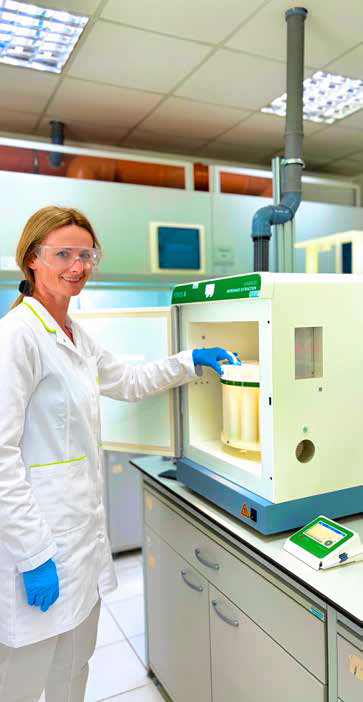
Image Credit: Milestone
Results
A substantial improvement in laboratory performance was observed following the transition to microwave-assisted extraction. This has led to a dramatic reduction in extraction times, allowing improved overall throughput due to faster sample processing.
Solvent consumption has decreased considerably, contributing to both a more sustainable laboratory operation and significant cost savings. The closed-vessel design also minimizes operator exposure to volatile organic solvents, improving safety.
From an analytical standpoint, this technique offers efficient, consistent extraction across various waste matrix types, supporting reliable downstream analysis via chromatographic techniques.
Microwave extraction offers a scalable and future-proof solution aligned with both operational and regulatory requirements. This will continue to prove essential as Elixir Group prepares for increased analytical demand related to its waste-to-energy plant.

This information has been sourced, reviewed, and adapted from materials provided by Milestone S.p.A.
For more information on this source, please visit Milestone.