Some adhesive and sealant manufacturers, as well as those who provide them with raw ingredients, are beginning to use artificial intelligence extensively. Some are more hesitant.
For some, the concern is that they do not have enough data in the appropriate format to do AI. Others are concerned that they lack the necessary skills in-house to get started.
This article explains how adhesives and sealant companies are already benefiting from AI and provides practical advice on getting started and what to look for in an AI supplier.
Image Credit: Citrine Informatics
Return on Investment: Moving From Being a Supplier to a Partner
Whether you are a specialty adhesives company selling to an OEM or a raw material company selling into an adhesives company, you must have a thorough understanding of how your product affects the performance of your customer's product in order to advise them properly, charge based on value, and identify a market niche with higher margins.
Citrine's customers use its tools to accomplish exactly this. A recent Handlesblatt article described how Citrine’s customer, Dorfner, a mining firm with a coatings ingredients section, increased its revenues by 30 %.
[with Citrine] we are able to enter new business models… we are able to get customer lock-in… we were just a supplier before and now we are a development partner… this cannot be ROI’ed, it is far beyond
Mirko Mondan, CEO, Dorfner
Accelerated Time to Discovery
Many customers have noticed a reduction in the number of experiments, and thus the time to discovery, required to meet property targets.
Using the Citrine Platform, a company that was optimizing the qualities of a multi-layer polymer coating for an automotive application was able to achieve target properties in two weeks rather than the typical ten.
This is not uncommon among Citrine customers. Researchers can focus on conducting tests that are likely to yield the target properties, as they can anticipate their likelihood of success.
Dealing with Problem Ingredients
Other clients need to remove problematic substances such as PFAS compounds from their product portfolio. This is where scalable AI comes in handy; once a model has been trained on the base recipe, it can be simply altered for any product in the range, assuring both consistency and speed.
Citrine's AI platform "featurizes" compounds by transforming their molecular structure and chemical formulas into additional information, such as molecular weight or the number of hydrogen bonds. Citrine's AI can then recommend alternatives based on the problem ingredient's fingerprint and its position in the original formulation.
Amplify Your Expert Formulators - Reliable Knowledge Sharing
Deloitte estimates that up to 25 % of the industry's workers may retire between 2021 and 2026. While AI cannot prevent your top formulators from retiring, it can be used to codify their specialist knowledge, allowing it to be reused by more junior employees both now and in the future.
In a data-scarce, knowledge-rich setting such as an adhesives and sealants lab, it is critical that Citrine's AI platform capture both data and team expertise and use them together to achieve results. With this in mind, Citrine's platform was specifically designed to be accessible to people from diverse backgrounds.
Your specialists can train the no-code platform in the same way that they would a new team member. This knowledge is then used to direct the AI model's power toward unexplored areas rather than reinventing the wheel, hence accelerating progress.
Knowledge is captured as follows:
- Data should be uploaded into the system rather than stored in a spreadsheet.
- The AI model represents how inputs affect outcomes.
- In a search space, specify formulation limitations such as ingredients and mixing parameters.
AI is proving beneficial to the adhesives and sealants industries and could become a standard tool for formulators.
When the Data is a Mess
There is a distinction between Big Data AI, such as ChatGPT, and Small Data AI. In chemistry, creating and testing a sample can cost hundreds or even thousands of dollars, so databases are limited. Citrine Informatics has spent over ten years developing AI for small datasets.
To make the most of small data, Citrine Informatics can devise strategies such as knowledge integration (using your team's expertise to focus the model), chemical featurization (automatically generating extra data), and uncertainty quantification (clever math to calculate the likelihood of hitting targets).
Some AI Projects Start with No Data
Sometimes, whether by necessity or desire, projects begin before any relevant data has been acquired. In this situation, an initial set of tests is performed, similar to a Design of Experiment (DOE) matrix, but with the goal of covering the search space in as few experiments as feasible.
The goal is to prime the AI model so that it can direct subsequent experiments. Sequential Learning (the process of suggesting groups of 5 or so experiments, running them, inputting the findings, and retraining the AI model to suggest the next set of trials) is then used to move closer to the project's objectives. Compared to trial and error or DOE, this process involves fewer experiments.
Some Companies Have Data in Silos
Commercial ingredient information is sometimes stored in an ERP system, while rheological measurements are stored in a LIMS. Perhaps your intellectual property is housed in handwritten notes on a shelf? Running a short-term AI project first will allow you to determine which data is relevant to your AI model and, therefore, worth digitizing.
Citrine Informatics has an experienced team that can assist you in developing a data strategy and integrating your historical data into their platform. Data pipelines can be set up to ensure that all future data is entered automatically.
The Citrine data model is scalable. It can readily accept data from new sources as time passes.
Unlike a SQL-based data format, which requires data in a single large rigid table, Citrine's graphical database structure develops with you as you learn more and desire to add new properties, or as you receive data from your raw material suppliers.
To summarize, learn by doing. Starting with a modest but valuable AI project can help you discover the data you need and how to implement a data strategy that provides quick benefit without boiling the ocean.
When There Are No Data Scientists
AI platforms have advanced significantly during the past five years. While they were originally exclusive to data scientists, the best ones can now be used by anybody. In fact, you want your formulators to use them directly.
Cutting out the middleman allows formulators to easily integrate their own knowledge into the platform and iterate concepts more quickly. They can also learn what the AI model considers significant, deepening their own understanding.
We understand our own laboratory more than before. It is fun to work in this way."
Oliver, Technical Application Lead
No-Code, Graphical User Interface is Essential
While the Citrine Platform includes an API (code-based interface) that data scientists can use if they so desire, keeping the graphical user experience intuitive and simple is a top goal.
It allows formulation experts to add information like linkages and equations directly to AI models, expediting work and giving your team ownership of the models, resulting in faster adoption.
AI models are built automatically based on the data set chosen, with some assumptions. The formulator then only needs to add their expertise and sense-check the model.
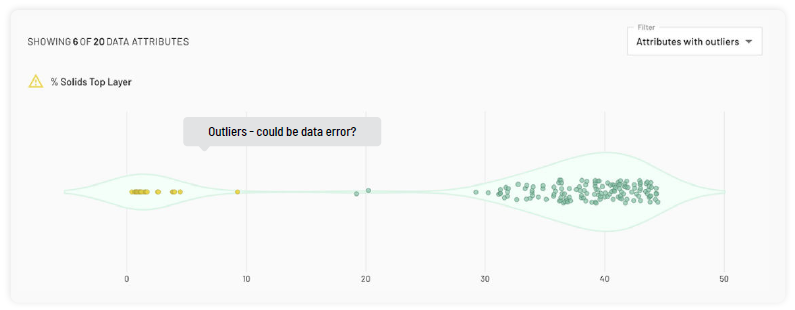
Review your data graphically. Image Credit: Citrine Informatics
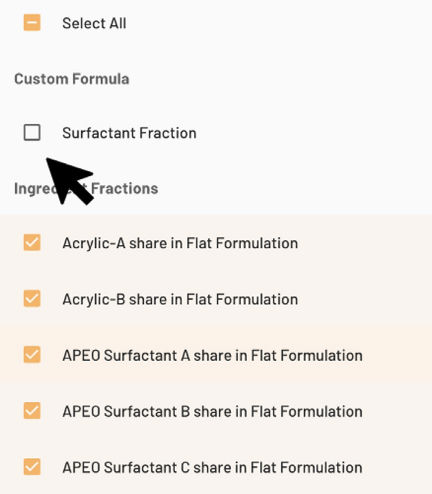
Tick a box to say that the amount of surfactant is important. Image Credit: Citrine Informatics
Make Sure Your Team Can Learn from the AI Platform
AI models function by identifying relationships between input and output properties. Your team will benefit from a deeper awareness of these linkages.
If you can demonstrate that an ingredient does not affect the target output attributes, this is highly valuable. Sometimes, unintuitive connections can be created, and by analyzing the traits that the AI model considers relevant, you will learn something new.
“AI lets us solve problems with less work. It’s like having a flashlight in a dark room.”
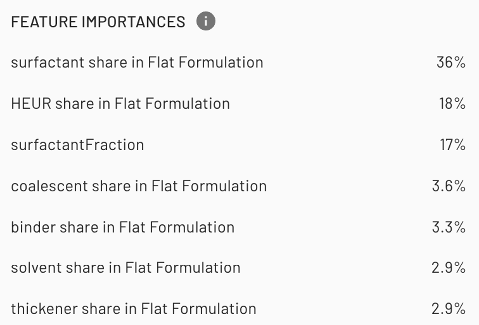
The team can review the feature importance to both sense check the model and perhaps learn something new. Image Credit: Citrine Informatics
Change Management
Adopting AI requires a change in people's daily working methods, which offers a challenge. However, it is only a minor portion of many companies’ overall digital transformation and an excellent method to demonstrate the importance of solid data management practices.
By completing high-value AI initiatives initially, you can demonstrate the worth of your team's data and encourage them to engage in larger data digitization activities. Citrine has created an experienced team of change managers over the last ten years, drawing on over 100 engagements to develop a robust framework for implementing AI.
AI should not be distributed like a dish of fruit. While it seems ideal to make something freely available to those who could use it, in fact, a bowl of fruit in an office can become moldy because people do not have the time to go downstairs and peel an orange. The same is true for AI.
Even if researchers understand that a new technology could save them time in the long term, they may be too busy to stop and learn something new.
Citrine's skilled customer success team has established techniques to assist groups in adopting the technology, including developing a network of advocates and achieving high-level buy-in for project business goals.
What to Look for in an AI Provider
- Deep expertise in AI for adhesives and sealants
- An experienced change management team to smooth the adoption process
- A platform that is chemically aware and offers chemical featurization
- A graphical data model that can accept data from lots of different sources and is scalable
- A no-code, easy-to-use platform that can capture and leverage your team’s expert knowledge
- Easy ways to search, filter, visualize, and share data between team members so that no one reinvents the wheel
- AI tailored to work with small data sets
AI is unavoidable. It represents a significant advancement in a variety of disciplines. In the end, it is just math. However, choose an easy-to-use platform supported by an experienced taeam to assist you in getting started.

This information has been sourced, reviewed, and adapted from materials provided by Citrine Informatics.
For more information on this source, please visit Citrine Informatics.