Temperature measurement in laminated safety glass production is difficult due to the glass's low infrared emissivity, reflective coatings, and limited access in lamination machinery. These difficulties hinder precise temperature management, resulting in uneven heating, poor PVB film adhesion, and defective products.
 Image Credit: Shutterstock.com/Vyshedko
Solution
The lamination process is properly monitored and controlled using infrared sensors that can measure surface temperature accurately through narrow viewing apertures. Line-scanning infrared cameras and tiny pyrometers provide real-time heat feedback despite coated or low-emissivity glass and limited sensor positioning possibilities.
Benefits
- Provides homogeneous heating for strong and consistent PVB bonding between glass layers
- Reduces product faults by detecting temperature changes in real time
- Detects lamination faults early, reducing material waste and rework
- Improves production efficiency through rapid, data-driven modifications
- Provides accurate monitoring in confined or obscured equipment spaces
The Importance of Infrared Measurement in Safety Glass Production
Laminated safety glass is commonly made by bonding two to three glass panes together with a polyvinyl butyral (PVB) film under heat and pressure. The purpose of this technique is to form a coating that assures the shards stick together in the case of a glass breaking, hence avoiding injury.
This technique is frequently carried out in autoclaves or under vacuum, employing heating systems to achieve the required temperature and pressure, resulting in a firm bond within the laminate.
The production of laminated glass, however, involves a number of challenges. One key issue is that glass is naturally configured to emit as little infrared light as possible.
While this is useful for reducing sunlight-induced heating, it presents a substantial barrier to temperature measurement throughout the lamination process. Because the film between the glass panes cannot be directly measured, the surface temperature of the glass must be used to determine the temperature inside the laminate.
In addition, depending on the type of glass used, the lamination process is usually carried out at relatively low temperatures, between 40 and 60 °C. Lower temperatures are difficult to precisely measure with typical temperature sensors.
Another difficulty occurs when coated glass is employed. Certain varieties of glass, particularly those used in facades or automotive applications, have specific coatings that deflect infrared radiation, preventing sunlight heating.
These coatings, however, make reliable temperature measurement much more difficult because they dramatically reduce the glass's emissivity. Inaccurate measurements can prevent the required temperature for proper lamination from being reached, compromising PVB film adhesion and resulting in unsatisfactory products.
In addition to these material-related hurdles, there are practical issues, such as restricted access to the glass units during lamination. Often, pressing machines or laminating ovens are designed with only modest viewing slots for temperature measurements.
These limited visual access points make it difficult to precisely monitor the entire laminate, resulting in uneven temperature distributions and, as a result, poor lamination.
Accurate temperature measurement is critical for manufacturers because it ensures the glass surface is heated evenly, resulting in a homogeneous connection between the glass panes and the PVB film.
 Image Credit:Shutterstock.com/Salazar Benjamin
Optimizing Laminated Glass Production with Line-Scanning Capabilities
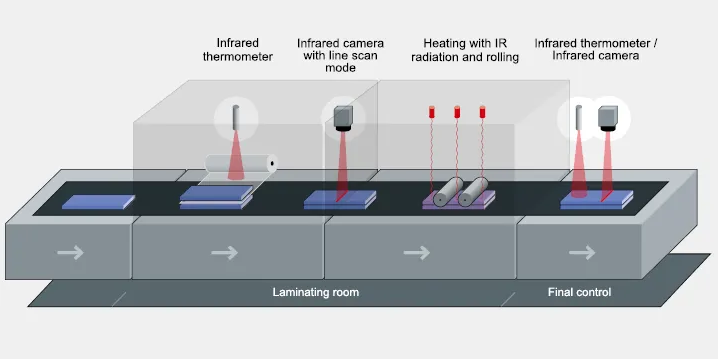
Image Credit:Optris GmbH & Co. KG
Precision temperature control is crucial in the production of laminated safety glass to ensure appropriate glass layer bonding. Optris infrared cameras and pyrometers offer innovative solutions for monitoring and optimizing this process, notably models such as the PI 640i G7, PI 450i G7, Xi 400, Xi 410 and CTi LT pyrometer.
Infrared technology suited to specific wavelengths is required due to glass's low emissivity and reflective properties. Infrared cameras with a spectral range of seven to nine micrometers are ideal for this work because they can precisely monitor the glass surface temperature, regardless of the material's limits.
The Optris PI 640i is a high-resolution infrared camera that specializes at precise temperature monitoring. Its 640 x 480 pixel resolution enables manufacturers to obtain exact thermal photographs of the whole glass surface, resulting in consistent temperature distribution across the laminate.
This is especially significant in large manufacturing facilities because uniform heating is critical to preventing flaws in the finished product.
The PI 640i can be connected to the manufacturing line to continually monitor real-time temperatures and make fast modifications to ensure optimal process conditions. This high level of thermal accuracy lowers the likelihood of production errors, resulting in consistently high-quality output.
The Xi 400 and Xi 410 infrared cameras are small and adaptable, making them suitable for use in confined locations on the production line. These models provide great precision at a relatively affordable price range, making them ideal for manufacturers seeking dependable temperature-monitoring solutions without a large budget.
All cameras include line scanning capabilites which allow them to monitor temperature throughout the glass surface even in small apertures. This is especially beneficial in glass laminating furnaces, where narrow viewing apertures may be present.
The cameras' ability to record comprehensive thermal data through such limited access points guarantees that the glass is evenly heated, minimizing temperature variations that could result in faulty bonding.
The Optris CTi LT pyrometer is a precise, small infrared sensor intended for point temperature measurement. In laminated glass production, it is commonly used to measure the temperature of the glass surface in real time, which serves as a reference point for the entire process.
The CTi LT is useful in short production lines or places where only spot measurements are required. It gives reliable temperature measurements even in tough conditions with limited sensor positioning space.
The CTi LT's continuous, non-contact temperature monitoring allows producers to swiftly identify and remedy any temperature aberrations that could negatively impact the lamination process.
Achieving Consistent Lamination with Optris Infrared Solutions
Integrating Optris infrared cameras and pyrometers, such as the PI 640i G7, PI 450i G7, Xi 400, Xi 410, and CTi LT, into the laminated safety glass production process provides considerable benefits for glass producers.
One significant advantage is the ability to establish exact and consistent temperature control, which is critical for maintaining the excellent quality of laminated glass. These devices serve to prevent common manufacturing concerns such as uneven bonding or delamination by providing uniform heating throughout the whole glass surface.
The Optris PI 640i has unmatched thermal resolution, making it excellent for applications that require detailed temperature mapping. This camera enables producers to monitor huge portions of the glass laminate with outstanding clarity, detecting temperature variations that may impair the bonding process.
The camera's exceptional resolution detects even the tiniest temperature differences, allowing for fast process adjustments. This level of precision enhances product quality while decreasing the likelihood of production errors, saving time and resources.
The Xi 400 and Xi 410 infrared cameras are compact yet capable alternatives for manufacturers with limited space or more budget-conscious projects.
Their capacity to scan lines through small gaps enables them to monitor temperature distribution throughout the entire glass surface without requiring a direct view of the full laminate.
This is especially beneficial in complex production setups where full visual access to the glass may be limited. The cameras' autonomous operation characteristics allow for easy integration into current manufacturing lines, giving manufacturers greater flexibility and convenience of use.
The CTi LT pyrometer offers another layer of control by providing precise temperature measurements at important moments during the manufacturing process. Its tiny size and accuracy make it an excellent instrument for continuous monitoring, ensuring that specific portions of the glass reach the proper temperature.
The CTi LT's ability to give real-time feedback enables manufacturers to avoid costly production errors, decrease waste, and improve overall process efficiency.

This information has been sourced, reviewed and adapted from materials provided by Optris GmbH & Co. KG.
For more information on this source, please visit Optris GmbH & Co. KG.