Collaborating across globally distributed teams can make research and manufacturing activities significantly more complex, ultimately affecting time-to-market.
To streamline processes and enhance communication, agrichemicals specialist PI Industries implemented lifecycle management and design solutions from Revvity Signals Notebook and Lead Discovery. These platforms have helped the organization accelerate product development and introduce innovations to the market more efficiently.
- Reduced time-to-market
- Accelerated data transfer from field to lab
- Increased productivity and fewer errors
About the Company
PI Industries is a rapidly expanding agrichemicals company known for its expertise in chemistry and engineering. Headquartered in Gurugram, Haryana, India, the company also operates in Japan, Germany, and China with a workforce of more than 3600 employees. In 2023, PI reported revenue exceeding $900 million.
Challenges of Reaching a Global Market
The global market for innovative agrichemicals and bio-based chemicals continues to expand, fueled in part by increasing demand for more sustainable agricultural practices.
To capitalize on this growth, companies like PI Industries are strengthening research and development capabilities, building internationally distributed teams, and expanding their supply chains.
Operating in such a competitive landscape, PI sought ways to reduce development timelines and accelerate product launches. Because the company works with a broad network of specialized partners, its leadership recognized that effective collaboration and communication at every stage were essential to preventing delays.
PI faced many challenges that drove their adoption of Signals Notebook:
- Missed innovation opportunities: Collaboration was limited, hindering the creation of innovative solutions. The lack of diverse expertise and perspectives limited the opportunity for breakthroughs.
- Duplication of effort: The lack of communication meant researchers sometimes unknowingly duplicated experiments, leading to wasted resources, time, and budgets.
- Slow time-to-market: The aforementioned issues prolonged the R&D process. Competitors could seize market opportunities, resulting in PI losing market share and revenue.
- Reduced productivity: With no streamlined tools for collaboration, too much time was spent searching for information and coordinating tasks. This negatively impacted productivity, project timelines, and output.
- Missed deadlines and targets: Poor communication and coordination led to missed targets and deadlines, leading to contractual breaches, penalties, and damage to the company’s reputation.
- Poor decision-making: These issues catalyzed poor decision-making. Incomplete or outdated data could lead to costly issues.
Atanu Roy, President and Group CIO at PI, explains, “We deal with clinical research organizations, farmers, startups, and regulatory authorities, and a lack of communication can lead to missed innovation opportunities and duplication of effort. If one person made a mistake, how can others learn from it to avoid wasting time making the same mistake? When we all come together, that is where the magic happens.”
Managing change across PI's global network of research, development, manufacturing, and distribution operations presents another major challenge. Even minor modifications can affect numerous stages of the process, often extending the time required to bring products to market.
According to Atanu, assessing the impact of changes must occur almost in real time, and coordinating with partners located in different cities adds another layer of complexity.
Ankit Aggarwal, Director of R&D Information Technology at PI, notes that integrating multiple laboratory technologies creates opportunities to execute work more quickly. When laboratory equipment, the physical value chain, and the information value chain are connected, the capabilities of the overall solution increase exponentially.
Selecting Signals Notebook and Lead Discovery from Revvity Signals
To strengthen collaboration across internal teams and external partners, PI adopted Signals Notebook and Lead Discovery from Revvity Signals as its core collaboration solution. The solutions provide a common environment for sharing information while allowing PI to maintain full control over access for third-party collaborators.
For instance, the molecular modeling simulations team relies on Signals Notebook to communicate internally and collaborate with external chemists, biologists, and even farmers during field testing.
As Ankit Aggarwal explains, all third-party information must be consolidated on a common platform to support future analytics. Data may be the new oil, but without analytics it has little value.
PI uses Signals Notebook and Lead Discovery to derive analytics and predictions in combination with actual test results, enabling us to gain insights into which aspects of a chemical or process could potentially be improved, and make the data selectively available to our partners.
Ankit Aggarwal, Director of R&D Information Technology, PI
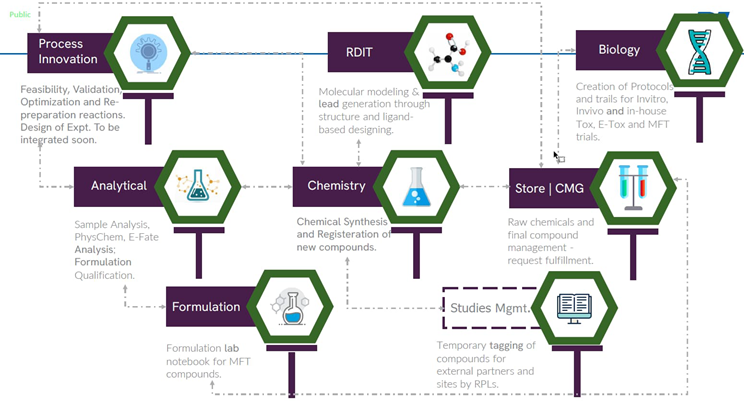
Rollout of Signal Notebook expanded to integrate across multiple departments and functions. Image Credit: Revvity Signals Software Inc.
Together, Signals Notebook and Lead Discovery support PI in determining which molecules should advance to the next stage of development.
Ankit describes the platforms as collaborative environments for aggregating data. During development, ideas no longer originate from a single scientist. Instead, they emerge from molecular biologists, modeling and simulation tools, and chemists working across different phases of research and development. Signals Notebook enables everyone throughout the value chain to access reliable data, learn from it, and respond accordingly.
Once an experimental design has been finalized, the chemistry team uses Signals Inventory to verify whether the required chemicals are available or whether additional materials must be procured.
When the biology team evaluates a new molecule, protocols are created within Signals Notebook, where data from in vitro, in vivo, toxicity, and micro-field testing is automatically captured. The platform also records experimental data related to molecule formulations as development progresses.
Ankit explains, “By this point, PI has filtered the investigational molecules down maybe from 500 or 5000 to 50 or so. At this stage, we need to optimize the processes for the best yield and investigate whether there is a better route to synthesis, or we may be ready to take a molecule to the lab or pilot plant phase, and this is where PI puts Revvity Signals Notebook and Lead Discovery to good use.”
Accelerated Productivity and Time-to-Market
PI has realized a wide range of benefits through its use of Signals Notebook and Lead Discovery. Atanu believes that Signals Notebook enables field data to be returned to the laboratory more quickly, allowing teams to refine products much faster.
He adds that an integrated platform has made collaborative product lifecycle management and design solutions especially valuable. Using the same platform across multiple functions has significantly improved the company's ability to shorten time-to-market.
From collaboration to data capture, PI now operates with integrated workflows that support the company's ongoing expansion objectives.
Atanu concludes, “PI also connects Signals Notebook with its SAP business management systems, and when we bring these together, the power of the solution goes up exponentially; productivity increases, and the process becomes almost mistake-proof. The combination helps us achieve faster time to market, and size our share of the global agrochemicals opportunity.”

This information has been sourced, reviewed, and adapted from materials provided by Revvity Signals Software Inc.
For more information on this source, please visit Revvity Signals Software Inc.