A new donor-acceptor bonding framework shows how oxidized metals and functionalized polymers can form stronger hybrid joints for lightweight engineering.
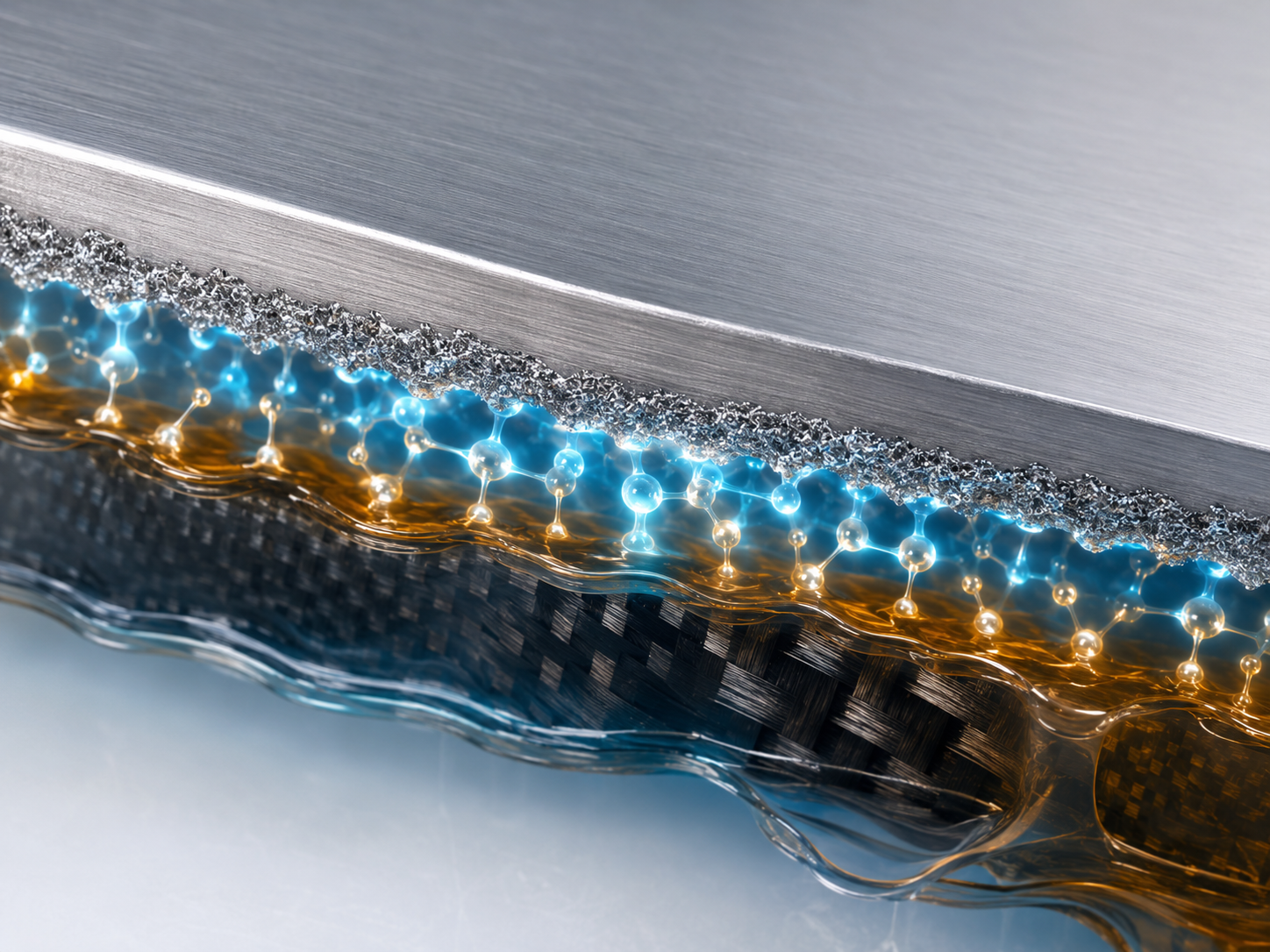
Paper: Elucidation of the intrinsic electronic mechanism governing interfacial chemical bonding in metal-polymer hybrids. Image credit: AI-generated image created using ChatGPT/OpenAI
In a recent study published in the journal Nature Communications, researchers explored the atomic-level mechanisms by which oxidized metal surfaces and carboxyl-functionalized polymers form direct chemical bonds. They discovered that lone-pair electron donation, charge redistribution, and orbital hybridization at oxidized metal-polymer interfaces create strong chemical bonds, providing a clear understanding of hybrid interface behavior.
The findings showed that optimizing the electronic structure at the interface increases coordination bonding and joint strength without relying on adhesive interlayers in the tested joining strategy. This approach offers a practical way to design stronger, lighter hybrid materials for advanced applications.
Overcoming Challenges in Metal-Polymer Joining
Metal-polymer hybrid structures combine the strength of metals with the lightweight, flexible properties of polymers, making them attractive for advanced engineering applications. However, joining these materials is difficult because they have different atomic structures, surface properties, thermal expansion, and bonding behavior. As a result, industries often rely on mechanical fasteners, surface roughening, or adhesive layers to connect them.
Although these methods are widely used, they increase weight, create stress concentration, require additional processing, and can fail because of moisture, temperature changes, or repeated loading. Forming direct chemical bonds at the interface provides a stronger, more durable solution. However, this has remained difficult because the electronic interactions between metal atoms and polymer molecules were not well understood, forcing engineers to rely on trial-and-error surface treatments instead of fundamental design principles.
Advanced Techniques for Interface Investigation
To understand how metals and polymers bond at the atomic level, researchers combined advanced computer simulations with high-resolution experiments. They used density functional theory (DFT) calculations to predict electron redistribution and orbital interactions at the interface between metal oxide surfaces and functionalized polymers during thermal joining.
The study then prepared metal surfaces with controlled cleaning and oxidation, or with an oxygen-vacancy-rich surface treatment, before joining them with high-performance polymers under carefully controlled conditions. To verify the simulations, it employed several advanced characterization techniques. X-ray photoelectron spectroscopy (XPS), Fourier transform infrared spectroscopy (FTIR), electron paramagnetic resonance (EPR), electron energy loss spectroscopy (EELS), atomic force microscopy (AFM), scanning electron microscopy (SEM), and valence band spectra measured changes in electron binding energy, functional groups, oxygen vacancies, interfacial morphology, and electronic structure.
Electron localization functions (ELFs) were analyzed alongside charge density differences, projected density of states, Bader charges, and ab initio molecular dynamics simulations to evaluate orbital interactions and chemical bonding. Together, these methods identified how charge transfer, orbital overlap, oxidation state, oxygen vacancies, and electron density determine the strength of metal-polymer interfaces.
Enhancing Interfacial Strength through Hybridization
The study demonstrated that strong metal-polymer adhesion relies on electronic interactions at the interface rather than mere physical contact. When the metal's electronic states, particularly vacant metal orbitals on oxidized surfaces, align with occupied oxygen lone-pair orbitals from polymer functional groups, electrons transfer more readily between the two materials. This alignment promotes orbital hybridization and the formation of strong coordination-type chemical bonds.
As a result, the interfacial chemical bonding became stronger, increasing tensile-shear strength from 5.5 ± 1.2 MPa in the clean AZ31B/CFRTP joint to 29.1 ± 1.3 MPa after combined oxygen-vacancy-rich metal treatment and polymer grafting. These chemical bonds also improved mechanical performance, resulting in an increase of more than 400% compared to the untreated joint. In many tests, failure shifted toward cohesive failure within the resin-carbon fiber mixture rather than simple interfacial separation, confirming that the interface had been substantially strengthened. The bonded interfaces also showed improved interfacial stability, although the grafted polymer surface exhibited aging-related strength loss over 30 days, highlighting the need to control surface-treatment durability.
Potential Applications for Hybrid Materials
This bonding strategy has the potential to improve manufacturing across various high-tech industries. In aerospace and automotive engineering, it could support the direct joining of magnesium, aluminum, or titanium alloys with carbon-fiber-reinforced polymers, reducing reliance on mechanical fasteners or adhesives. This may reduce structural weight and improve load distribution in lightweight transport applications.
In microelectronics and flexible devices, this technique may help create stronger bonds between metal circuits and polymer substrates, reducing the risk of delamination. It could also inform the design of interfaces in energy storage systems and other functional devices where stable metal-polymer contact is important.
A New Framework for Designing Hybrid Interfaces
In summary, this study establishes a framework for designing strong metal-polymer interfaces based on their electronic properties. By demonstrating that metal electron-accepting sites and polymer electron-donating functional groups govern chemical bonding, researchers have replaced trial-and-error joining with a more predictable design approach.
This work could improve the development of high-performance composites and protective coatings. Future research may extend these design principles to additive manufacturing, multi-component alloys, and high-temperature polymers. Integrating this electronic framework with machine learning could accelerate the discovery of new metal-polymer combinations for lightweight structures and energy storage systems.
Disclaimer: The views expressed here are those of the author expressed in their private capacity and do not necessarily represent the views of AZoM.com Limited T/A AZoNetwork the owner and operator of this website. This disclaimer forms part of the Terms and conditions of use of this website.
Source:
- Liu, Y., Su, J., Han, R., et al. (2026). Elucidation of the intrinsic electronic mechanism governing interfacial chemical bonding in metal-polymer hybrids. Nature Communications. DOI: 10.1038/s41467-026-75952-3, https://www.nature.com/articles/s41467-026-75952-3