X-ray photoelectron spectroscopy (XPS) is widely regarded as one of the most effective methods for assessing elemental composition and chemical state of the top 10 nm of a material's surface.
Though XPS is essentially surface-sensitive, many modern devices demand chemical information as a function of depth. The removal of material to 'drill through' towards the bulk is achieved by ion sputtering, gradually removing material and exposing hidden interfaces.
XPS depth profiling typically involves monatomic argon ion (Ar+) sputtering. As the number of complex modern materials has grown to include organic electronics, polymer coatings, battery components, biomaterials, and complicated hybrid architectures, the limitations of traditional sputtering have become more evident.
The development, introduction, and expanded use of argon gas cluster ion sources (GCIS) over the last 10 to 15 years have significantly changed the capabilities of XPS by allowing depth profiling of many materials that had previously been difficult, if not impossible, to characterize.
Sputter-Induced Damage: The Primary Challenge
A standard monatomic Ar+ ion beam removes material by colliding single Ar+ ions with the atoms in the sample. This method of sputtering has been used for decades, successfully depth profiling inorganic and metallic materials. However, it is well known that this sputtering method concentrates a tremendous amount of energy in a small, localized area of the surface.
Both theoretical and empirical research on monatomic ion sputtering show that sputter-induced damage to a material can include:
- Preferential sputtering behavior (in some elements)
- Roughening and topographical change, diminishing interface resolution
- Graphitization of organic compounds
- Changes in film stoichiometry
- Argon implantation
These effects can dramatically modify the chemistry of the specimen being characterised, so that the XPS spectra do not accurately reflect the original sample composition. Such artefacts are especially problematic when examining ion-sensitive materials or attempting to detect tiny changes in chemical state using a depth profile.1
Maintaining chemical integrity during sputtering is critical in sophisticated electronic devices and functional coatings, where performance is frequently determined by buried interfaces and nanoscale compositional gradients.
Advantages of Using Gas Cluster Ions in Place of Monatomic Ions
Argon gas cluster ion sources (GCIS) overcome the constraints of monatomic Ar+ ion depth profiling by substituting a single energetic argon ion with large argon clusters composed of hundreds to thousands of weakly bonded argon atoms.
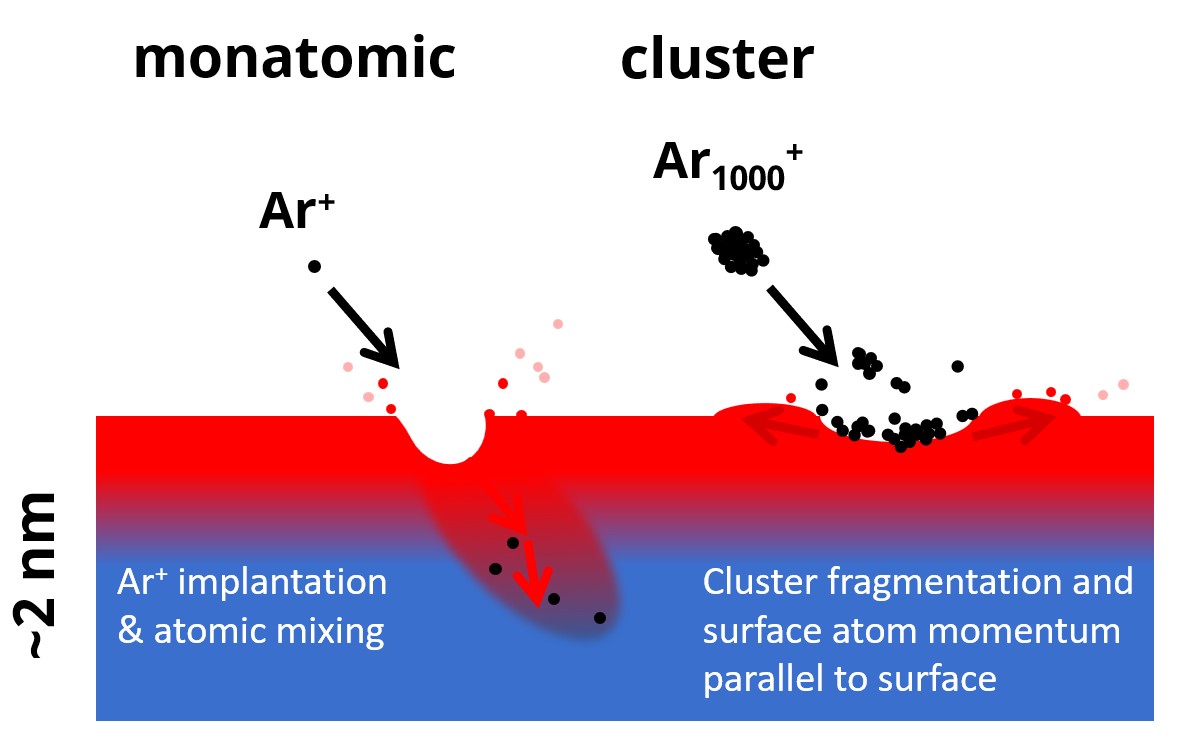
Schematic diagram of the interaction of (left) monatomic Ar+ ions and (right) Ar1000+ clusters with a material's surface. Image Credit: Kratos Analytical, Ltd.
Although the overall beam energy may be similar to that employed in conventional sputtering, it is dispersed throughout the cluster. For instance, a 10 keV monatomic Ar+ ion possesses 10,000 eV per incident atom on the surface. In comparison, a 10 keV Ar1000+ cluster ion has an average energy of only 10 eV per atom.
As a result, the energy delivered by each atom in the cluster is significantly reduced. Upon impact, the cluster distributes its energy over a larger surface area, resulting in efficient sputter removal while reducing subsurface penetration and chemical damage.2,3
GCIS technology is now widely used in surface analysis due to its improved sputtering mechanism using Arn+ cluster ions.
Preserving Surface Chemistry During Depth Profiling
Perhaps the most notable benefit of Arn+ argon cluster sputtering is its capability to maintain chemical-state information.
Traditional monatomic Ar+ sputtering can alter the chemistry measured by XPS. Bond scission and crosslinking in polymers and organic materials can change their fundamental molecular structure. Preferential sputtering of oxygen atoms in metal oxides can cause reduction processes, resulting in falsely lower oxidation states that confuse spectrum interpretation.
Because cluster ion sputtering removes material with significantly lower energy-per-atom impact, the severity of these damage processes is dramatically reduced, and the surface measured by XPS is a better representation of the material.
This indicates that chemical-state spectra collected during cluster ion depth profiles better reflect the material's genuine chemistry. This leads directly to more valid findings about composition, interfacial chemistry, and material functionality.4
Enabling Depth Profiling of Organic and Complex Hybrid Materials
The emergence of organic and hybrid materials has rapidly increased in the last decade. Materials characterisation as a function of depth from the surface is important for numerous classes of materials including:
- Organic light-emitting diodes (OLEDs)
- Packaging and adhesive materials
- Biomaterials, including coatings
- Polymer multilayers
- Soft coating
Many of these materials are vulnerable to sputter damage. In many cases, monatomic ion bombardment degrades chemical information faster than material removal.
Arn+ cluster ions overcome this limitation by causing shallow, low-damage sputtering 2, allowing materials scientists to measure chemical composition and bonding across multilayer structures while keeping useful spectrum data.
GCIS depth profiling retains compositional detail in organic systems, unlike traditional Ar+ sputtering. This is well demonstrated by a 10 keV Ar1000+ cluster depth profile through a 50-layer polystyrene (PS) / polyvinylpyrrolidone (PVP) metrology sample.
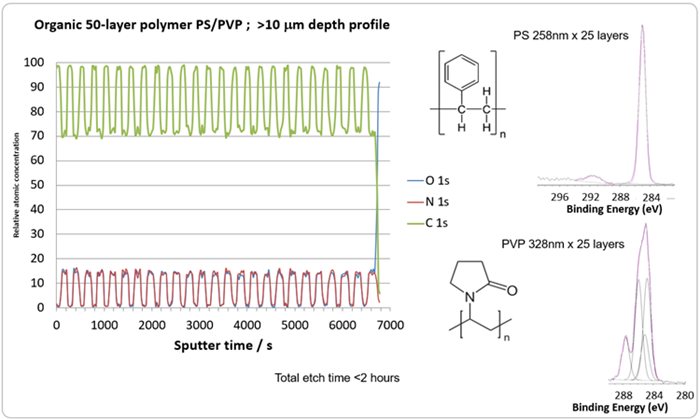
(left) concentration depth profile through alternating PS/PVP 50-layer polymer stack and (right) polymer structure and C 1s spectra from PS and PVP layers. Image Credit: Kratos Analytical, Ltd.
The use of Arn+ cluster ions for depth profiling enables the successful characterization of complicated organic devices as a function of depth.
Improving Analysis of Sensitive Inorganic Materials
Although Arn+ cluster technology is most effective for organic depth profiles, it also benefits many inorganic systems.
Conventional Ar+ ion sputtering of oxides and other functional materials can cause oxidation state changes, resulting in inaccurate depth profiles. Recent research has shown that using correctly sized clusters and energies can significantly decrease these artifacts while maintaining acceptable sputter rates.
To maintain appropriate sputter rates for inorganic materials, the partition energy must be more than 30 eV per atom. These conditions are attained with 20 keV Ar500+ ions.
While monatomic Ar+ remains the favored choice for many metals and hard inorganic coatings, cluster ion sputtering is increasingly adopted when chemical state preservation is the primary analytical goal.
Beyond Depth Profiling: Gentle Surface Cleaning
Another advantage of cluster ion source technology is its applicability in surface preparation.
Most real-world samples show contaminated layers from air exposure, handling, or processing. Traditional monatomic ion sputtering will remove the contaminants or passivation layers, but it may also change the underlying material.
Low-energy, large cluster-size ion beams are a gentler approach for removing adventitious carbon and other surface impurities while reducing substrate chemical changes.
This capability is especially useful for sample preparation before analysis using ultraviolet photoemission spectroscopy (UPS) or inverse photoemission spectroscopy (IPES), which are much more surface-sensitive analytical techniques than XPS due to the lower kinetic energy of the electrons used.
Surface cleaning of molybdenum disulfide using 5 keV Ar2000+ ions is shown below. Removal of the carbon contamination using the cluster ions does not change the chemical state of molybdenum or sulfur.
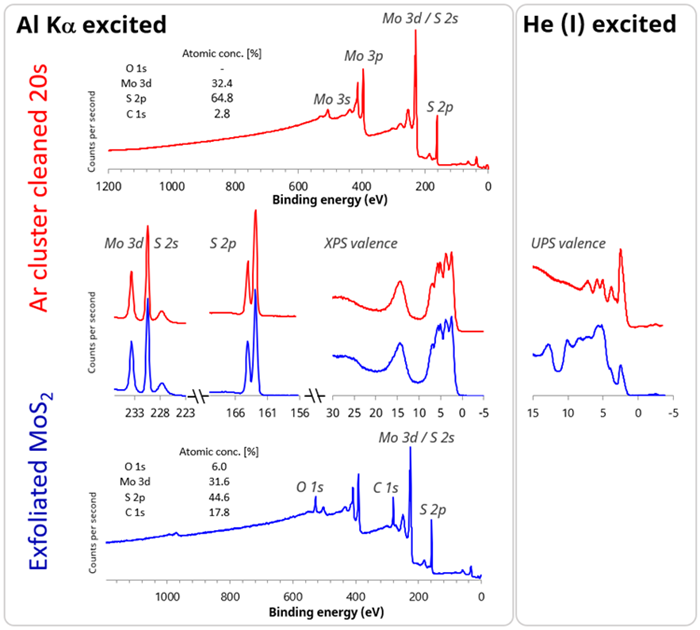
(blue spectra) 'as received' exfoliated MoS2 (red spectra) after 20 s of 5 keV Ar2000+ ion cleaning. Image Credit: Kratos Analytical, Ltd.
As a result, Arn+ cluster cleaning has become an important step in current surface-sensitive operations.
The Future of XPS Sputtering
The application of Arn+ cluster ions and XPS has increased over the last 15 years, as evidenced by the number of publications. The increasing complexity of innovative materials will also drive greater use of GCIS-equipped XPS instruments.
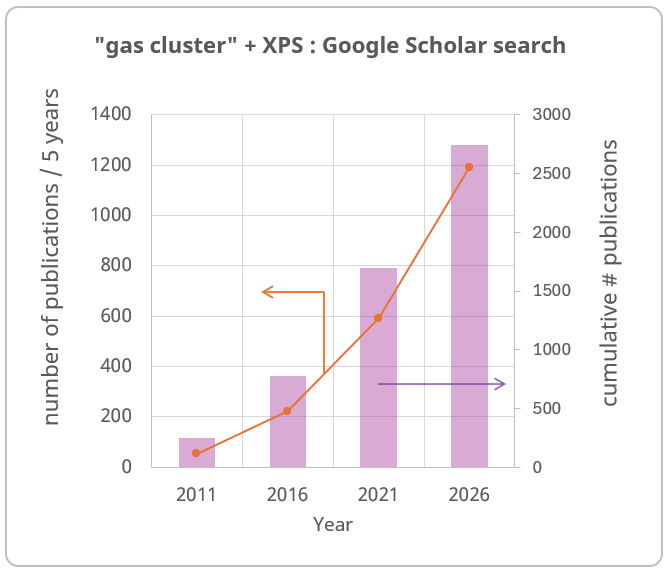
Image Credit: Kratos Analytical, Ltd.
The use of cluster ions for depth profiling reduces sputter-induced damage and allows chemically relevant characterization of organic materials. It also enhances the analysis of ion-sensitive inorganic systems and offers a useful method for low-damage surface cleaning.
A femtosecond (fs) laser is a recently introduced alternative method for material removal during XPS depth profiling. The interaction of the laser photon with the material results in ablation by melting, vaporization, or Coulombic explosion.
Despite the vastly different ablation process when compared to Arn+ cluster ion sputtering, the two methods produce similar outcomes, allowing for material removal with minimal chemical damage.5
Conclusion
Argon cluster ion sources have increased the analytical capabilities of XPS depth profiling.
GCIS can now give precise, chemically accurate depth profiles of organic electronics, polymer coatings, hybrid devices, biomaterials, and a variety of other technologically significant materials.
Arn+ cluster ions will not totally replace monatomic Ar+ projectiles, as the latter have substantially higher sputter rates for metallic and inorganic materials.
Cluster ion depth profiling is a crucial accessory for any current XPS instrument, providing the low-damage sputtering capabilities needed to expose the real chemistry beneath the surface.
References and Further Reading
- Shard, A.G. and Baker, M.A. (2024). Practical guides for x-ray photoelectron spectroscopy: Use of argon ion beams for sputter depth profiling and cleaning. Journal of Vacuum Science & Technology A, 42(5). DOI: 10.1116/6.0003681. https://pubs.aip.org/avs/jva/article-abstract/42/5/050801/3304093/Practical-guides-for-x-ray-photoelectron?redirectedFrom=fulltext
- Zbigniew Postawa, et al. (2004). Microscopic Insights into the Sputtering of Ag{111} Induced by C60 and Ga Bombardment. The Journal of Physical Chemistry B, 108(23), pp.7831–7838. DOI: 10.1021/jp049936a. https://pubs.acs.org/doi/10.1021/jp049936a.
- Aoki, T., et al. (1997). Molecular dynamics simulation of damage formation by cluster ion impact. Nuclear Instruments and Methods in Physics Research Section B: Beam Interactions with Materials and Atoms, 121(1–4), pp.49–52. DOI: 10.1016/s0168-583x(96)00698-2. https://www.sciencedirect.com/science/article/abs/pii/S0168583X96006982?via%3Dihub.
- Cumpson, P.J., et al. (2013). Accurate argon cluster-ion sputter yields: Measured yields and effect of the sputter threshold in practical depth-profiling by x-ray photoelectron spectroscopy and secondary ion mass spectrometry. Journal of Applied Physics, 114(12). DOI: 10.1063/1.4823815. https://pubs.aip.org/aip/jap/article-abstract/114/12/124313/393050/Accurate-argon-cluster-ion-sputter-yields-Measured?redirectedFrom=fulltext.
- Shard, A.G. and Baker, M.A. (2024). Practical guides for x-ray photoelectron spectroscopy: Use of argon ion beams for sputter depth profiling and cleaning. Journal of Vacuum Science & Technology A, 42(5). DOI: 10.1116/6.0003681. https://pubs.aip.org/avs/jva/article-abstract/42/5/050801/3304093/Practical-guides-for-x-ray-photoelectron?redirectedFrom=fulltext.

This information has been sourced, reviewed, and adapted from materials provided by Kratos Analytical, Ltd.
For more information on this source, please visit Kratos Analytical, Ltd..