Researchers adapted Birch reduction chemistry for battery recycling, using lithium-ammonia solvated electrons to tackle lithium loss and structural damage in model end-of-life NMC532 cathodes.
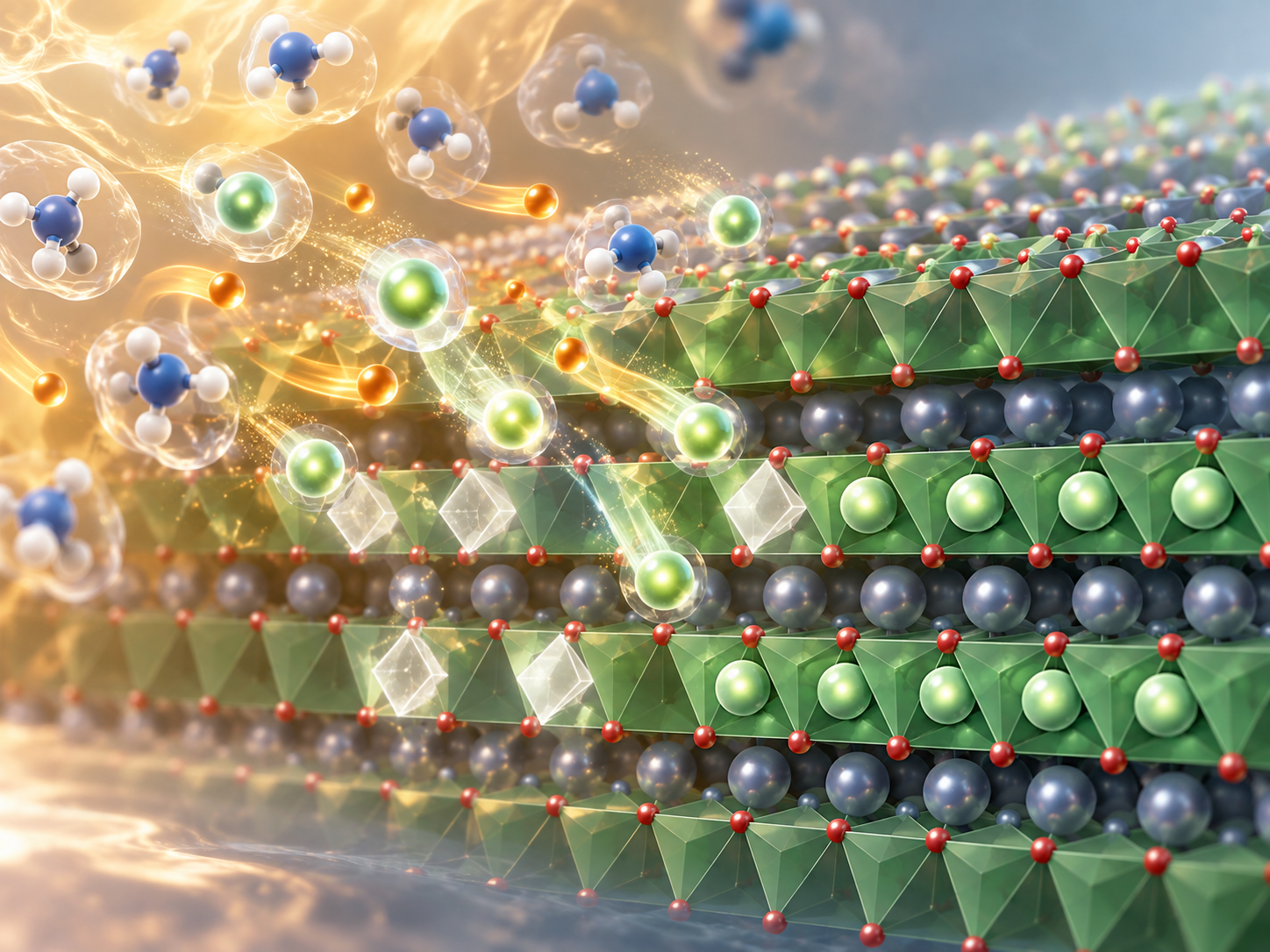
Paper: A Rapid Chemical Relithiation Method Using Solvated Electrons for the Direct Recycling of Lithium-ion Battery Cathodes. AI-generated abstract conceptual image created using ChatGPT/OpenAI
With retired electric vehicle (EV) batteries projected to exceed 300 GWh by 2030, developing methods to regenerate degraded cathode materials has become increasingly important. A recent research paper from Northwestern University, USA, posted on the ChemRxiv preprint server introduced a rapid solution-phase relithiation method to restore the stoichiometric composition and structural integrity of chemically delithiated lithium-nickel-manganese-cobalt oxide (NMC532), used as a model end-of-life cathode material. The work is a preprint and has not been peer-reviewed.
This new process utilizes a solvated electron solution to replenish lithium ions while simultaneously reducing oxidized transition metals. In lithium-metal half-cell testing, the regenerated material achieved an initial specific discharge capacity of 159.49 mAh/g and retained 94.10% of its capacity after 100 cycles, indicating strong stability.
Recycling Challenges in the EV Sector
The transition toward electrified transportation is increasing demand for lithium-ion batteries, supported by their high energy density and durability. Passenger and commercial EV battery demand is projected to reach 4.3 TWh by 2030. As these batteries reach the end of their typical eight- to twelve-year service lives, decommissioned battery waste is expected to grow at an annual rate of 18.8%.
Conventional methods, including pyrometallurgical and hydrometallurgical processes, are energy- and chemical-intensive, often require further refinement, and can result in lithium loss. Compared to these approaches, direct recycling regenerates the cathode active material while preserving its existing crystal structure, potentially reducing energy and processing requirements.
Solvated Electron Chemistry for Cathode Regeneration
To address limitations in existing direct recycling methods, researchers developed a rapid chemical relithiation protocol based on Birch reduction chemistry. This approach used chemically delithiated NMC532 powder as a model for end-of-life cathode material. The degraded powder had lost lithium and undergone oxidation of transition metals. The researchers used a 1.5-molar excess of lithium relative to the calculated lithium deficiency during relithiation.
The regeneration process involved preparing a solvated electron solution by condensing anhydrous ammonia at -78 °C in a dry ice-acetone bath under air-free conditions. The liquid ammonia was transferred to a vial containing lithium metal pellets and agitated at room temperature. After excess ammonia evaporated, a concentrated solvated-electron solution remained. The degraded NMC532 powder was mixed with this solution in an argon-filled glovebox. Manual stirring for tens of seconds enabled simultaneous reduction and relithiation without prolonged reaction times or elevated temperatures. The remaining ammonia evaporated, resulting in a dry treated powder without additional washing or purification.
The treated material was then annealed in a tube furnace at 850 °C for 3 hours under a continuous flow of pure oxygen to restore the near-surface crystal structure. This step did not require an additional lithium source. The recovered material was characterized using inductively coupled plasma optical emission spectroscopy (ICP-OES), scanning electron microscopy (SEM), X-ray diffraction (XRD), X-ray photoelectron spectroscopy (XPS), and high-resolution transmission electron microscopy (HRTEM).
Characterization of Cathode Materials
Comprehensive characterization of the regenerated cathode confirmed the restoration of its composition and structure. ICP-OES results showed that the lithium molar content of the recovered powder was nearly identical to that of pristine commercial material, supporting effective relithiation while showing no substantial transition-metal loss during treatment.
XRD analysis showed that the recovered particles retained their bulk crystallinity, with the restoration of characteristic layered hexagonal structural peaks and a reduction in lattice distortion associated with degradation. Rietveld refinement showed that lithium-nickel cation mixing remained approximately 4.5-4.7% across all samples, with no increase after recovery.
High-resolution transmission electron microscopy and X-ray photoelectron spectroscopy demonstrated that oxygen annealing restored the degraded surface, replacing disordered near-surface phases with a layered oxide structure extending from the particle core to the surface. XPS also found no discernible nitrogen signal consistent with residual ammonia at the surface. Electrochemical testing in lithium-metal half-cells showed that the regenerated cathode delivered an initial specific discharge capacity of approximately 159.49 mAh/g at a cutoff voltage of 4.3 V. After 100 cycles, it retained nearly 94.10% of its capacity, compared with 82.98% for the pristine material under the same testing conditions.
Implications for Sustainable Battery Manufacturing
Using solvated electrons enables chemical relithiation of NMC532 within tens of seconds at room temperature, but full regeneration still requires a three-hour anneal at 850 °C under pure oxygen. Ammonia's volatility allows the solvent to evaporate after treatment, minimizing the need for separation and washing.
Direct regeneration preserves the cathode active material rather than converting it into elemental precursors for subsequent resynthesis. This approach may reduce the processing requirements for producing new cathode powders and facilitate the reintegration of regenerated materials into the battery manufacturing supply chain. Studies of solvent recovery, energy use, environmental effects, and costs are still needed to establish the process's practical performance.
Toward Faster Direct Cathode Recycling
Overall, this study demonstrates that Birch reduction-inspired solvated-electron solutions can rapidly relithiate degraded layered-oxide cathodes while restoring their composition and structure. The simultaneous supply of electrons and lithium ions enables rapid room-temperature bulk relithiation, while oxygen annealing restores the near-surface structure. Under the reported half-cell test conditions, the regenerated material performed comparably to or better than the pristine reference.
This rapid room-temperature relithiation step may reduce processing intensity, but the complete regeneration process still requires high-temperature oxygen annealing. Future work should evaluate scale-up, testing with genuinely retired battery materials, and performance across different cathode chemistries and battery aging conditions to determine whether this new approach can transition from laboratory-scale regeneration to practical battery recycling.
The authors disclose that Isha M. Sura, Jiyoung Lee, Dayne F. Swearer, and Jeffrey Lopez have a pending US patent application covering the battery recycling technology.
Disclaimer: The views expressed here are those of the author expressed in their private capacity and do not necessarily represent the views of AZoM.com Limited T/A AZoNetwork the owner and operator of this website. This disclaimer forms part of the Terms and conditions of use of this website.