Sponsored by TOFWERKReviewed by Olivia FrostAug 18 2026
Chemical analysis is fundamental to semiconductor manufacturing, which necessitates dependable process stability and precise control of complex gas-phase chemistry to ensure maximum yields.

Image Credit: YURIMA/Shutterstock.com
These demands have seen mass spectrometry (MS) become an increasingly important tool, with its speed and sensitivity underpinning its ability to simultaneously monitor multiple species.
A significant number of widely employed MS techniques, most notably quadrupole-based instruments like residual gas analyzers (RGAs), operate at what is referred to as ‘unit mass resolution’ (UMR).
These instruments are appropriate for basic monitoring tasks, but UMR imposes major limitations. For example, peaks often overlap when representing different compounds with the same nominal mass, resulting in ambiguous identification and uncertainty.
Users are often required to rely on indirect interpretation, such as applying prior process knowledge, selecting the most probable species, or introducing chromatographic separation.
These approaches either compromise time resolution and system simplicity or reduce confidence in the result.
Practical Implications of Mass Resolution
The International Union of Pure and Applied Chemistry (IUPAC) defines mass resolution as:
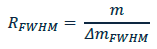
In this formula, m represents the mass-to-charge ratio (m/z), while ΔmFWHM represents the peak width at half maximum.
Increasing resolution reduces peak width, allowing the separation of adjacent species with similar exact masses. Figure 1 highlights the importance of mass resolution in relation to the observed peak for Ar+.
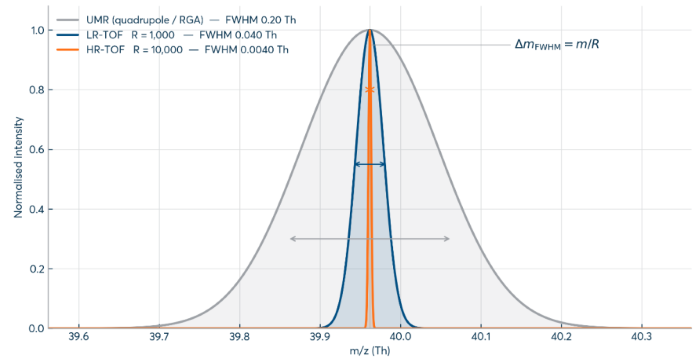
Figure 1. Effect of mass resolution on peak width and separability (UMR vs. LR-TOF vs. HR-TOF). Image Credit: TOFWERK
The Isobar Issue: When Nominal Mass Is Not Enough
Many chemically distinct species encountered in process gas analysis and monitoring share the same nominal integer mass. These species are referred to as ‘isobars.’
A traditional RGA based on quadrupole mass spectrometry operates at unit mass resolution (resolving power R≈1000), meaning that it is unable to differentiate between two species occupying an identical nominal m/Q value.
An RGA simply reports a combined signal, with no means of attributing this signal to one compound or the other. This may be tolerable in benign environments, but it represents a critical blind spot in advanced semiconductor manufacturing.
High-resolution time-of-flight mass spectrometry (TOFMS) addresses this issue at its core. Every ion species features a precise, unique exact mass that is determined by its elemental composition, meaning that sufficiently high resolving power separates isobaric peaks into distinct signals with accurate mass assignment.
For example, this requires R>5000 for most process-relevant isobars, or R>10,000 for the most demanding cases.
TOFWERK's portfolio of compact process solutions provides resolving power in the range of 4000 to 8000 FWHM, facilitating unambiguous chemical identification even in complex, multi-component gas mixtures. This resolving power is achievable without chromatography and with no reduction in acquisition speed.
Semiconductor technology continues to scale below 10 nm, including gate-all-around (GAA), FinFET, and future nanosheet architectures. These advances are leading to dramatic reductions in contamination budgets.
Even sub-ppb levels of nitrogen, carbon, or oxygen-containing contaminants in process gases can alter surface chemistry at these nodes, degrading gate oxide integrity, shifting threshold voltages, or introducing trap states in epitaxial layers.
There is effectively zero tolerance for chemical ambiguity in gas monitoring, but process complexity continues to increase as more carrier gases, more precursors, and more reactive byproducts coexist in the same gas stream.
These ongoing complexities are leading to more frequent and more consequential isobaric interferences.
The limitations of quadrupole RGA technology become a direct risk to reliability and yield under these circumstances, with high-resolution TOFMS transitioning from a useful laboratory tool to a process-critical instrument.
Improved selectivity is considered the most direct and practical benefit of TOFMS, allowing the independent measurement of individual compounds, even in crowded spectral regions. This is especially important for real-time monitoring, where there is a pressing need for rapid and confident interpretation.
TOFWERK TOFMS Offers Simultaneous Advantages
One key distinction separates TOFMS from other high-resolution scanning instruments like magnetic sector: TOFMS simultaneously detects all masses with each extraction pulse. This means that:
- It is possible to achieve isobar separation across the full mass spectrum at once as opposed to one m/Q pair at a time.
- The full chemical picture is always captured, including unexpected isobaric interferences in semiconductor processes that are not anticipated during instrument setup.
- Millisecond time resolution is maintained, even while performing high-resolution isobar separation.
- Even in high-resolution mode, a quadrupole RGA must sacrifice scan speed to improve mass resolution, and can only enhance resolution at one mass at a time.
Conversely, TOFWERK TOFMS simultaneously delivers full mass coverage, high resolving power, and millisecond time resolution. No other compact process MS technology offers this robust combination.
TOFMS Versus RGA: Isobar-Relevant Capability Comparison
Source: TOFWERK
| . |
. |
. |
| Resolving power (FWHM) |
~4000–8000 |
~500–1000 |
| CO/N2 separation (m/Q 28) |
? Resolved |
X Not resolvable |
| CO2/N2O separation (m/Q 44) |
? Resolved |
X Not resolvable |
| NH3/OH separation (m/Q 17) |
? Resolved |
X Not resolvable |
| SiH2+/NO separation (m/Q 30) |
? Resolved |
X Not resolvable |
| Simultaneous full-spectrum acquisition |
? Yes |
X Sequential scan |
| Time resolution |
Milliseconds |
Seconds (full scan) |
| Accurate mass (elemental composition) |
? Yes |
X No |
| In-line, real-time process monitoring |
? Yes |
? Yes |
Key Isobaric Interferences in Semiconductor and Industrial Process Gas Monitoring
There are a number of practically relevant isobaric interferences that are commonly encountered in advanced materials manufacturing, semiconductor fabs, and related industries. None of these interferences can be resolved by a quadrupole RGA.
m/Q 28: CO Versus N2 Versus C2H4 Versus Si
These are widely regarded as the classic isobaric interferences in semiconductor processes.
The region around m/z 28 is especially relevant and challenging for process analysis. Multiple chemically distinct species contribute signals within a few tens of millidaltons in this region (Figure 2), including:
- Si+ (process fragments from silane-based chemistries)
- CO+ (byproduct or vacuum background)
- N2+ (air ingress or process gas)
- C2H4+ (hydrocarbon contamination, fragment from a reaction product or precursor molecule)
Carbon monoxide (CO, exact mass 27.9949 Da) and molecular nitrogen (N2, exact mass 28.0061 Da) differ by just 11.2 mDa.
This specific mass defect requires a resolving power of around R≈2500 for baseline separation, far beyond the capacity of any quadrupole RGA.
This is considered the most consequential isobar pair in process analysis. It is important to note that the mass defect for the other listed species is still too small for a QMS to correctly separate and quantify, even though it is slightly larger than for the CO/N2 mass pair.
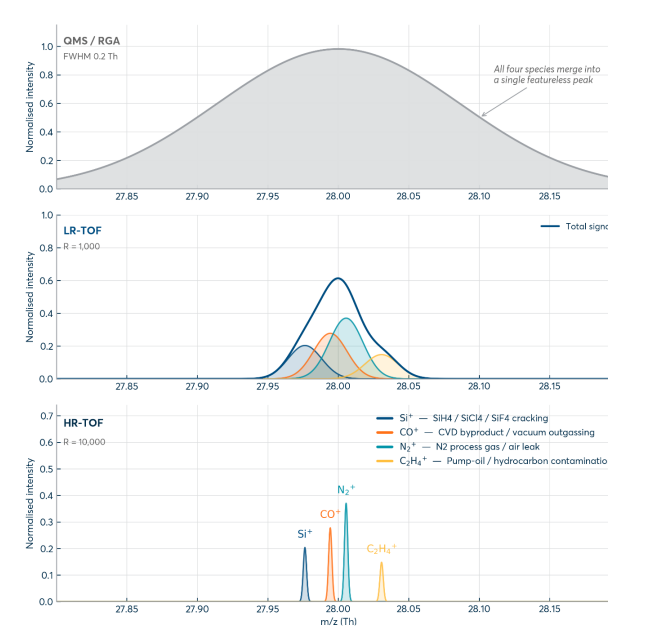
Figure 2. Separation of isobaric species at m/z 28 across different resolution regimes. LR and HR refer respectively to a low-resolution and high-resolution TOF analyzer. Image Credit: TOFWERK
Differentiation is impossible because these contributions collapse into a single broad peak at UMR. Only partial deconvolution is achieved at moderate resolution (R≈1000), but all four species are baseline separated at high resolution (R≈10,000).
This example underscores that changes in one species may be incorrectly attributed to another without sufficient resolution, potentially resulting in incorrect process decisions.
Why This Matters
CO is a key trace contaminant that poisons growth and results in crystal defects in epitaxy and CVD processes such as GaN MOCVD and Si epitaxy, while N2 is a standard purge gas or carrier present in significant quantities.
An RGA measuring m/Q 28 is unable to detect trace CO even at ppm levels and will see an overwhelming N2 background.
Distinguishing CO formation from this N2 background is essential for real-time reaction control and emissions verification in exhaust gas monitoring of combustion or catalytic processes.
CO contamination in N2-balance mixtures must be independently certified in gas purity qualification for specialty gases used in atomic layer deposition (ALD) or lithography. TOFMS provides this inline and in real time.
This separation was demonstrated by high-resolution magnetic sector instruments as early as 2001 for transient catalytic reaction monitoring at 48 Hz sampling rates. TOFWERK's Process solutions simultaneously achieve this degree of chemical identification across the full mass spectrum with millisecond-level time resolution.
m/Q 44: CO2+ Versus C2H4O+
These major and trace species are often found in the same window: carbon dioxide (CO2+) has an exact mass of 43.9898 Da and acetaldehyde/ethylene oxide (C2H4O+) is 44.0262 Da, a difference of only 36.4 mDa.
The small mass gap and extreme intensity contrast present a particular analytical challenge in terms of separately quantifying this mass pair (Figure 3). This is because CO2 is generally a dominant reaction product or matrix gas, while C2H4O+ appears as a trace organic contaminant or byproduct at signal levels orders of magnitude lower. The tail of the large CO2 peak totally masks the minor species on an RGA.
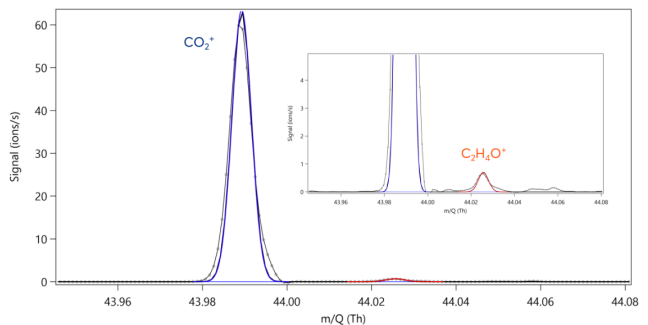
Figure 3. Separation of CO2+ and trace C2H4O+ at nominal m/Q 44 by TOFWERK TOFMS. The main panel shows the dominant CO2+ signal (blue) and the much smaller C2H4O+ peak (red). The inset zoom confirms that C2H4O+ is fully resolved from the CO2+ peak tail, enabling both their separate detection and quantification. Image Credit: TOFWERK
Why This Matters
Trace C2H4O byproducts signal chamber contamination, polymer buildup, or undesired side reactions in plasma etch processes, but these byproducts are undetectable at m/Q 44 when CO2 dominates the signal on an RGA.
CO2 is the primary carbon emission species in exhaust gas and sustainability monitoring, while oxygenated VOCs like acetaldehyde require independent quantification as part of regulatory reporting. TOFMS can be used to separate and quantify both species in the same continuous acquisition.
Oxygenated hydrocarbon byproducts co-eluting with CO2 in exhaust streams offer early warning of incomplete conversion or precursor decomposition in CVD and ALD reaction monitoring.
m/Q 17: NH3 Versus OH
This differentiation is critical for ALO and wet chemistry. Ammonia (NH3) weighs in at 17.0265 Da, while the hydroxyl fragment OH is 17.0027 Da, a difference of just 23.8 mDa.
This can be resolved at R≈715, but an RGA will still fail to separate NH3 and OH because its unit-resolution scan produces a single peak at m/Q 17.
Why This Matters
NH3 is a key precursor in nitride deposition, for example, Si3N4, TiN, and TaN, as well as epitaxial III-nitride growth and ALD of metal nitrides. Unresolved OH interference stemming from residual H2O in the system masks genuine contamination events by inflating the apparent NH3 signal.
Distinguishing residual NH3 outgassing from water vapor is an essential factor in post-etch surface analysis or chamber qualification, confirming that a chamber is clean and ready for the next wafer run.
High-resolution TOFMS can cleanly separate these two peaks, facilitating the independent, accurate, and real-time monitoring of both species.
m/Q 30: SiH2+ Versus NO, CH2N, and C2H6
This differentiation is key to silane process monitoring. Silane (SiH4) is the main silicon source gas for LPCVD and CVD processes, but its fragment ion SiH2+ at nominal m/Q 30 (exact mass 30.0013 Da) is located in a cluster of isobars:
Source: TOFWERK
| Species |
Exact Mass (Da) |
Δm from SiH2+ |
| SiH2+ |
30.0013 |
− |
| NO+ |
29.9980 |
−3.3 mDa |
| CH2N+ |
28.0187 (m/Q 28) |
− (different nominal) |
| 14N15NH+ |
29.0059 |
− (m/Q 29) |
| C2H6+ |
30.0470 |
+45.7 mDa |
NO contamination in a silane process environment (for example, from air ingress or N2/O2 background) co-elutes with the diagnostic SiH2+ fragment on a quadrupole. This co-elution means it is impossible to independently monitor silane consumption and nitrogen oxide contamination. TOFMS, however, simultaneously resolves all species.
m/Q 32: O2 Versus S Versus CH3OH
Monitoring oxygen purity and sulfur contamination is essential. Molecular oxygen (O2) features an exact mass of 31.9898 Da, while atomic sulfur (S) features an exact mass of 31.9721 Da, just 17.7 mDa apart.
Trace sulfur signals are completely obscured by the O2 background on an RGA when working with processes involving sulfur-containing precursors like H2S-based chemistries, CuS, or MoS2 ALD.
TOFMS enables the simultaneous monitoring of oxygen purity and sulfur-containing reaction products by separating the two species.
Application Use Cases in High-End Manufacturing
TOFMS has a range of use cases in a high-end manufacturing setting.
ALD/CVD Chamber Qualification in Semiconductor Fab
It is important to confirm that residual contaminants have been purged after chamber cleaning or conditioning and before introducing wafers.
TOFMS simultaneously monitors NH3 versus OH (m/Q 17), CO versus N2 (m/Q 28), and process byproducts across the full spectrum in real time. An RGA cannot certify chamber cleanliness with chemical specificity because it would report a combined signal.
Trace Contamination Control in Epitaxial Growth (MOCVD, MBE)
CO at sub-ppm levels directly impacts device performance because it results in deep-level traps in III-nitride and III-V epitaxial layers.
TOFMS continuously resolves CO from the N2 carrier gas background, preventing costly wafer runs under contaminated conditions and allowing real-time feedback to gas delivery systems.
Endpoint Detection and Process Fingerprinting in Plasma Etch
The independent tracking of CO2 byproduct formation and N2O consumption (both at m/Q 44) provides a precise etch endpoint signature in N2O-based etch processes. TOFMS enables this tracking with millisecond resolution across the entire etch transient. This measurement is chemically inaccessible to any quadrupole instrument.
Exhaust Gas Analysis and Sustainability Reporting
The accurate separation of N2O from CO2 in fab exhaust streams underpins compliance with contemporary reporting standards for greenhouse gases.
TOFMS delivers species-specific quantification without the need for preseparation via chromatography, facilitating continuous inline exhaust monitoring as opposed to periodic grab-sample analysis.
Gas Purity Certification for Specialty and Electronic-Grade Gases
The detection and identification of trace isobaric impurities and interferences is necessary for the qualification of N2, NH3, and H2 process gases to semiconductor-grade purity specifications.
This detection and identification cannot be resolved by standard RGA methods, but TOFMS offers a comprehensive and accurate impurity profile in a single, continuous measurement, including species identification by exact mass.
Broader Examples Across Semiconductor Processes
Mass resolution is also relevant to a wide range of semiconductor applications. Figure 4 summarizes a number of representative scenarios:
Silicon Etch (m/z≈28)
Separation of Si+ from N2+ is key to distinguishing process chemistry from an air leak (CO+), nitrogen background, or other contaminants like C2H4+ that may be indicative of hydrocarbon contamination.
Silane Fragments Versus NOx (m/z≈30)
Differentiation between SiH2+ and NO+ is key to avoiding the misinterpretation of contamination sources.
Oxidation Chemistry (m/z ≈44)
The accurate resolution of CO2+, SiO+, and hydrocarbon fragments helps to support accurate process diagnostics.
Fluorocarbon Plasma Versus GaN Etch (m/z≈69)
Effectively distinguishing CF3+ from Ga+ facilitates the simultaneous monitoring of substrate response and etch chemistry.
Mo CVD Versus Etch Byproducts (m/z≈100)
Accurate separation of Mo+ isotopes from fluorocarbon fragments is key to enabling selective tracking of deposition processes.
Xe Implant Versus Etch Byproducts (m/z≈131)
The ability to resolve Xe+ from C5F5+ prevents cross-interference between chamber background and implantation signals.
Each example specifies the resolution required (R≈1000 to R≈5500), highlighting that the required resolution depends on the interference in question.
A general-purpose process analyzer benefits from a sufficient resolution headroom to address every example, however.
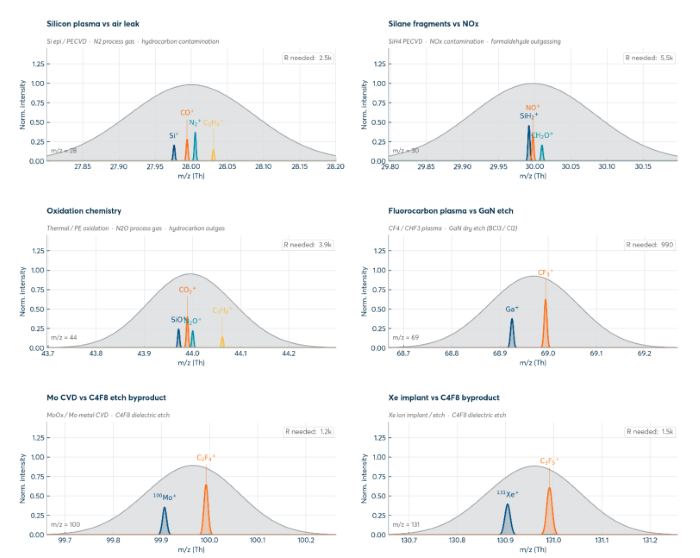
Figure 4. Representative interferences in semiconductor process analysis and required resolution. Image Credit: TOFWERK
Conclusion
In semiconductor process analysis, mass resolution underpins the quality and interpretability of mass spectrometric data. Unit-mass resolution instruments offer basic monitoring capabilities, but these instruments can lead to ambiguous results because they inherently limit selectivity.
High-resolution TOFMS directly separates isobaric species, overcoming these limitations and enabling accurate identification and quantification without sacrificing time resolution. This supports faster diagnostics, enhances process monitoring confidence, and reduces reliance on indirect interpretation methods.
Semiconductor processes are becoming increasingly complex. The capacity to distinguish closely spaced mass peaks is essential for reliable, real-time analysis.
Meanwhile, quadrupole RGAs’ inability to separate isobaric interferences in semiconductor processes represents a fundamental architectural constraint that produces misleading or ambiguous data in applications where chemical certainty is imperative.
Advanced semiconductor manufacturing is moving towards sub-2 nm nodes with increasingly strict contamination budgets, resulting in a rising cost of chemical ambiguity in process monitoring, particularly in terms of unplanned downtime, yield loss, and misattributed root causes.
TOFWERK's Process Solutions meet this challenge at its core, providing accurate mass measurement, high-resolution isobar separation, full-spectrum simultaneous acquisition, a single-digit ppb limit of detection, and millisecond time resolution in a compact and process-hardened instrument.
RGA reports a number, but TOFWERK TOFMS reports the chemistry.

This information has been sourced, reviewed, and adapted from materials provided by TOFWERK.
For more information on this source, please visit TOFWERK.