Sponsored by TOFWERKReviewed by Olivia FrostAug 18 2026
Front-opening unified pods (FOUPs) are used for wafer transport and storage between semiconductor manufacturing process steps.
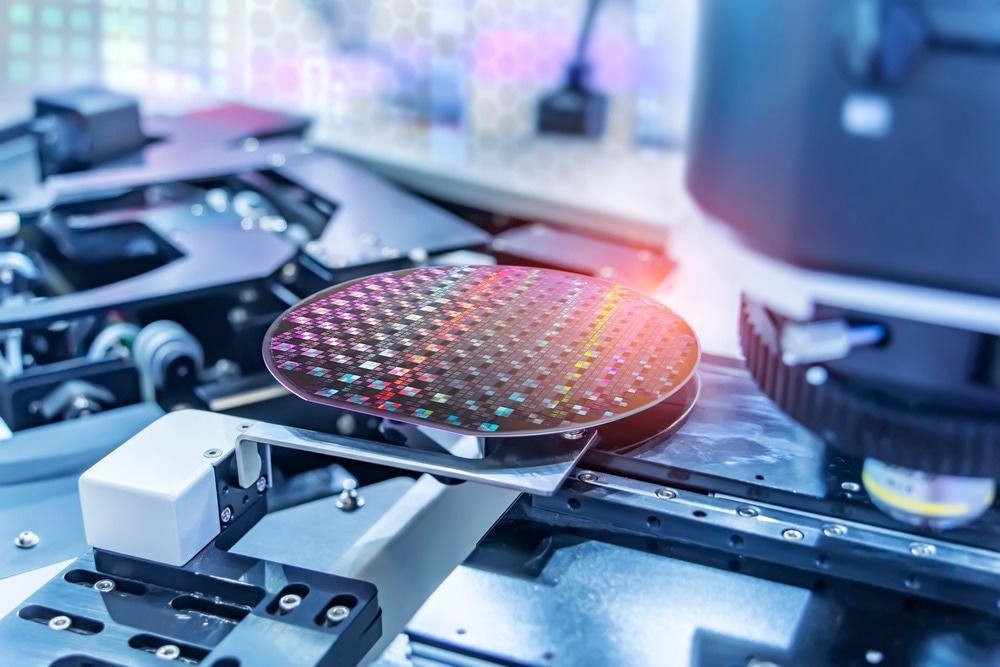
Image Credit: asharkyu/Shutterstock.com
Despite careful control, these mini-environments can see a build-up of airborne molecular contaminants (AMCs) due to prior process exposure, material outgassing, and interaction with ambient fab air during transport and handling.1,2
FOUPs are also a key vector for cross-contamination. Each process uses specific chemicals, meaning that compounds compatible with one step may interfere with another.
There is also a risk of FOUP polymer materials absorbing volatile organic compounds (VOCs) during one process step before subsequently releasing them at later stages. This exposes wafers to unintended chemical environments.
Wafer defects and yield loss have been directly linked to AMC contamination within FOUPs, especially at advanced technology nodes. FOUP monitoring and qualification are, therefore, essential factors in the prevention of contamination-driven yield loss in advanced manufacturing.1,2
The Importance of Rapid, Fab-Compatible FOUP Monitoring
FOUP qualification in high-volume fabrication environments must be both fast and comprehensive, without reducing tool availability and introducing delays in wafer handling.
FOUP monitoring solutions must deliver a range of capabilities to meet fab requirements. These include:
- Broad chemical coverage across every AMC category (acids, bases, condensables, and organics)
- Compatibility with load ports and automated handling systems
- Rapid measurement cycles
- Minimal workflow disruption
The TOFWERK AMC Monitor: Designed for Speed and Integration
When integrated with a suitable load-port docking interface, TOFWERK's AMC Monitor facilitates the fast, direct, real-time measurement and characterization of AMCs within an FOUP.
The system employs soft chemical ionization, multiple reagent-ion chemistries, and fast polarity switching to deliver high sensitivity, minimal fragmentation, and broad chemical coverage across the full range of AMC categories.3
Measurements outlined here were acquired using an R&D FOUP sampling configuration (Figure 1). The FOUP was initially docked onto the load port before purging the internal mini-environment volume with ultra-high-purity nitrogen (UHP N2) at a rate of 10 standard liters per minute (slpm).
Real-time AMC analysis was enabled by directly connecting the outlet stream to the instrument.
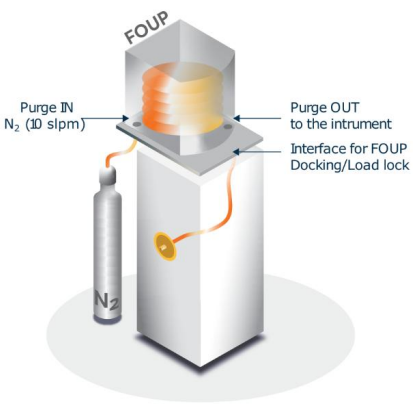
Figure 1. R&D FOUP sampling setup using the AMC Monitor. The FOUP was docked onto a load port interface, where the purge inlet was supplied with ultra-high-purity nitrogen (UHP N2, ~10 slpm). The outlet stream is directly connected to the instrument, enabling real -time FOUP analysis. Image Credit: TOFWERK
Rapid Snapshot-Based FOUP Measurement
A range of measurement strategies can be used to assess FOUP contamination, depending on the application in question.
For example, extended purge measurements involve the tracking of AMC levels over time, offering detailed insight into temporal trends and outgassing behavior. This approach is especially beneficial for root-cause analysis, process development, and in-depth contamination studies.
Rapid FOUP qualification is also essential for high-throughput fab operations. The AMC Monitor supports both of these approaches, delivering a full AMC profile within seconds by facilitating a high-flow purge combined with short-duration ‘snapshot’ measurements.
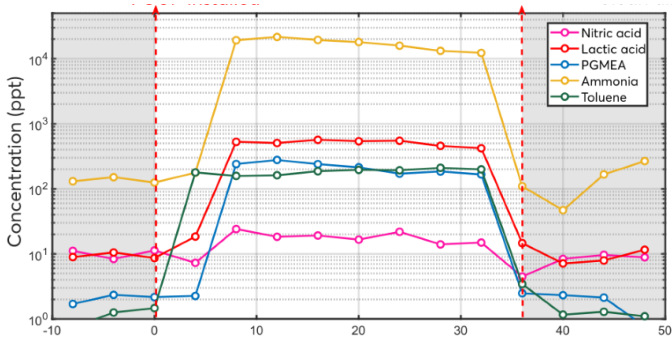
Figure 2. Fast and comprehensive AMC monitoring in a FOUP using the AMC Monitor, showing detection of representative compounds across ppbv, sub-ppbv, and pptv concentration levels. Image Credit: TOFWERK
Figure 2 features the real-time instrument response following FOUP docking (shown by the red dashed line).
The FOUP was docked at t=0 before being analyzed for around 30 seconds prior to removal. Multiple averaged mass spectra were acquired across four measurement chemistry modes during this short measurement window, offering an in-depth AMC characterization of the FOUP microenvironment.
The instrument’s high mass resolving power and selective ionization meant that it was possible to identify detected compounds based on exact mass and isotopic patterns.3
Figure 2 shows representative AMCs from key classes, including volatiles, acids, bases, and condensable species. A range of species were detected in the parts-per-billion-by-volume (ppbv) to sub-ppbv range, including ammonia, PGMEA, lactic acid, and toluene. Nitric acid was measured at single-digit parts-per-trillion-by-volume (pptv) levels.
The data-rich spectra also allow untargeted analysis, facilitating the identification of emerging contaminants outside of any predefined targeted list.
High-Throughput Sequential FOUP Screening
It is possible to analyze multiple FOUPs sequentially within minutes (Figure 3). Each FOUP in the example presented here was manually installed on the load port before being analyzed for around 30 seconds and removed.
A background measurement was also recorded between consecutive FOUPs. Figure 3 displays the averaged concentrations of representative analytes for each FOUP as a filled circle with different colors.
A total of 10 FOUPs were screened in under 10 minutes, including both FOUP and background measurement intervals.
Rapid system stabilization between measurements directly supports rapid FOUP screening in high-throughput environments, enabling continuous operation with no compromise in analytical performance.
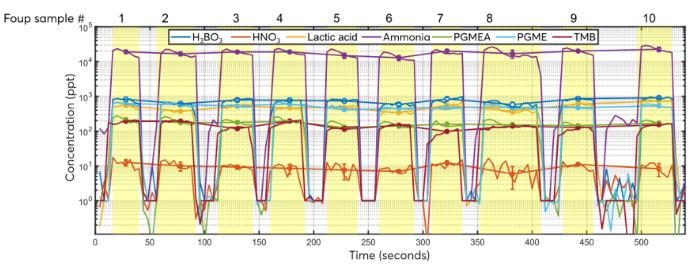
Figure 3. Sequential high -throughput measurement of 10 FOUPs. Each FOUP was analyzed for approximately 30 seconds (highlighted yellow regions), followed by a background measurement. Average concentrations of representative AMCs are shown for each FOUP. Image Credit: TOFWERK
Conclusion
The AMC Monitor delivers rapid, sensitive, and comprehensive FOUP AMC qualification in real time with no sample preparation requirements.
The instrument’s ability to screen FOUPs within seconds, seamlessly integrate with automated load-port handling workflows, and scale to thousands of units per day is key to acquiring actionable contamination data that reduces risk, supports improved yield, and optimizes fab operations.
References and Further Reading
- Den, W. et al. (2020) Review - Airborne Molecular Contamination: Recent developments in the understanding and minimization for advanced Semiconductor Device Manufacturing, ECS Journal of Solid State Science and Technology, 9(6), p. 064003. DOI:10.1149/2162-8777/aba080. https://iopscience.iop.org/article/10.1149/2162-8777/aba080.
- González-Aguirre, P. et al. (2018b) Ammonia sorption outgassing and cross contamination ability of Entegris FOUPs evaluation and its volatile acids comparison, Microelectronic Engineering, 205, pp. 53–58. DOI:10.1016/j.mee.2018.11.012. https://www.sciencedirect.com/science/article/pii/S0167931718305057?via%3Dihub.
- Bansal, P. et al. (2025) Comprehensive airborne molecular contamination monitoring with single-digit parts-per-trillion sensitivity, Journal of Micro/Nanopatterning Materials and Metrology, 24(04). DOI:10.1117/1.jmm.24.4.044003. https://www.sciencedirect.com/science/article/pii/S0167931718305057?via%3Dihub.
Acknowledgments
Produced from materials originally authored by Priyanka Bansal, Felipe Lopez-Hilfiker, and Carla Frege from TOFWERK.

This information has been sourced, reviewed, and adapted from materials provided by TOFWERK.
For more information on this source, please visit TOFWERK.