How vehicle lifetimes, cross-border sales and second-life storage could shape Europe’s supply of recycled battery materials
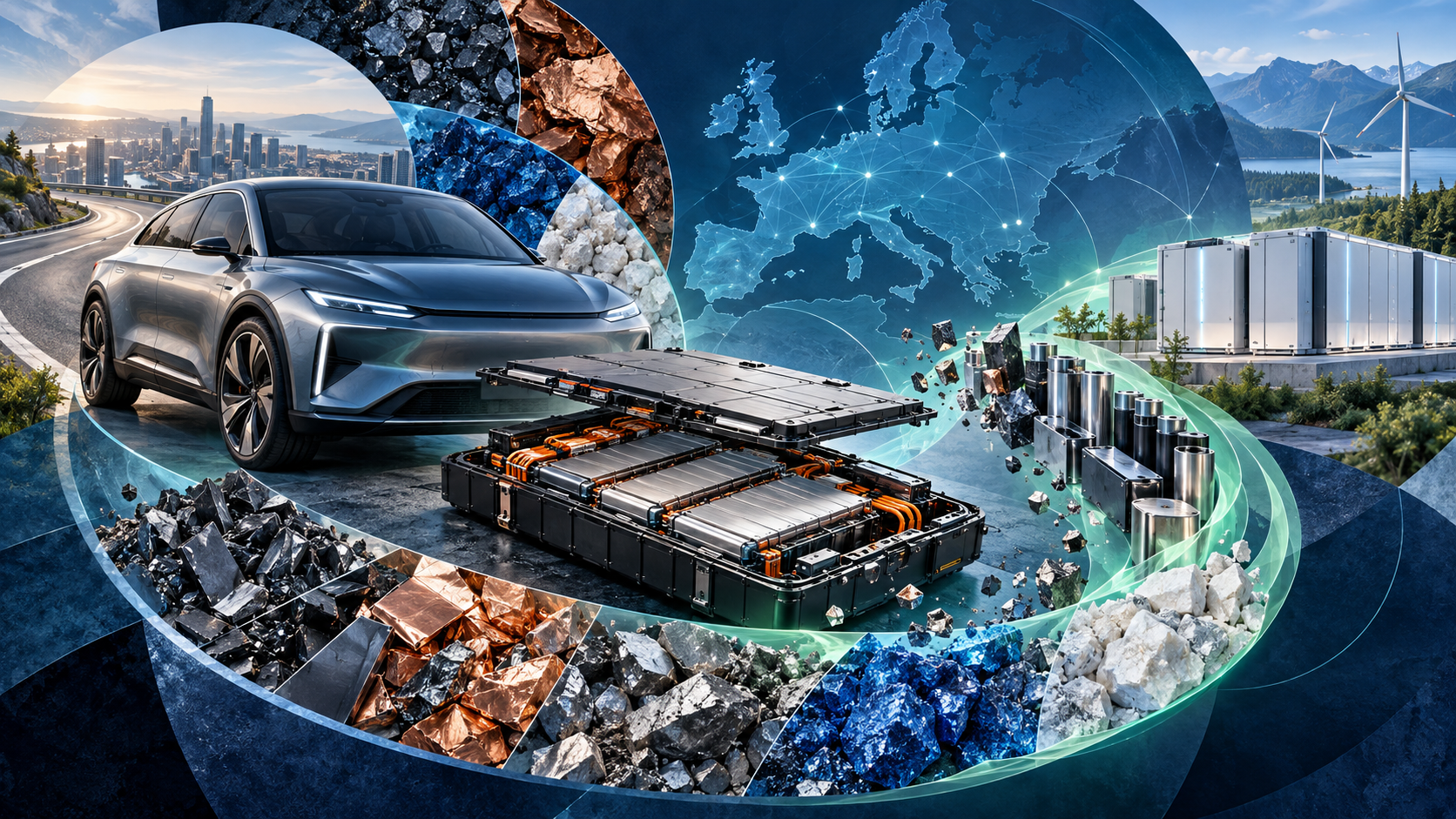
Paper: Assessing recycling potential of critical materials in European electric vehicle fleet. AI-generated abstract conceptual image created using ChatGPT/OpenAI
A recent study published in the Journal of Cleaner Production finds that its high-reuse scenario reduces the cumulative availability of recycled material by about 20%–25% through 2045. Cobalt shows the largest projected shortfall against EU recycled-content targets.
It also develops a material flow analysis (MFA) model to estimate the theoretical recovery of critical materials from end-of-life (EoL) light-duty electric vehicle (EV) and plug-in hybrid electric vehicle (PHEV) batteries through 2045.
The researchers combine EV adoption projections, vehicle survival patterns, cross-border flows, and changes in battery chemistry. They also incorporate material intensities (the amount of each material per unit of battery capacity), second-life use, and recycling efficiencies to track future battery stocks and material flows.
Linking EV Growth With Future Material Recovery
Europe’s transition to electric mobility will increase demand for battery materials while creating a growing source of secondary raw materials. Yet the materials in newly sold EVs are not immediately available for recycling.
Battery packs remain in vehicles for several years, and used vehicles can also move between countries before reaching EoL. These factors make it difficult to estimate when and where recyclable materials will become available.
The study addresses this gap with an MFA model that connects EV deployment with battery retirement and material recovery. It covers passenger cars and light commercial vehicles in the EU-27, the UK, Norway, Iceland, Switzerland, Turkey, and Liechtenstein. Medium- and heavy-duty vehicles are excluded. The model uses EV and PHEV sales from 2011 to 2024 and projects adoption through 2045.
The analysis focuses on lithium, cobalt, nickel, and manganese, as these materials are strategically important in battery manufacturing and recycling. It also examines how second-life applications could alter the timing of material recovery.
Modeling Vehicle Stocks, Battery Materials and Recycling
The researchers construct a cohort-based stock-flow model to follow EVs through their operational lifetimes. It uses country-specific logistic growth calibrated to historical sales and 2035 penetration targets aligned with the International Energy Agency’s Announced Pledges Scenario (APS) and Net Zero Emissions (NZE) Scenario. APS reflects announced policy pledges. NZE assumes a faster path to net-zero emissions.
The model separates technical degradation from behavioral turnover. This distinction allows young vehicles leaving one national fleet to enter another through exports rather than immediately becoming EoL vehicles.
The analysis translates vehicle stocks into battery stocks using data on battery capacity, chemistry, energy density, and material intensity. It also incorporates changes in battery chemistry, including the growing role of nickel-rich NMC and lithium iron phosphate (LFP) systems.
Researchers model direct recycling and second-life use in stationary storage. Reuse begins in 2025 and rises from 0% to 25% by 2045 in the low-reuse scenario or 50% in the high-reuse scenario. Only batteries from vehicles older than five years that leave service through behavioral turnover qualify for reuse. A reused battery remains in second-life use for 10 years.
Recycling calculations apply material- and chemistry-specific recovery efficiencies. The infrastructure model groups countries into 10 regional clusters and tests plant capacities of 10,000, 50,000, or 100,000 tonnes per year as EoL flows increase. The calculation assumes unrestricted battery availability within each region and omits logistics costs and cross-border constraints.
Recoverable Materials Rise as Battery Cohorts Reach EoL
The results show that EV adoption will develop unevenly across Europe. Norway is already approaching market saturation, while Turkey and Poland are emerging as important late-stage growth markets. The NZE pathway results in faster stock accumulation than the APS pathway, thereby increasing the volume of batteries entering the EoL stream.
Under NZE in 2045, Germany will have about three times the Balkan region’s cumulative EV sales and will require roughly five times its recycling capacity, reflecting faster vehicle turnover.
Cross-border vehicle movement further alters the geographic distribution of recyclable batteries. In a stylized allocation based on historical trade shares, Germany, Belgium, Luxembourg, and the UK emerge as important exporters, reflecting high vehicle turnover. Balkan and Baltic countries are projected to rely more on imported used vehicles.
Recycling demand will depend on EV sales, vehicle lifetimes, and second-hand market conditions. These projections indicate structural trade effects. Exact bilateral flows fall outside the model, which omits prices, policy changes, and market frictions.
Battery chemistry strongly influences the composition of future recyclable material. Embedded cobalt mass grows more slowly as the modeled chemistry mix shifts toward cobalt-free or low-cobalt chemistries. Nickel continues to accumulate, with nickel-rich NMC batteries remaining important in the modeled fleet.
Lithium, cobalt, nickel, and manganese together account for 10%–12% of total battery mass under the assumed chemistry mix and material intensities. The study identifies a sharp rise in recoverable material from the late 2020s, as larger EV cohorts begin to reach EoL. Second-life deployment changes this trajectory.
The reduction in recyclable material appears under both APS and NZE, with reuse postponing recycling. Under the NZE–High Reuse scenario, modeled second-life storage capacity reaches 15.7 GWh by 2030. This equals about 5% of the lower bound of the projected range for 2030 EU storage needs, 300 GWh. By 2045, the same scenario reaches 2.58 TWh of second-life storage capacity. Sensitivity cases that start reuse at 10% or 25% increase the 2030 estimate to 27.6 GWh or 45.1 GWh, respectively.
Under NZE–Low Reuse in 2045, Germany, France, Belgium, and the UK show high recovery yields, while countries with slower EV development show lower yields. Luxembourg exceeds 100% for all four materials because its high turnover produces large EoL flows relative to annual new-vehicle demand. The yield is the ratio of material recovered that year to material in domestic new-EV sales, excluding imports. This flow ratio differs from recycling-process efficiency.
The values are theoretical upper bounds because the model assumes all EoL batteries are collected. It also assumes fixed recovery efficiencies and does not assess economic feasibility or material purity.
The PHEV contribution remains small: under the modeled phase-out to zero PHEV sales by 2035, PHEVs supply about 3% of the cumulative recycled critical materials used by BEVs and do not affect the compliance result.
Toward More Sustainable Battery Recycling
The study shows that Europe’s battery-recycling challenge depends on capacity and timing. EV sales are growing rapidly, but batteries remain in vehicles for several years, and cross-border movements and second-life use delay recovery. Under the study’s assumptions on adoption, lifetime, collection, and annual matching, this timing gap could complicate compliance with recycled-content targets.
Second-life use can extend battery service life and support stationary energy storage, but it also delays recycling. The authors call for joint reuse and recycling plans, faster collection, incentives for domestic capacity, battery traceability, strategic stockpiling, and cross-border coordination. The compliance comparison matches recovery with demand one year at a time. Carrying material forward could improve the result but would require additional assumptions about stockpiling, traceability, and timing.
The findings support coordinated planning for EV adoption, battery chemistry, and reuse and recycling capacity. Future work should add probabilistic uncertainty analysis for adoption, battery lifetimes, chemistry, and recovery.
Disclaimer: The views expressed here are those of the author expressed in their private capacity and do not necessarily represent the views of AZoM.com Limited T/A AZoNetwork the owner and operator of this website. This disclaimer forms part of the Terms and conditions of use of this website.