A small change in the chemistry of sodium iron sulfide altered ion transport, cycling behavior, and the material’s structure in ways that could shape future all-solid-state battery research.
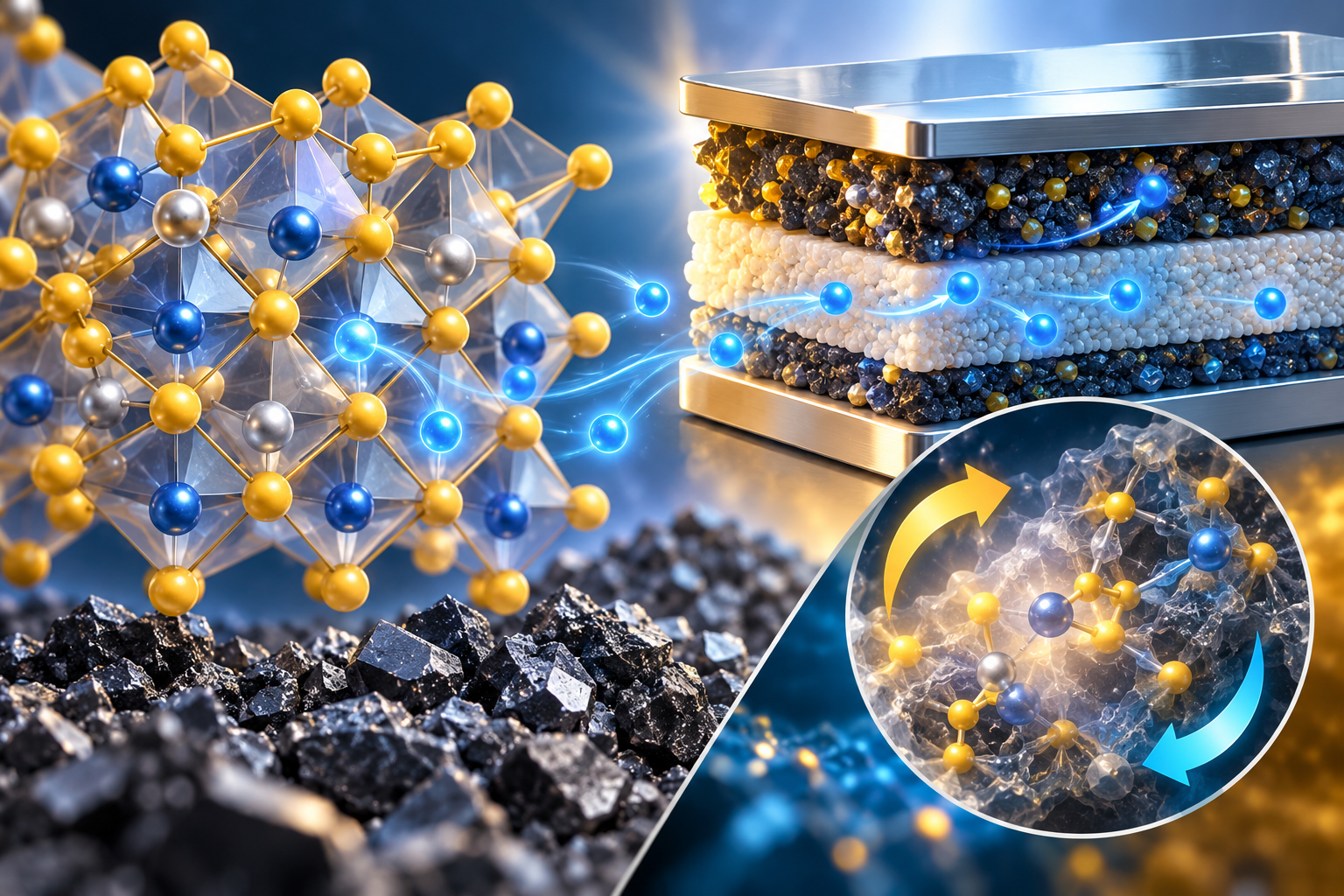
Paper: Al-substituted Na5FeS4 as earth-abundant positive electrode active materials for all-solid-state sodium batteries. AI-generated abstract conceptual image created using ChatGPT/OpenAI
In a recent research article published as an Article in Press in Scientific Reports, researchers synthesized Al-substituted Na5FeS4 as an earth-abundant positive electrode active material for all-solid-state sodium batteries.
The materials showed increased apparent ionic conductivity, high capacity, and reversible operation. At low substitution levels, replacing a small fraction of the iron with aluminum improved sodium-ion transport and increased capacity.
Al substitution for Na5FeS4
Growth in renewable power has increased demand for safe, low-cost, and sustainable large-scale energy storage. Sodium-ion batteries (SIBs) are one candidate because sodium resources are abundant and relatively inexpensive.
All-solid-state sodium batteries replace liquid electrolytes with inorganic solid electrolytes. This design offers high safety and the potential for higher energy density.
Na5FeS4, a sodium iron sulfide, is a high-capacity, reversible positive-electrode candidate whose electrochemical activity is largely attributed to sulfur redox reactions. The study tested whether replacing part of the iron with aluminum could improve electrode properties while preserving high capacity.
Synthesis and characterization
The researchers synthesized Al-substituted Na5FeS4, denoted as Na5Fe1−xAlxS4, over a wide compositional range: x = 0, 0.05, 0.1, 0.3, 0.5, 0.7, 0.9, and 1. The materials were prepared by heat treatment using sodium polysulfides as a self-flux.
Na2S, Fe, Al, and S were heated at 750 °C for 5 hours under ambient pressure, with all procedures carried out under dry Ar. The samples were cooled in the furnace, then the bulk products were ground into powders.
The Na3PS4 solid electrolyte was produced by a mechanochemical process followed by heat treatment at 225 °C for 2 hours. The resulting glass-ceramic contained the β-Na3PS4 phase and had a room-temperature ionic conductivity of about 5 × 10⁻⁵ S cm−1.
Composite positive electrodes were made by mixing Na5Fe1−xAlxS4, Na3PS4, and acetylene black at a weight ratio of 40:60:6. The negative electrodes contained a Na–Sn alloy and Ketjen Black prepared by mechanochemical alloying.
The all-solid-state cells had the configuration Na–Sn/Na3PS4/Na5Fe1−xAlxS4-Na3PS4-AB. The positive electrode layer was pressed at 180 MPa, and the negative electrode at 360 MPa. The assembled cells were tested under an applied pressure of about 75 MPa.
The team used XRD, XPS, and SEM-EDX to examine crystal structure, electronic states, morphology, and elemental distributions. Electrochemical measurements assessed charge-discharge behavior, cycling, rate performance, sodium-ion transport, and conductivity. Tests were conducted at about 25 °C from 0.6 to 3.2 V.
Performance, amorphization, and sulfur redox
Minor Al substitution increased the apparent ionic conductivity of Na5FeS4. Na5Fe0.95Al0.05S4 had an apparent ionic conductivity of 5.8 × 10⁻⁷ S cm−1, higher than pristine Na5FeS4. The highest measured value, 2.9 × 10⁻⁶ S cm−1, was recorded for Na5Fe0.3Al0.7S4. The paper calls these values apparent because resistance at the active material/Na3PS4 interface could not be separated from the measurement.
Among the compositions tested at low current, the lightly substituted material showed the highest electrochemical performance. A cell using Na5Fe0.95Al0.05S4 as the positive electrode active material delivered an initial charge capacity of 497 mAh g−1 and an initial discharge capacity of about 510 mAh g−1. Pristine Na5FeS4 had an initial charge capacity of 470 mAh g−1.
In the cycling test, the Na5Fe0.95Al0.05S4 cell maintained more than 460 mAh g−1 for over 70 cycles. The reported value of about 500 mAh g−1 on an active-material basis corresponds to about 189 mAh g−1 for the whole composite positive electrode, which contained about 37.7 wt% active material.
Na5Fe0.5Al0.5S4, in which half the Fe was replaced by Al, had an initial charge capacity of 481 mAh g−1 and cycled reversibly for more than 30 cycles. Its discharge capacity rose from about 405 to 460 mAh g−1 during the first 10 cycles and then remained near 460 mAh g−1. Compositions with x ≥ 0.7 exhibited markedly lower electrochemical activity and limited capacity.
Rate performance remained limited. The cells delivered about 220-280 mAh g−1 at 0.51 mA cm−2 and only about 10 mAh g−1 at 1.02 mA cm−2. Al substitution did not produce a clear improvement in capacity retention at higher current density under the cell configuration used in the study.
Intermittent charge-discharge measurements of the x = 0, 0.05, and 0.5 compositions showed that apparent ionic diffusivity was maintained throughout the initial charge process. The authors linked this behavior to the high capacities of these materials. Among the three compositions, Na5Fe0.95Al0.05S4 showed higher apparent sodium-ion diffusivity and lower polarization than pristine Na5FeS4 over most of the initial charge.
Ex situ XRD showed that Na5Fe0.95Al0.05S4 became X-ray amorphous during the first charge and remained amorphous after discharge. XPS showed reversible sulfur-related changes consistent with oxidation during charge and reduction during discharge. The authors link the loss of crystallinity to sulfur redox processes and possible S-S bond formation, but note that XPS alone cannot determine the exact local sulfur coordination.
Key Al-substitution findings
The study produced Na5Fe1−xAlxS4 solid solutions across the full composition range from Na5FeS4 to Na5AlS4. Continuous changes in lattice parameters supported the formation of a solid solution between the two end members.
The results support continued research on environmentally friendly, high-capacity sodium iron sulfide positive electrode active materials for all-solid-state sodium batteries. The paper also cautions that the 0.6 V lower cutoff may permit Na3PS4 decomposition or interfacial side reactions, and that their contributions to the measured capacity could not be quantitatively separated.
Source:
- Doi Y., Motohashi K., et al. (2026) Al-substituted Na5FeS4 as earth-abundant positive electrode active materials for all-solid-state sodium batteries. Scientific Reports. DOI: 10.1038/s41598-026-71083-3, https://www.nature.com/articles/s41598-026-71083-3