In this interview, industry expert Nate Newbury explains how handheld XRF users can improve reliability through better technique, sample preparation, safety practices, and mode selection.
Can you give us an overview of why handheld XRF is a key technique to obtain reliable results?
Handheld XRF analyzers are powerful tools, but the quality of the result depends heavily on how the instrument is used. I often compare an XRF analyzer to a calculator: if the wrong inputs go in, the wrong outputs come out.
Users need to understand the sample they are testing, including its geometry, size, surface condition, and accessibility. Small, curved, hard-to-reach, or irregular samples can all affect the result. Welds can also be challenging because there may be mixed metal in the area being analyzed.
Sample preparation is another major factor because handheld XRF is largely a surface technique. If the surface is contaminated, oxidized, painted, or inconsistent, the analyzer may not be measuring the true material underneath. Training also matters, even if it is just learning a few practical tips. Small changes in technique, sample preparation, or setup can make a significant difference to repeatability and data quality.
How can sample size and geometry affect handheld XRF analysis?
Sample geometry has a major impact because the X-rays are emitted from a defined spot size on the front of the analyzer. A useful way to think about it is that the spot size is roughly around the size of a dime; if the sample is much smaller than that, such as a thin piece of weld wire, many of the X-rays will miss the sample entirely.
When that happens, the X-rays may hit the table, floor, desk, or whatever is underneath the sample. This can introduce scatter and noise into the data, which can lead to the wrong chemistry, the wrong grade match, or unreliable results.
This is why users need to think carefully about the sample's size and shape before testing. A flat, clean sample that fully covers the measurement area is much easier to analyze than a thin, curved, narrow, or otherwise hard-to-position sample.
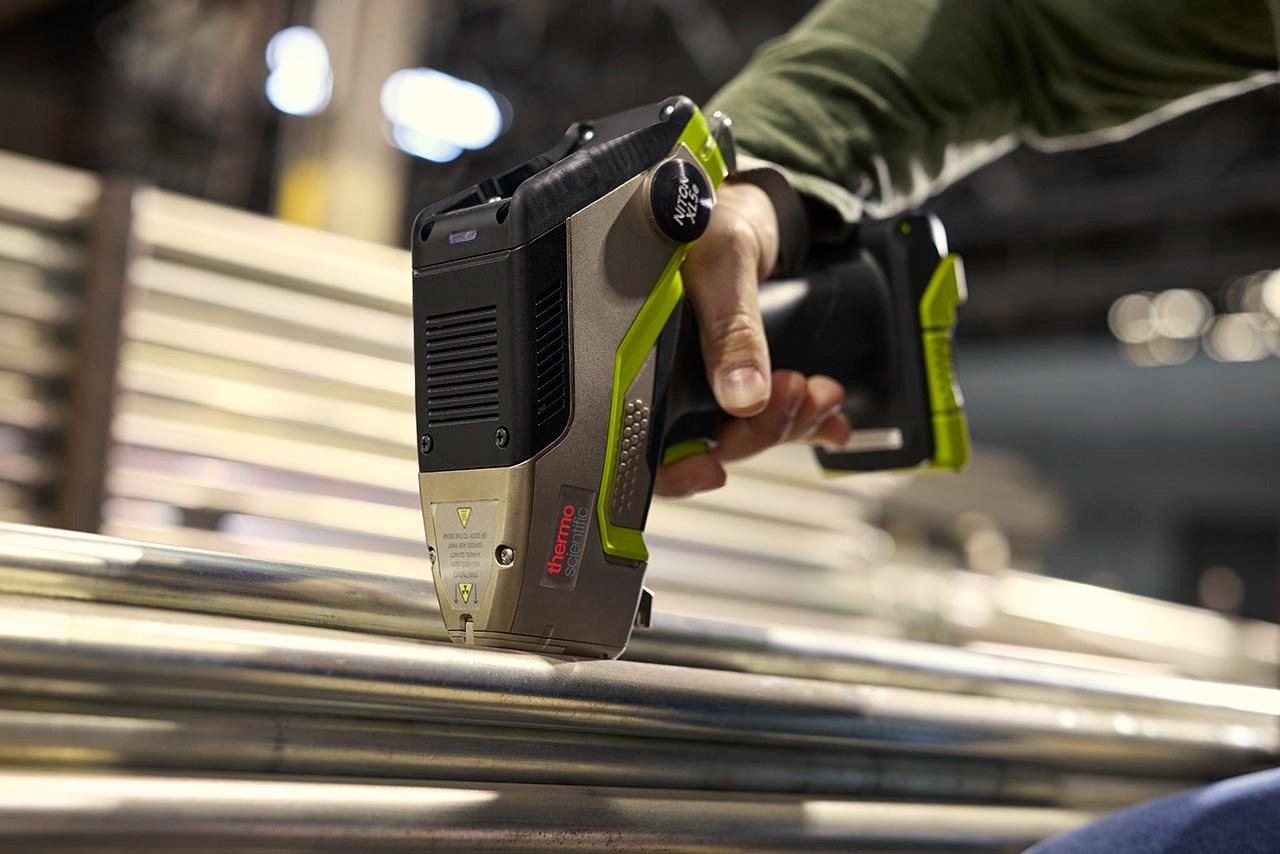
Image Credit: Thermo Fisher Scientific – Handheld Elemental & Radiation Detection
Why are test stands useful for small samples such as weld wire?
Test stands are very helpful when analyzing small samples because they improve both repeatability and safety. With weld wire, for example, the sample may only cover a small percentage of the XRF spot size. Without a test stand, most X-rays can miss the wire and hit the surface behind it, adding noise to the data.
A test stand helps solve this by positioning the analyzer and sample in a controlled chamber. The X-rays that miss the small sample are dissipated inside the sample chamber rather than scattering from a desk or floor. This means the analyzer measures only the X-rays that interact with the thin weld wire, helping to produce cleaner and more repeatable results.
This method is also safer. Operators should not be holding tiny samples, such as weld wire, in front of the analyzer with their fingers or hands. A test stand provides a controlled setup, reduces the risk of poor targeting, and makes the workflow easier to repeat.
Click here to watch Analyze That episode 13 - Handheld XRF best practices - getting accurate results
How do closed-beam systems improve safety and usability?
A closed-beam benchtop system operates a bit like a microwave. When the chamber is closed, the safety interlock allows the system to operate. When the chamber is open, the X-rays cannot be on, which makes it useful for small samples where users do not want their hands anywhere near the beam path.
This is especially valuable for samples that are smaller than the analyzer’s spot size, such as weld wire, earring backs, thin gold chains, and other small jewelry components. In these cases, a closed beam system or a test stand makes testing safer and easier.
The main benefit is control. The sample is placed inside the chamber, the instrument is positioned consistently, and the operator does not try to hold or manually target a tiny object. This all improves the overall user experience while supporting more repeatable measurements.
What risks can small or sharp samples create for the analyzer itself?
One of the biggest risks to any handheld XRF analyzer is puncturing the measurement window at the front of the instrument. That window is usually a very thin polypropylene film, only a few microns thick. It is designed to let X-rays pass in and out of the analyzer without distortion or attenuation.
Because the window is so thin, sharp or small materials can damage it. Weld wire, chips, turnings, and similar samples can puncture the window if pressed into the analyzer. The window itself is a relatively simple, low-cost part to replace, but damage beyond the window can be much more serious.
The detector sits deeper inside the analyzer and is one of the most expensive components. Nothing should go inside the front of the analyzer, and users should not use items like Q-Tips or compressed air to clean inside the instrument. Even though some analyzers have protective features, users should still be mindful of the samples they test and avoid anything that could damage the window or detector.
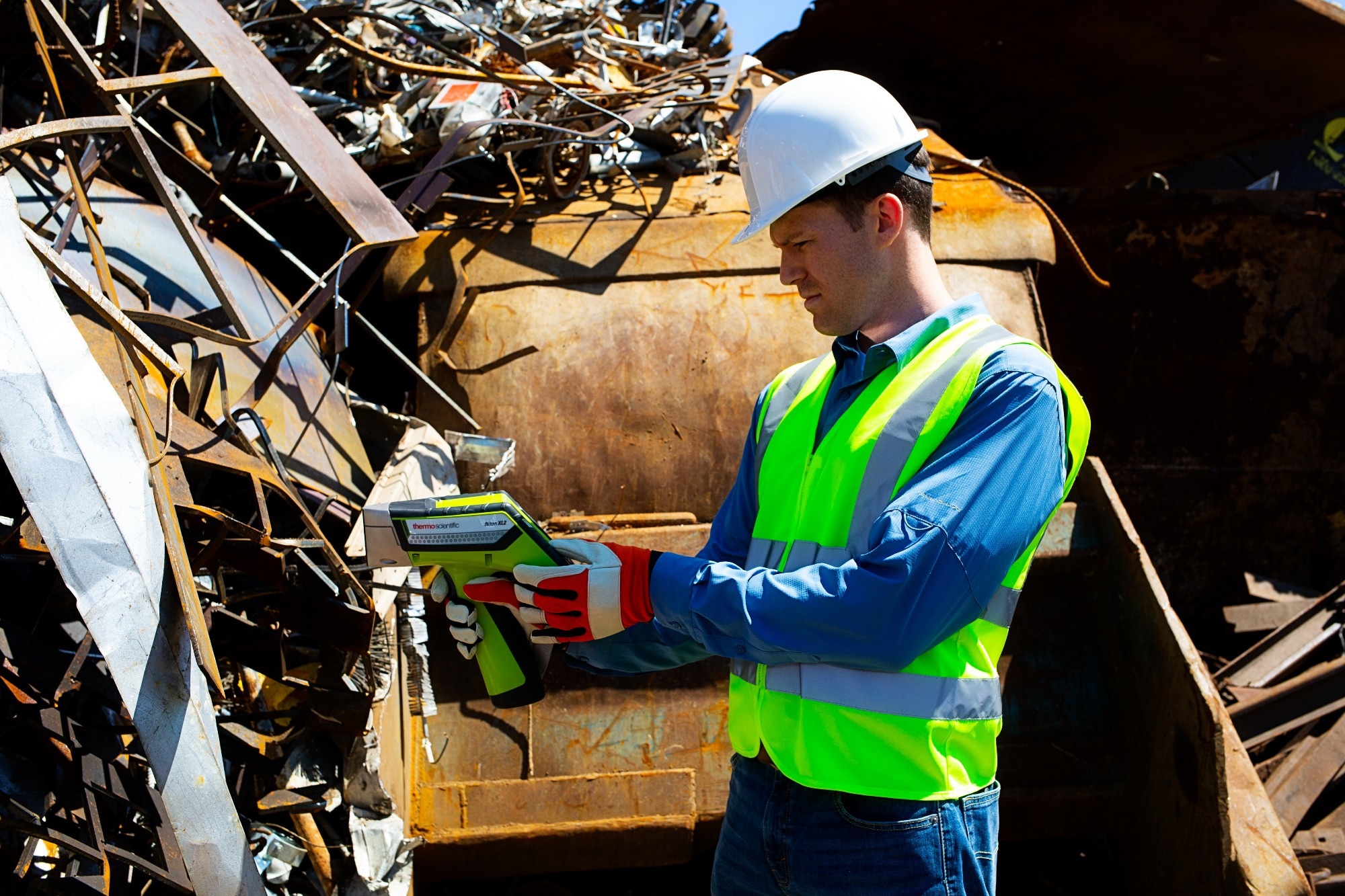
Image Credit: Thermo Fisher Scientific – Handheld Elemental & Radiation Detection
Why is surface preparation so important for handheld XRF?
Surface preparation is critical because handheld XRF primarily measures what is on the sample surface. If there is grime, oxidation, paint, or other contamination on the surface, the analyzer may detect that instead of the base material.
This is especially important for light elements such as aluminum (Al), magnesium (Mg), silicon (Si), sulfur (S), and phosphorus (P). These elements are sensitive to attenuation, distortion, and contamination by surface materials; dust, dirt, oxidation, and nearby debris can all affect the result.
In many cases, users do not need to polish a sample to a mirror finish; an angle grinder is often enough to clean the surface. The goal is not to grind deeply into the material, but simply to remove whatever is on the surface. If a clean metal spot is already available, such as an unpainted edge or cut surface, users should test that area instead of performing unnecessary surface preparation.
Click here to watch Analyze That episode 13 - Handheld XRF best practices - getting accurate results
What should users consider when testing scrap materials or painted surfaces?
In scrap environments, users need to be mindful of the whole environment around the sample. Scrap materials may contain grime, paint, oxidation, as-cast surfaces, chips, or other contaminants that can affect the result.
If a surface is dirty or oxidized, users should clean it before scanning. If a sample is painted, the best approach is often to find a clean metal area, such as an end cap, cut edge, or exposed section, rather than scanning through the paint. Industrial paints can contain elements such as lead, zinc, titanium, or other heavy metal particles. If the analyzer scans the paint instead of the metal, it may produce a misleading result.
As-cast surfaces can also be harder to test than clean, machined, or prepared surfaces. Users should pause before scanning and think about what the sample has been through, what is on the surface, and whether the location they are testing truly represents the material underneath.
Why is light element capability important for aluminum and magnesium alloys?
Aluminum alloys are often sorted based on key light elements, particularly magnesium and silicon. To measure these elements properly, users need an XRF analyzer with light element capability.
This is where analyzer configuration matters. Not every XRF analyzer is the same, even if two instruments look similar. For light element analysis, the instrument needs the right hardware, such as a silicon drift detector (SDD). If an analyzer lacks this capability, it will not measure light elements.
This is especially important when buying pre-owned or second-hand analyzers. Someone may purchase an instrument designed for lead paint or a different application and then expect it to perform alloy analysis. Depending on the hardware and configuration, that may not be possible. Users need to know the analyzer's elemental range and capabilities before buying or applying it to a specific workflow.
How should users think about the different modes in handheld XRF devices?
Different modes in an XRF analyzer are designed for different applications, so users need to choose the right tool for the job. An analyzer can look identical on the outside but have different modes installed, different calibrations, and different workflows available inside.
General Metals mode is one of the most widely used modes and is designed for industrial alloys. It focuses on grade matching and uses robust grade libraries for materials such as aluminum alloys, magnesium alloys, stainless steels, copper (Cu), titanium (Ti), nickel (Ni), cobalt (Co), and others.
In jewelry or gold-buying applications, the focus is usually not on a grade match but on karat, elemental composition, and plating detection; Precious Metals mode is helpful here, as it helps users know whether something is solid gold, gold-plated, or another material.
This is why choosing the right mode is so important. The analyzer may be capable of detecting many elements, but the workflow, calibration, and output need to match the application.
What should users understand about precious metals testing and XRF limitations?
In precious metals analysis, users need to understand that handheld XRF is still primarily a surface technique. It can be very useful for identifying gold, silver, plating, and surface composition, but it has limits.
Standard handheld XRF can penetrate farther than typical gold plating, which is why plating detection is possible. However, if a counterfeit material is hidden deeper inside a thick gold bar, the analyzer may not see it. If the material is buried more than a small distance beneath the surface, it becomes a physics limitation rather than a brand-specific limitation.
That means XRF is a powerful tool in counterfeit detection, but users still need to do their homework. For thick bullion or high-value samples, additional checks such as cutting, drilling, or other verification methods may be needed. The analyzer provides important information, but users should understand what it can and cannot tell them.
Analyze That episode 13 - Handheld XRF best practices - getting accurate results
Handheld XRF best practices - getting accurate results
About Nate Newbury 
Nate Newbury is the Founder and CEO of Alloy Geek, where he helps customers select, use, and maintain metal analysis solutions. He holds a Bachelor’s degree in Materials Engineering: Metals & Polymers from Iowa State University.

This information has been sourced, reviewed, and adapted from materials provided by Thermo Fisher Scientific – Handheld Elemental & Radiation Detection.
For more information on this source, please visit Thermo Fisher Scientific – Handheld Elemental & Radiation Detection.
Disclaimer: The views expressed here are those of the interviewee and do not necessarily represent the views of AZoM.com Limited (T/A) AZoNetwork, the owner and operator of this website. This disclaimer forms part of the Terms and Conditions of use of this website.