Many avoidable scale-up mistakes start with data and context issues, not just chemical ones.
Consider a batch that gels. A formulation has performed consistently at 500 g for weeks. At 50 kg in the pilot reactor, it gels before the operator can finish the addition, causing molecular weight drifts, cure profile shifts, and warping of the molded object.
The team gathers to determine what has changed. The bench chemist may be correct that the recipe is the same. However, the pilot handoff may not convey the process context that enabled the bench result to work.
What Gets Left at the Bench
At the bench, chemistry and conditions are inextricably linked in the scientist's mind: the order of addition, the ramp rate, how long it actually mixed, the humidity that day, and the specific initiator lot.
The majority of it will be required before the plant can begin operations. The issue is not that no one values this information. It exists in various locations, such as a notebook, an instrument, or someone's memory, and is unrelated to the formulation.
As a result, when the recipe is transferred to pilot as ingredients and amounts, the process context is lost, and the team must rebuild it from memory or re-run the job to recover it.
For polymers, this omission can be extremely costly because the attribute of interest is dictated by both technique and composition. Temperature, time, and mixing all affect molecular weight and dispersity. Crystallinity and morphology are determined by cooling and shear history.
Cure and crosslink density are determined by the process profile rather than stoichiometry alone. Thermal exposure during processing affects the residual monomer and its breakdown. Without the process background, the pilot crew misses out on some of the explanation.
Why Scale Itself Changes the Chemistry
Part of what makes scaling up difficult is that some variables change merely because the batch size increased, even when the recipe remains the same. As a reactor's volume increases faster than its surface area, heat is created throughout the batch but can only be evacuated from the walls.
An exothermic polymerization that was simple to manage at 500 g can self-heat at 50 kg, raising peak temperatures, increasing gelation, and broadening dispersity.
Mixing and shear also change: tip speeds, residence periods, and shear rates that were insignificant on the bench can degrade chains or fail to disseminate a filler at scale.
Cooling, which was nearly instant in a small vessel, becomes gradual in a large one, affecting crystallinity, morphology, and, eventually, shrinkage and warpage of the completed part.
Not all scale-up surprises start in the reactor. Common causes are also found outside the recipe: raw-material variability, such as a new supplier lot that is slightly off-spec or a cost-driven substitute, and ambient circumstances, where the identical process acts differently in a humid facility in July than in a dry one in January.
A connected record combines the lot number, ambient circumstances, process, and result. When a property drifts, the team can observe what has shifted.
The recipe alone does not contain this information. It belongs in the process record, and if that record is not sent with the formulation, the pilot team may have to relearn it through failed batches.
The Investigation That Begins as a Scavenger Hunt
When a pilot batch fails to meet specifications, determining why requires reuniting four records from four different locations: the bench formulation in a spreadsheet, the bench process notes in a notebook, the pilot run conditions in a MES or a paper batch sheet, and the QC results on both in a LIMS or another spreadsheet.
Most of the job is reassembling things by hand, and when they do not line up, the crew relies on memory. By the time the data is ultimately in one place, the pilot slot has passed, and the lesson is rarely recorded wherever the next project may look. So the same surprise awaits the next product.
What Changes When the Record Travels with the Formulation
The practical requirement is simple: retain the entire record, including formulation version, process parameters, and results, as it transitions from bench to pilot to production.
This allows the pilot run to be compared to the bench run using the same formulation version. QC results are linked to the batch and recipe that created them, including full curves where applicable, and the investigation can begin with analysis rather than data collection.
The scale-up history is now queryable, allowing the next project using comparable chemistry to begin with documented bench-to-pilot-to-production changes rather than from scratch.
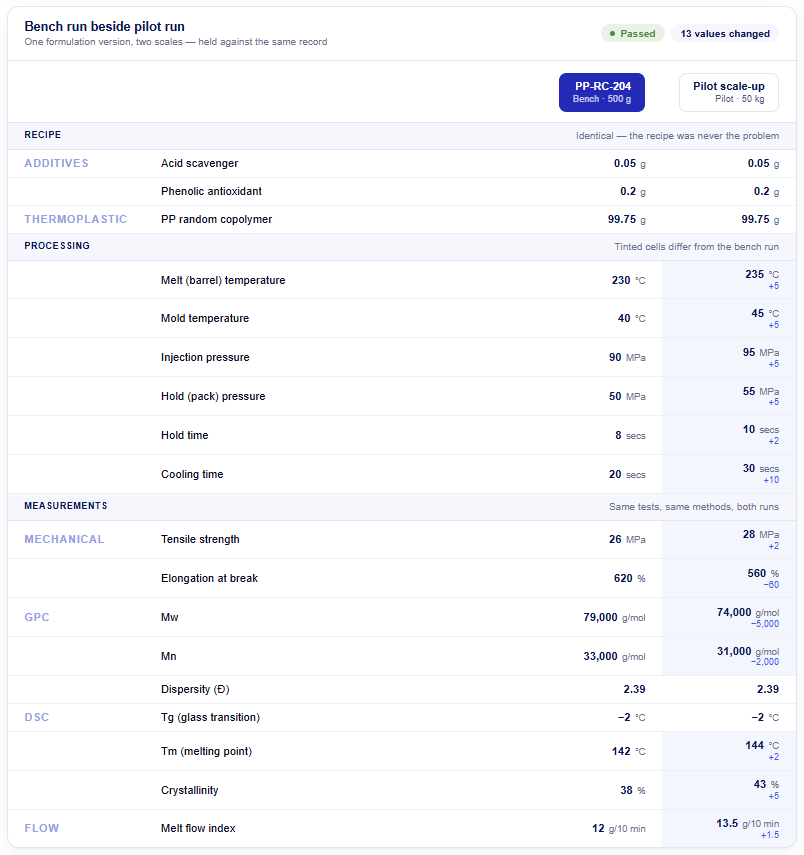
When both runs sit on the same record, “what changed” is visible in seconds, not days. Image Credit: Uncountable Inc.
Quality of life also improves. When the same data backbone connects to production QC, control charts can be updated as new results arrive. The technician can review the chart with the measurement rather than exporting data to statistical software once a month and discovering drift after multiple batches have been affected.
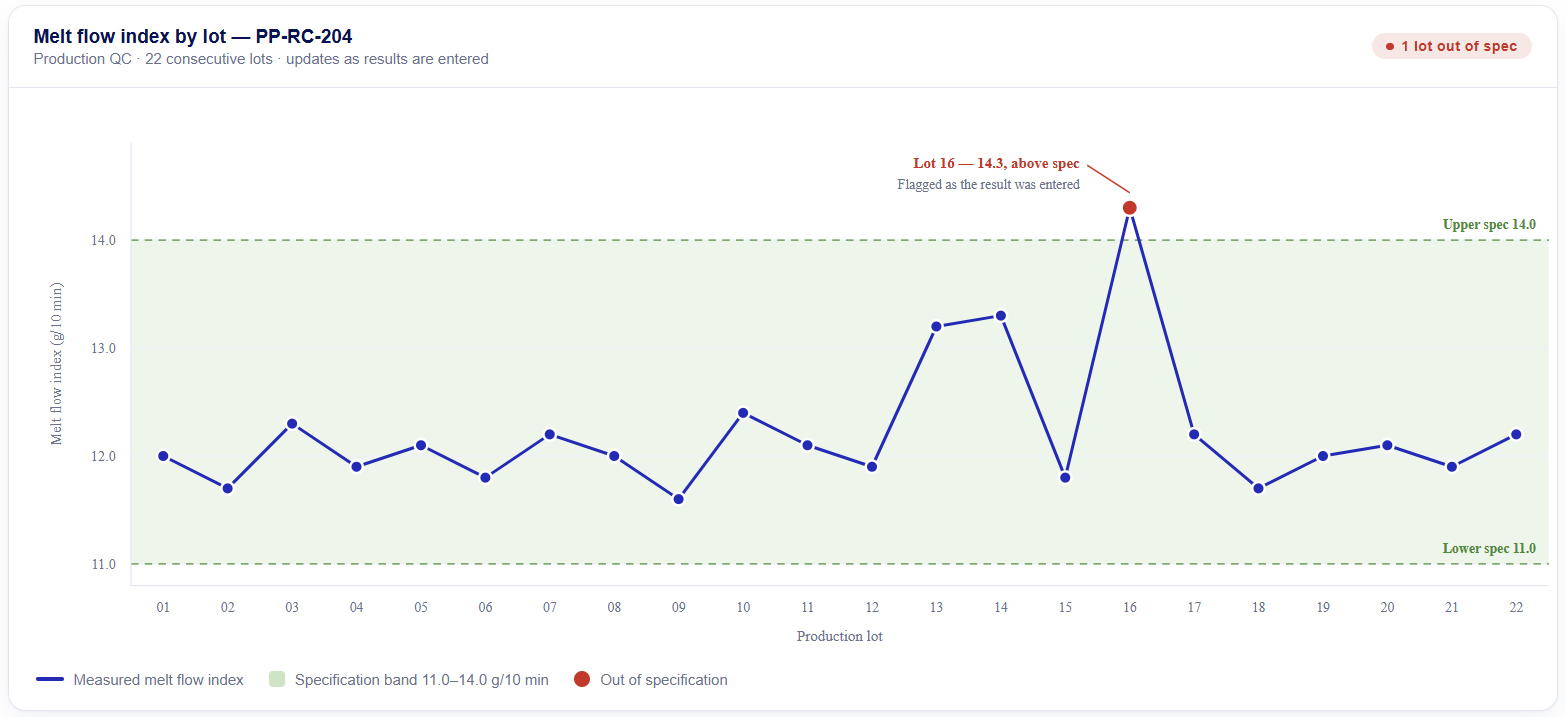
SPC as the data lands, not a monthly export after the batches are gone. Image Credit: Uncountable Inc.
The Bottom Line
Scaling up always involves some risk; polymers are sensitive to processing in ways that no spreadsheet can fully predict. However, many avoidable difficulties arise because context isn't carried with the formulation from the bench to the pilot line.
Keeping the formulation, process conditions, material lots, and results connected lets the team detect relevant changes quickly and apply what they have learned in the next run.
Acknowledgements
Amy Saunders, Content Marketing, Uncountable

This information has been sourced, reviewed, and adapted from materials provided by Uncountable Inc.
For more information on this source, please visit Uncountable Inc.