The most expensive experiment in a polymer lab may be one that the team repeats without realizing it has previously been conducted.
Every polymer group maintains a large archive of checked grades, tried additives, studied conditions, and shelved candidates. On paper, it is one of the laboratory's most valuable assets. In practice, much of it is impossible to locate; therefore, someone with no idea whether it already exists reproduces the work at full cost.
Three Ways the Same Work Gets Done Twice
Past experiments are not lost due to carelessness. They become difficult to access since they were never kept in a format that allows for content-based searches.
Files can be named after a person or a date (AS-6-8-26-114), rather than the chemical, property, or result. Failures, which are typically the most informative records, may go undocumented.
This results in three common types of duplicated work: a formulation challenge reappears after the person who addressed it has moved on or forgotten; a shelved candidate becomes viable again due to a regulatory change, new client demand, or raw-material price fluctuation, but no one can recreate what was tried; or a scientist begins a screen that another site previously ran and abandoned for a known reason, with nothing to flag it.
What it Actually Costs
Teams frequently report spending three months returning to a stage they had already reached because they couldn't retrieve the relevant knowledge. The delay for bringing a shelved project back into scope can range from seven to eight months. Each hour represents effort that the organization has already compensated for once.
What Makes an Experiment Findable
The difference between an archive a team can and cannot use depends on how the record is stored.
A document, whether a notebook page, PDF, or PowerPoint, is often searchable using only the words included. A structured record contains data from the experiment, such as the formulation and its components, process parameters, measured attributes, findings, and outcome, as well as why a candidate was shelved.
That structure lets you query by content, such as "every screen using this monomer that reached elongation above a threshold," and return results that include both failures and achievements.
It is not necessary to capture everything. It is necessary to capture a few consistent fields, such as composition, method, property, result, and outcome, in the same manner each time so that a result made by one scientist is legible to another years later.
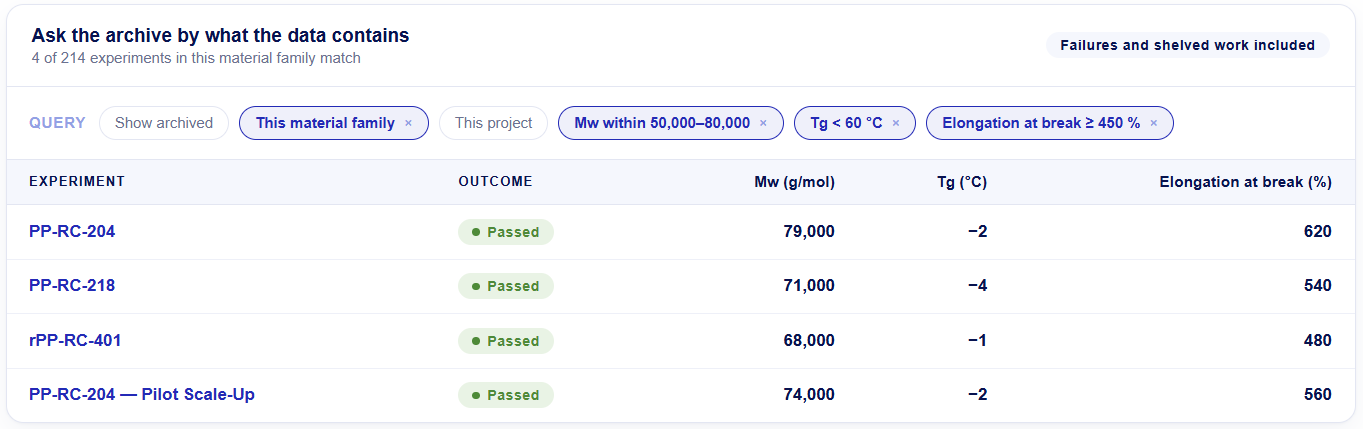
See what's already been tried before you run it again. Image Credit: Uncountable Inc.
Cooper Standard: The Same Experiment, Run in Three Regions
Cooper Standard's ∼80 chemists develop rubber and sealing formulations at global R&D sites, creating over 600 compositions annually.
Before they connected their data, chemists in different locations used fragmented spreadsheets in various languages and formats, and they often duplicated experiments that their colleagues had already completed. Researchers spent more than half of their effort simply gathering and synthesizing previous data.
As Senior Global Materials Director Jean-Marc Veille put it, the team needed “a way to cross-check information and ensure we are all working from the same knowledge base.”
Once that history was searchable in one location, scientists could build on each other's work rather than duplicate it, freeing up at least four hours per person each week. As Material Data Engineer Benoit Beaubreuil put it, “our chemists can learn from one another’s experiments rather than working from incomplete data.”
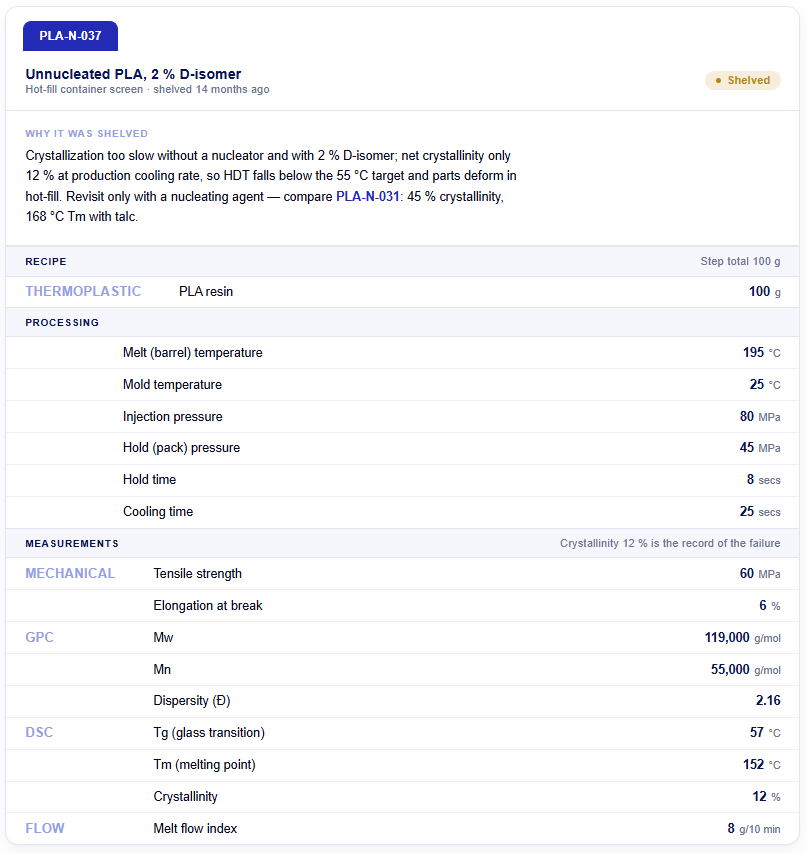
A failure captured this way is an asset, not a dead end. Image Credit: Uncountable Inc.
When Reuse Changes the Economics
The goal is simple, even if consistent execution requires discipline: document experiments, including failures, so they can be discovered based on what they contain rather than who conducted them or when.
A reusable record converts a previous outcome from a sunk expense into information that the team can use again. When information is easily accessible, a characterization run, failed screen, or process tweak can be beneficial even after the original project is completed.
The Takeaway
Depending on whether people can find and use what is in a lab's archive, it could be either a valuable asset or an expensive liability. Teams that can retrieve earlier work do not necessarily conduct more experiments; they are less likely to repeat the same work. The least expensive experiment is frequently the one that the team avoids repeating.
Self-Assessment: Is the Data Costing You?
Score one point for each statement that accurately describes your lab.
Finding all previous characterization data on a specific chemistry takes more than an hour. Raw instrument curves (GPC, DSC, and FTIR) are usually condensed to a single value in your shared records. At least one project within the last year replicated previously completed work.
In the previous two years, a polymer that had been bench-validated failed on the pilot or production scale. When possible, process conditions are recorded independently from the formulation. Manual reconciliation is required when comparing results from two different instruments or sites. A departing scientist would carry considerable unrecorded knowledge with them.
0-2 indicates robust foundations. 3-5: Fragmentation is costing you significantly. 6-7: Your data infrastructure, not your science, is the constraint on your research and development.
A Practical ROI Sketch
Customer-adjustable estimates, not guaranteed results. Source: Uncountable Inc.
| Input (adjust to your lab) |
Example |
Annual value |
| Scientist time recovered from finding/assembling data |
10 scientists × 0.5 day/week × 52 weeks |
260 scientist-days/year |
| Repeated screens or characterization runs avoided |
5 avoided reruns × $10,000 per campaign |
US$50,000 |
| Pilot/production batches saved from a preventable failure |
2 avoided batches × $25,000 per batch |
US$50,000 |
| Shelved project reopened months sooner |
up to 7-8 months faster |
project-specific |
The biggest benefit is often the hardest to quantify: a project that stays on track because the team can start with knowledge the lab already has.
Acknowledgements
Jacob Brutman, Sr. Solutions Engineer, Uncountable

This information has been sourced, reviewed, and adapted from materials provided by Uncountable Inc.
For more information on this source, please visit Uncountable Inc.