AZoMaterials sat down with Tony Carroll from Mid-Mountain Materials to discuss THERMOSEAL® Moldable and its use in demanding high-temperature applications. Tony explores the material’s versatility, key applications, maintenance and downtime benefits, and its evolving role in refractory repair, sealing, and insulation.
Tony, to start us off, could you tell us a little about your background, your role at Mid-Mountain Materials, Inc. and how your experience has shaped your work with high-temperature materials such as Thermoseal®?
I have been working with high-temperature materials and refractories for almost 48 years in roles of company ownership, sales, product development, and fabrication.
The privilege of working with major aluminium producers in more than 30 countries has allowed me to achieve patents in multiple countries and work with engineers, managers, and production staff to find and develop solutions for their most pressing high-temperature sealing, process control, and insulating needs.
Having had access to so many plants worldwide has informed my work, helping me develop, combine, and modify various high-temperature products into solutions such as Mid-Mountain’s patented THERMOPAK® Cathode Bar Seal Boot system, THERMOPAK® Anode Bar Seals, and pumping systems for THERMOSEAL® moldable refractories used in cathode bar packing glands.
For someone unfamiliar with the product, what is Thermoseal® Moldable, and what problem was it originally designed to solve for customers working in high-temperature environments?
THERMOSEAL® moldable is a wet, putty-like refractory composition consisting of ceramic fibers and various liquid components and binders that air-dry to a rigid material after being formed or applied into a particular sealing or insulating application.
Moldable refractory was originally designed to adhere to other refractory materials and steel linings inside kilns, furnaces, industrial boilers, non-ferrous metal transfer troughs, degassing stations, and filter boxes as a sealing and repair material for existing refractory linings.
This composition enabled quick, low-cost repairs to existing refractory linings, delaying or preventing the long, costly production shutdowns required for complete tear-outs and rebuilds of older, damaged refractory linings.
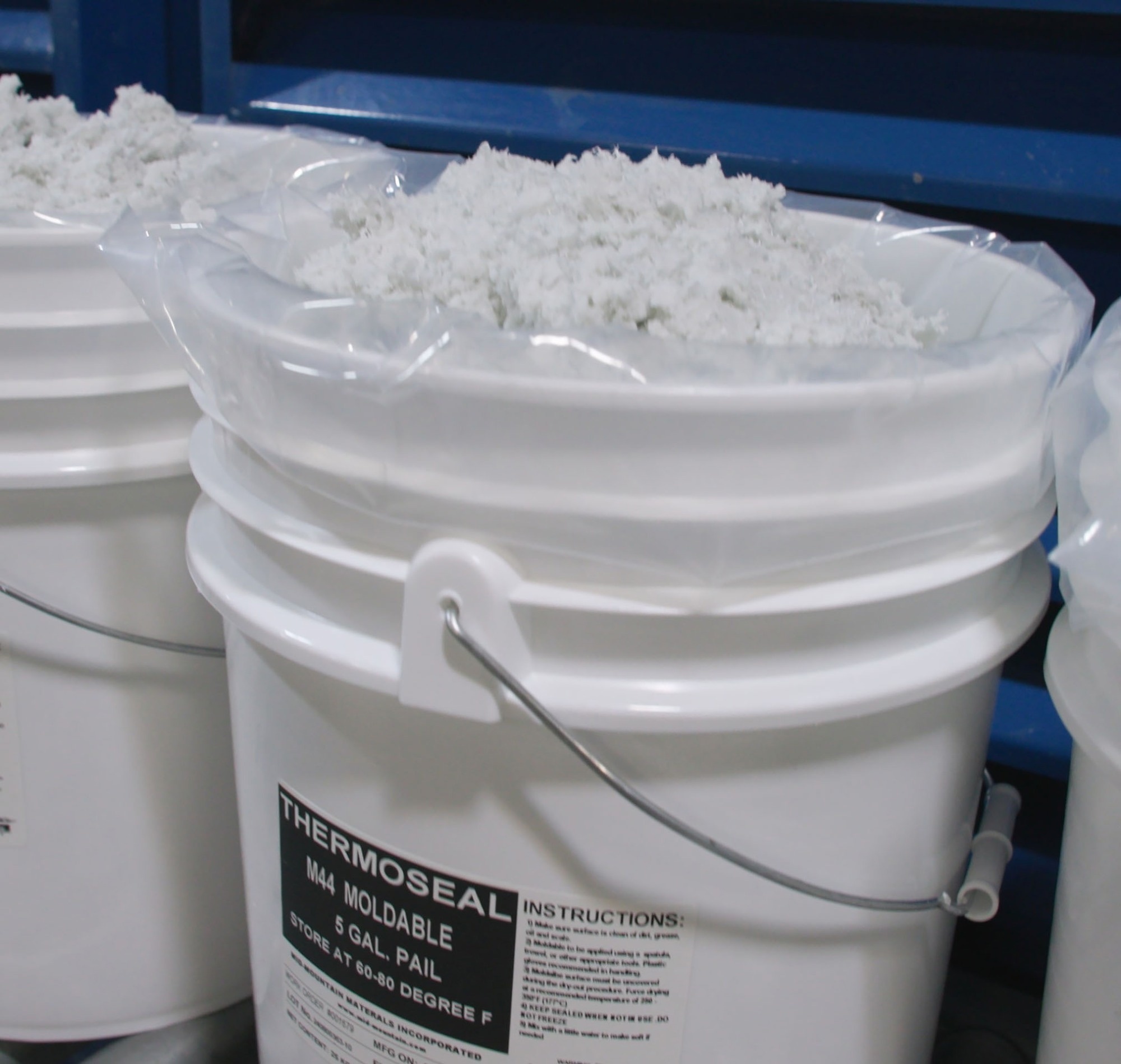
Image Credit: Mid-Mountain Inc
One of the interesting aspects of Thermoseal® Moldable is its versatility. What are some of the main applications you see customers using it for, and where does it provide the greatest advantages?
Because THERMOSEAL® Moldable is so versatile, it is used in a wide range of applications. Originally designed as patching material for cracks and spalling of existing refractory linings, it quickly became evident that the material was also excellent when used on its own as a sealing and lining material.
Applications for THERMOSEAL® Moldable have expanded to include lining repairs for kilns, furnaces, industrial boilers, non-ferrous launders, degassing stations, filter boxes, tap-out seals, cathode bar sealing material, firebox linings for the hearth industry, and artificial fireplace logs, to name a few.
The greatest advantage is in large-scale hard-to-seal applications such as cathode bar sealing in aluminium smelters. Using this material makes it possible to fully seal packing glands at cathode bar penetrations economically with no voids in less than a minute, providing hermetic sealing that lasts for the full service life of the reduction cells.
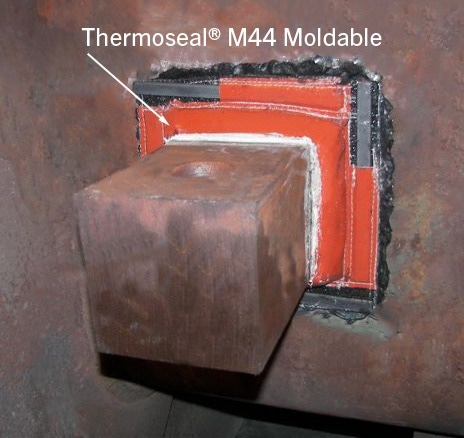
Image Credit:Mid-Mountain Inc
Thermoseal® Moldable can be formed into shapes, used to repair refractory linings, or applied over existing refractory as a surface coating. How does that flexibility benefit engineers and maintenance teams in practical applications?
The versatility of THERMOSEAL® Moldable provides engineers and maintenance crews with considerable latitude in repairing or improving their existing refractory linings and components. Rather than tear out and completely rebuild degrading linings, the moldable can be used to fill voids, repair cracks, reseal burner openings, or increase insulation by layering it onto the existing refractory linings.
Maintenance crews can keep operations in production and greatly reduce costly tear-out and rebuild downtime by making timely repairs when voids or cracks begin to appear. The moldable's sealing effectiveness is also crucial in applications around burner inlets or where an inert atmosphere needs to be maintained.
The fluid and pumpable consistency of THERMOSEAL® allows for the complete filling of voids such as cathode bar seal external metal packing glands where use of castable refractory or blanket materials is cumbersome, labor-intensive, and more prone to cracks and voids.
When customers are dealing with demanding conditions involving high temperatures, thermal expansion and contraction, what characteristics of Thermoseal® Moldable help it maintain reliable performance over time?
Once dried, THERMOSEAL® moldable is less dense than most other refractory materials with which it is used. This improves insulating effectiveness while preventing additional cracking or spalling of repairs because of the moldable's ability to compress somewhat without detaching, cracking, or causing additional damage to the existing refractory materials.
The interlocking of the fibers after drying provides a strong bond for a long service life.
There are several Thermoseal® Moldable formulations and consistencies available. How do you work with a customer to determine which formulation and application method are best suited to their particular process or equipment?
We consider many factors when helping a customer choose the best formulation of THERMOSEAL® for their specific application. Some of the many variables we consider include temperature, chemical atmosphere, possibility of erosion from combustion sources, air movement, or molten aluminium contact, duration required in the application, resistance to molten aluminium, ease of installation, worker safety to install, and, of course, price.
Beyond the material's technical performance, what benefits can Thermoseal® Moldable offer customers in terms of installation, maintenance, equipment protection, or downtime reduction?
Some of the other key advantages of THERMOSEAL® are ease of use, speed of repairs, durability, and the peace of mind plants have by using an affordable, quick solution to keep production moving and avoid downtime or, worse yet, complete shutdowns of their production lines.
Looking to the future, where do you see the biggest opportunities for Thermoseal® Moldable, and how do you expect the product range to evolve as customers face new challenges in high-temperature industrial applications?
The future will continue to see aluminium smelters expand the use of THERMOSEAL® in external packing glands, providing hermetic sealing at cathode bar penetrations, because it has been proven to be a superior seal that is less expensive and more durable than any other sealing method to date.
Evolutions, such as Mid-Mountain Materials' patented THERMOPAK® Cathode Bar Seal Boots system, will continue to expand alongside the THERMOSEAL® Moldable used in traditional steel external packing glands, and Mid-Mountain will continue product and application development to stay ahead of the ever-changing and ever-improving industrial applications for THERMOSEAL®.

About Tony Carroll
Tony Carroll is responsible for Aluminium Industry Sales and Product Development at Mid-Mountain Materials Inc. Tony began working with the aluminium industry in early 1979, 45 years ago in the position of engineering sales and product design.
In 1986, Tony established the Evansville Refractory and Insulation Supply Company Inc., functioning as President and Chief Product Design Engineer, which became a worldwide supplier to the aluminium industry into the 1990’s prior to being purchased by a multi-National firm.
Having designed multiple patented products in multiple countries, Tony has worked with plant engineers and operators in over 40 countries for nearly 45 years, developing and producing a range of sealing and process control solutions for the aluminium smelting, casting, and processing industries.
This information has been sourced, reviewed, and adapted from materials provided by Mid-Mountain Materials, Inc.
For more information on this source, please visit Mid-Mountain Materials, Inc.
Disclaimer: The views expressed here are those of the interviewee and do not necessarily represent the views of AZoM.com Limited (T/A) AZoNetwork, the owner and operator of this website. This disclaimer forms part of the Terms and Conditions of use of this website.