Sponsored by ServomexReviewed by Olivia FrostNov 9 2026
Servomex's SERVOPRO DF-700 Series analyzers use TDLAS to provide industry-leading moisture measurements. This sensor technology continuously sweeps across the entire moisture peak curve, removing fluctuations in laser source/detector performance or mirror reflectivity. Since these typical causes of drift are eliminated, no zero calibration is necessary.
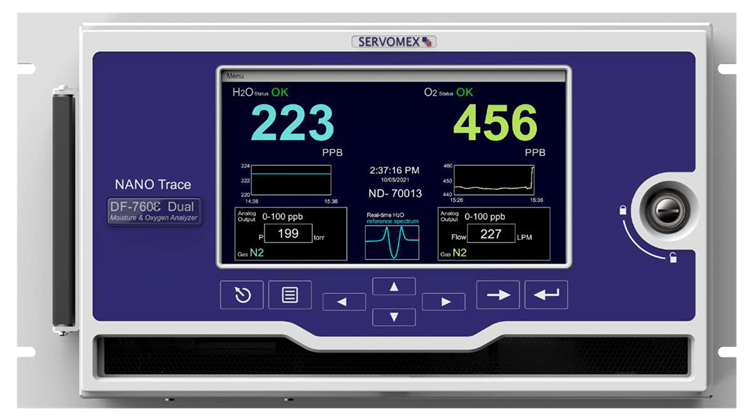
Image Credit: Servomex
Measurement Principle
The DF-700 Series of moisture analyzers from Servomex employs a technique known as tunable diode laser absorption spectroscopy (TDLAS), a reliable gas analysis method based on Beer's Law. The analyzer's laser emits a near-infrared beam that is absorbed by moisture molecules in its passage.
The analyzer consists of two parts: the laser chamber and the sample chamber (Herriott Cell), separated by a sapphire window. The laser chamber contains the tunable laser and photodiode detectors. The Herriott Cell is a hollow tube with highly reflective mirrors at either end, through which the sample gas passes.
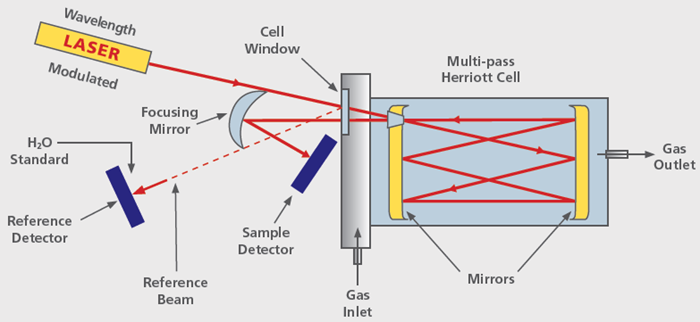
Figure 1. Gas analysis using the DF-700’s TDLAS technology. Image Credit: Servomex
As shown in Figure 1, light from the laser is transmitted at an angle through the cell window and into the sample chamber through an aperture in the mirror nearest to the laser chamber. The laser beam travels through the sample gas 93 times, bouncing back and forth between mirrors.
By the time the light leaves the sample chamber and hits the detector, it has traveled around 50 meters. The analyzer continually sweeps the narrow infrared (IR) spectrum of the moisture-absorption curve. This IR modulation enables the analyzer to monitor light intensity across the whole moisture absorption peak, a technique known as spectroscopy.
Beer's law governs moisture concentration. The area of the curve corresponds to the baseline, which is determined during each sweep.
To prevent the laser output from straying from the moisture peak, a small portion of the laser light is intentionally reflected off the window via a reference cell containing water vapor.
This moisture peak is recorded by a second detector, and a feedback mechanism in the laser electronics locks the laser output to it.
Why Calibration Is Not Required
Drift in optical-based systems can be caused by variations in the light source's output, changes in mirror reflectivity or alignment, and contributions from electronics.
Servomex's DF-700 Series is unaffected by these traditional sources of drift because it measures the ratio of on-peak to off-peak energy rather than the signal strength directly.
The continuous measurement of the baseline on either side of the moisture peak, when moisture does not absorb the laser's energy, distinguishes TDLAS from cavity ring-down spectroscopy (CRDS).
Changes in mirror reflectivity, alignment, laser intensity, or electronics would affect the signal intensity detected in CRDS, leading to moisture misidentification.
Because the reading is relative to a changeable baseline rather than a direct voltage or current, the analyzer's calculations are unaffected by the value's absolute position. As a result, any small variations induced by electrical disturbances, as well as aging effects on the laser diode, mirrors, and other internal components, have no bearing on the reading.
This, together with the lack of other variables in Beer's rule, eliminates the need for zero calibrations.
If Calibration Is Not Necessary, What Is the Purifier For?
Although it is not used during regular operation, a purifier is integrated with the DF-750 and DF-760 to support clients’ activities and aid in troubleshooting. Plumbing, both internal and external to the analyzer, can dry out over months or even years.
This can cause the analyzer's reading to start high and then trend downward over time. This is, of course, not triggered by the analyzer, but rather reflects actual variations in the moisture content of the measured gas within the sampling system.
While there is no requirement to zero the analyzer, customers may choose to do so during commissioning or preventative maintenance.
The purifier can also be used to determine how much of the piping running into the analyzer has dried out, and it serves as a sanity check to ensure that the analyzer is functioning properly. As a result, the purifier and zero-calibration functions have not been removed, despite the fact that they are not strictly needed.
Acknowledgments
Produced using materials originally authored by Servomex Product Managers and Servomex Engineering Department.

This information has been sourced, reviewed, and adapted from materials provided by Servomex.
For more information on this source, please visit Servomex.