Sponsored by ServomexReviewed by Olivia FrostNov 2 2026
The SERVOPRO MonoExact DF310E is specifically designed to measure oxygen (O2) in a variety of industrial gas processes. Built on the latest developments in software and hardware, it delivers a range of performance and cost-of-ownership benefits.
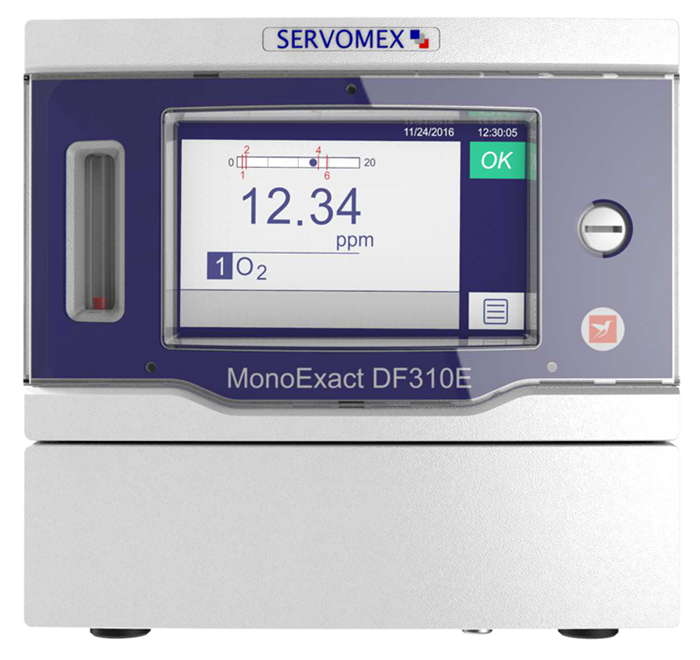
Image Credit: Servomex
An Advanced Industrial Analyzer Platform
The MonoExact DF310E O2 analyzer is intended for industrial and packaged-gas users who want precise process control and product-qualification data.
It is based on Servomex's innovative user interface and enables users to choose between coulometric sensing for part-per-million (ppm) measurements and paramagnetic sensing for percentage readings.
O2 sensor types are non-depleting, which reduces maintenance requirements and eliminates the cost of cell replacement.
They also meet US and European Pharmacopoeia standards. The coulometric sensor's dependability is supported by Servomex's best-in-class five-year sensor guarantee. The analyzer is fully compatible with both analog and digital communications, making integration simple.
- 4–20 mA
- RS232
- RS485
- Ethernet
- Modbus TCP/IP
- Profibus
The system's user interface is highly intuitive: a high-brightness color touchscreen display makes it simple to set up and alter control parameters, and the icon-driven Servomex software provides a seamless user experience.
When linked to the optional moisture sensor, the LCD displays both oxygen and moisture values.
The MonoExact DF310E is backward-compatible with SERVOPRO DF-310E installations, and its backplate design allows easy replacement of the older device with a new one. It also reduces training needs, eliminates retesting and requalification issues, and ensures that worldwide supply agreements are met.
Product Details:
| . |
. |
. |
| Gas measured |
O2 trace (ppm) |
O2 control (%) |
| Sensor technology |
Coulometric |
Paramagnetic |
| Range |
High resolution 0–100, 0–100, 0–1000, 0–10,000 ppm |
0–25% |
| Intrinsic error (accuracy) |
High resolution 0–100 ppm |
0–100
ppm |
0–1000
ppm |
0–10,000
ppm |
±0.1% O2 |
±3% of reading
or ±10 ppb, whichever
is larger |
±3% of reading
or ±50 ppb, whichever
is larger |
±3% of reading
or ±250 ppb, whichever
is larger |
±3% of reading
or ±2.5 ppm, whichever
is larger |
| T90 |
<20 seconds at 0.75 liters/min |
<10 seconds at 0.2 liters/min |
| Zero drift/month |
Negligible |
±0.05% O2 per week |
| LDL |
3 ppb |
50 ppb |
250 ppb |
2.5 ppm |
±0.1% |
Source: Servomex
Coulometric Oxygen Sensing
For over 50 years, Servomex coulometric sensors have been the industry standard for monitoring high-purity gases and providing trace and ultra-trace O2 measurements.
They do not require regular replacement, do not create false low readings like standard fuel cell sensors, and can handle both combustible and nonflammable materials.
While magnetic and zirconia solutions are quite effective for O2 percentage measurements, an electrochemical sensor is necessary to achieve the extremely low detection limits required for electronics-grade gas-quality monitoring.
Servomex's sensor for the MonoExact DF310E operates via a basic coulometric process: O2 in the sample gas is decreased by direct contact with the sensor cathode, where an electrochemical reaction transforms it to hydroxyl ions (OH-).
The electrolyte solution surrounding the sensor cathode and anode contains potassium hydroxide (KOH), which aids in the migration of OH- to the high-purity, non-carbon anode, where the ions are oxidized to complete the reaction. A tiny direct-current voltage applied across the sensor electrodes drives the redox reaction.
The current flow generated by the redox reaction is proportional to the O2 content in the sample gas. This enables direct O2 measurement, reducing the inaccuracies that generally occur with indirect measurement systems.
Using the 0–100 high-resolution sensor, the analyzer displays the O2 level in parts per million (ppm) down to a lower detection limit (LDL) of 3 ppb. When a typical micro-fuel cell or galvanic sensor cell is exposed to high concentrations, its capacitance is depleted.
This loss of capacitance affects the cell's accuracy over time, resulting in drift. When these events occur, it is impossible to correctly estimate when the cell will collapse.
Such situations necessitate unplanned recalibrations, which disrupt operations, or a total sensor replacement, which can delay product qualification by up to a full day because they expose the entire sample system to atmospheric O2.
Revenue is lost, and a product recall may be necessary if contamination is passed on to a client.
The electrolyte in Servomex's coulometric cell may be replenished with RSA for ongoing use, allowing a Servomex coulometric sensor to last five to 10 years, far longer than the six months typical of a micro-fuel cell or galvanic sensor cell.
Servomex's coulometric sensing provides highly sensitive and accurate O2 measurement with minimal drift. An operator may handle the process with more predictable and dependable monitoring, using only a few minutes per week for span calibration and once a month for electrolyte top-up with RSA solution.
Paramagnetic Oxygen Sensing
The paramagnetic sensing technique is extremely specific to O2, resulting in excellent accuracy and rapid reaction to changing O2 concentrations.
Paramagnetic cells are made up of two nitrogen-filled glass spheres suspended on a thin wire within a high magnetic field. Light shines on a mirror in the center of the suspension and reflects on a pair of photocells.
Because O2 is naturally paramagnetic, it is drawn to the magnetic field and so displaces the glass spheres, causing the suspension to deflect.
This deflection is sensed by the photocells, which send a signal to the feedback system. This causes a current to flow through the thin wire suspension, resulting in a motor effect that restores the suspension's position.
The restoring current is precisely proportional to the concentration of O2 in the gas mixture, providing an accurate, linear percentage measurement of O2 concentration.
Because this technology is non-depleting and does not require a reference gas, magnetic cells supplied with a clean, dry, noncondensing, and non-flammable sample gas never need to be replaced, and the performance does not deteriorate over time, saving significant amounts of money on ongoing maintenance and increasing sensor lifespan.
Key Applications
- Nitrogen production
- Argon production
- Hydrogen production
- Tanker transfill applications
- Blending of specialty gas
- Verification of electronic gas
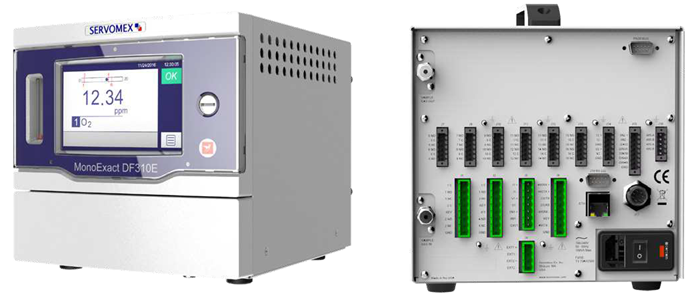
SERVOPRO MonoExact DF310E. Image Credit: Servomex
Acknowledgments
Produced using materials originally authored by Servomex Product Managers.

This information has been sourced, reviewed, and adapted from materials provided by Servomex.
For more information on this source, please visit Servomex.