Researchers turned an everyday carbon source into a three-dimensional reinforcement within nickel, offering a new way to tackle a persistent challenge in metal-composite design.
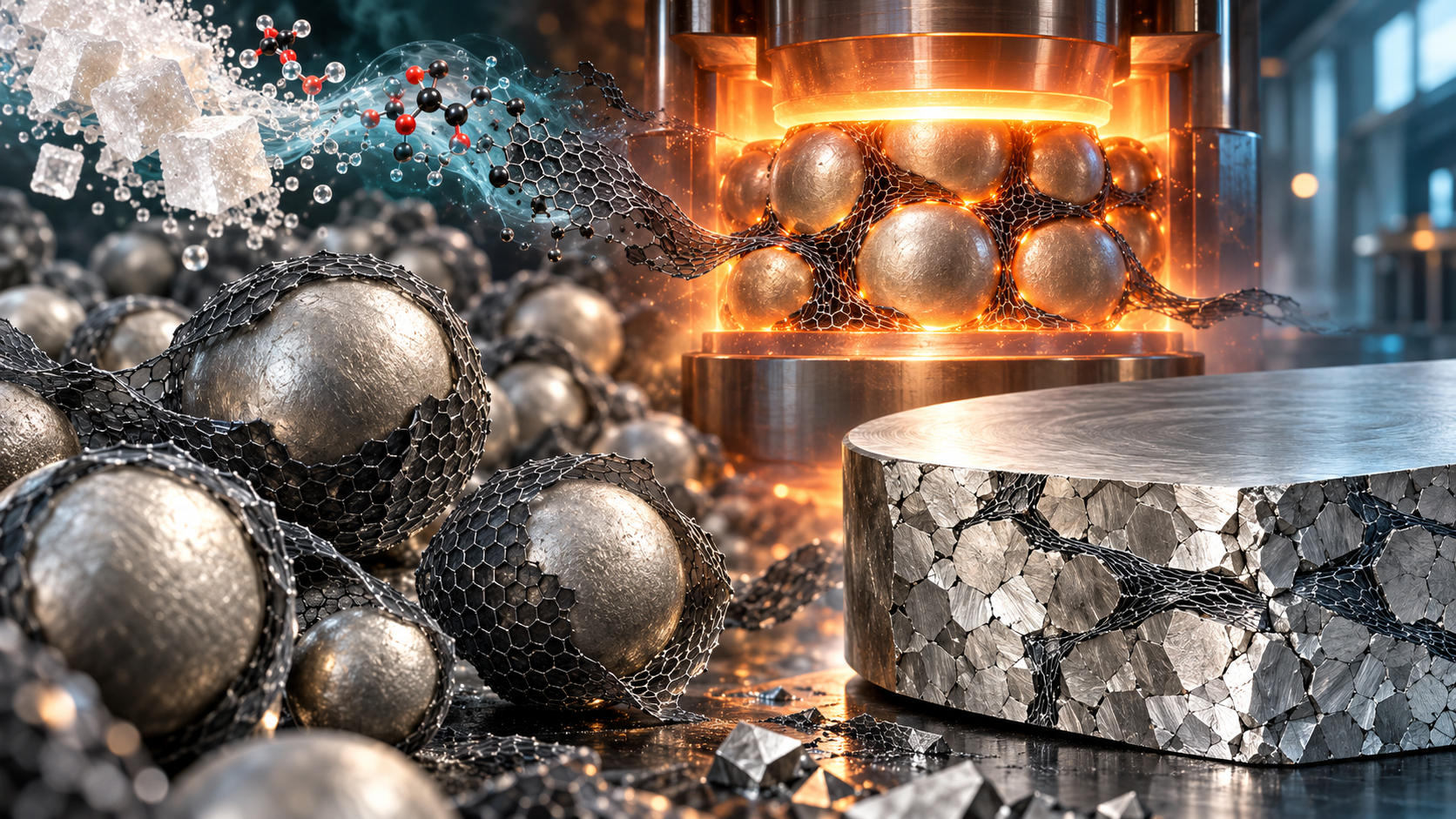
Paper: Fabrication of three-dimensional graphene-like networks 3D-GLNs for strengthening nickel-based composites. AI-generated abstract conceptual image created using ChatGPT/OpenAI
*Important notice: This news reports on an unedited version of an accepted paper and is awaiting final editing. Therefore, the paper should not be regarded as conclusive or treated as established information.
A recent study in the journal npj Advanced Manufacturing demonstrated a method to increase the ultimate tensile strength of a nickel-based composite by 54.93% relative to pure nickel while also increasing fracture elongation.
The technique uses sucrose as a carbon source and rapid thermal annealing to form thin, multilayer graphene-like coatings on spherical nickel powder. Researchers consolidated the coated particles into dense bulk composites, creating a three-dimensional (3D) graphene-like network within the nickel matrix.
Growing the carbon phase directly on nickel reduces the need to disperse pre-made graphene and helps preserve network connectivity during consolidation.
Challenges in incorporating graphene into metals
Graphene has a theoretical Young’s modulus of about 1 TPa and a tensile strength of around 130 GPa, making it a candidate reinforcement for metal composites. When added to nickel, it can increase hardness and strength and reduce friction and wear. Integrating graphene into structural metals remains challenging because of dispersion, structural damage, and interfacial reactions.
Conventional methods, such as liquid stir-casting and high-energy ball milling, can create these problems. The density difference between carbon and molten metal can cause graphene to float to the surface of the molten metal and agglomerate. High-energy milling can also damage graphene’s atomic lattice, creating defects that reduce its value as a reinforcing phase.
Methodology for in situ graphene coating
Researchers used a solid-state in situ thermal conversion process to create graphene-like coatings on nickel powder without mechanical milling. They mixed high-purity nickel powder (average particle diameter 5 µm) with sucrose in deionized water.
Among the concentrations tested, 2.4 wt.% sucrose produced the most favorable Raman spectra. After stirring, the mixture was dried to leave a thin, uniform sucrose coating on each nickel particle.
The authors heated the dried powder in a quartz tube furnace under a flowing mixture of 95% argon and 5% hydrogen. At 700°C and 750°C, the authors propose that sucrose decomposed into active carbon species that diffused across the nickel surface and formed graphene-like layers.
Keeping the RTA temperature below 800°C helped preserve the powder morphology needed for uniform network growth; at 800°C and above, the particles sintered strongly.
The coated powders were then consolidated by spark plasma sintering at 60 MPa at 850°C or 1,000°C for 10 minutes. During this process, graphene-like coatings on neighboring particles interconnected, forming a continuous 3D network throughout the nickel matrix.
The study characterized the material using scanning electron microscopy, Raman spectroscopy, electron backscatter diffraction, X-ray diffraction, and energy-dispersive spectroscopy.
Mechanical properties of the composites
The reinforced nickel composites showed higher strength, hardness, and fracture elongation than the corresponding pure nickel controls.
The processing condition involving annealing at 700°C for 30 minutes followed by sintering at 850°C is designated 700-30-850, with the numbers representing annealing temperature, annealing time, and sintering temperature.
This sample achieved a yield strength of 367.41 MPa and an ultimate tensile strength of 590.45 MPa, representing increases of approximately 33.53% and 54.93%, respectively, compared with Pure Ni-850.
A sample annealed at 750°C for 45 minutes and sintered at 850°C reached an ultimate tensile strength of 624.12 MPa and fracture elongation of 56.68%, the highest values for those two measures among the samples tested.
For the 700-30-850 sample, microhardness reached 178.5 HV, and fracture elongation rose from 33.13% in Pure Ni-850 to 49.70%. Electron backscatter diffraction showed that the graphene-like networks restricted grain growth.
At 850°C, average grain size fell from 2.22 µm in pure nickel to 2.07 µm in the 700-30-850 composite and 1.66 µm in the 750-45-850 composite. The authors link the finer grains, high-angle grain boundaries, and twin formation to greater resistance to dislocation motion.
Fracture surface analysis showed small dimples and attached graphene-like sheets. The authors observed bridging, pull-out, and sheet fracture and interpreted these features as signs of load transfer and resistance to crack propagation. X-ray diffraction did not detect nickel carbide phases, which the authors interpret as evidence of a stable graphene-like carbon/nickel interface.
Applications in aerospace and nuclear power
The 3D graphene-nickel composite may have relevance to fields such as aerospace and nuclear power, where nickel-matrix composites are already of interest. The researchers did not test the material in specific components or under service conditions.
Further testing is needed to examine high-temperature fatigue, oxidation and corrosion resistance, radiation tolerance, and long-term performance before researchers can judge the material suitable for specific aerospace or nuclear uses.
Future directions for composite development
The study shows that sucrose, or table sugar, can serve as a carbon precursor for multilayer graphene-like networks grown directly on nickel powder. The in situ thermal process avoids high-energy mechanical milling, and Raman spectra from the selected conditions showed relatively low defect levels in the graphene-like carbon.
This approach could be studied in other metal matrices, but the paper does not demonstrate transfer to another metal. Industrial use would require evaluating manufacturing scale-up and processing of complex shapes. Such work will help determine its potential for wider use in structural applications.
Disclaimer: The views expressed here are those of the author expressed in their private capacity and do not necessarily represent the views of AZoM.com Limited T/A AZoNetwork the owner and operator of this website. This disclaimer forms part of the Terms and conditions of use of this website.
Source:
- Hatami Farzaneh, O., Dar, J., Abbott, S., Roach, D. J., & Lin, D. (2026). Fabrication of three-dimensional graphene-like networks 3D-GLNs for strengthening nickel-based composites. npj Advanced Manufacturing. DOI: 10.1038/s44334-026-00117-5, https://www.nature.com/articles/s44334-026-00117-5