This article outlines how the SU-8 3000CF dry-film resist facilitates high-resolution microfluidic structures using hybrid liquid or dry-film processing and multilayer lamination.
Overview
SU-8 3000CF Dry Film Resist (DFR) is an antimony-free, low-halogen epoxy photoresist engineered for the production of high-aspect-ratio microstructures in MEMS, microfluidic, and high-performance microelectronic devices.
Provided in 20, 30, and 45 μm film thicknesses, the dry-film format yields extremely even layers with repeatable and accurate thickness regulation.
A key benefit of SU-8 3000CF DFR is that it can be stacked and laminated sequentially, enabling thicker structures while maintaining superior mechanical stability, vertical sidewalls, and resolution.
The material can be applied with both desktop laboratory laminators and industrial automatic laminators, making it appropriate for mass production, prototyping, and research.
This article outlines two techniques for the fabrication of microfluidic devices. The first is sequential stacking of SU-8 3000CF DFR layers, and the second is a hybrid procedure that combines laminated SU-8 3000CF DFR with spin-coated liquid SU-8.
These techniques deliver adaptable solutions to acquire accurate channel heights and complex microfluidic structures.
Application
Microfluidic devices depend on channels with smooth surfaces, vertical sidewalls, and uniform heights to ensure consistent device operation and reliable fluid flow.
SU-8 3000CF DFR is well-suited for fabricating capping layers, cavity structures, master molds, and microfluidic channels, offering high feature fidelity and effective dimensional control.
The inclusion of several dry-film thicknesses supports strict control of channel height through sequential lamination, while hybrid processing with liquid SU-8 broadens the design space for more sophisticated device configurations.
These fabrication techniques enable both scalable manufacturing and fast prototyping while maintaining high aspect ratio and high-resolution microstructures.
Key Features
- Proven performance with no degradation or delamination after highly accelerated stress testing (HAST) (85 ºC, 85% relative humidity (RH), 168 hours)
- Minimal water absorption
- Multi-layer processing abilities for intricate channel layouts
- Excellent adhesion to standard substrates (glass, silicon (Si))
- Even film thickness via dry film lamination
- High resolution and an aspect ratio greater than 3:1
Processing Information
To demonstrate the use of SU-8 3000CF in microfluidic devices, a TTS Automatic Laminator was used to print a microfluidic cell pattern with a two-layer stack of SU-8 3045CF DFR.
The TTS Automatic Laminator (Figure 1) is an industrial-grade system for the streamlined handling of wafers using DFR. A degree of process adaptation is assumed according to the kind of laminator used.
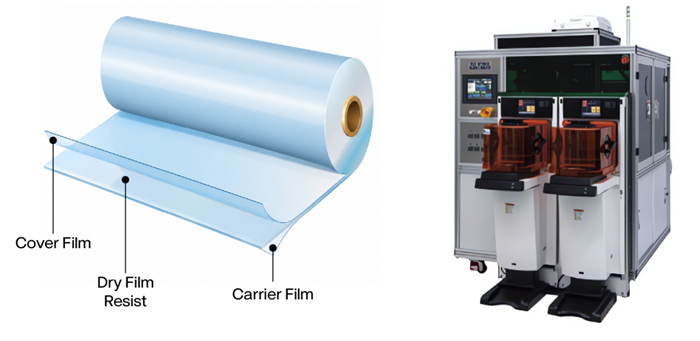
Figure 1. Schematic of typical dry film roll (left) and TTS Automatic Laminator used at Kayaku Advanced Materials (right). Image Credit: Kayaku Advanced Materials
Dry Film Only
Film fabrication details for the two-layer dry-film microfluidic device are outlined in Table 1 below, along with lamination parameters in Table 2. The resulting device displays outlet and inlet characteristics combined with distinct fluid flow paths for the microfluidic cell. The channels have a 90 μm depth from the two-layer processing of 3045CF DFR and SU-8 TF 6005 (Figure 2).
Table 1. SU-8 3045CF DFR processing steps for two-layer stack. Source: Kayaku Advanced Materials
| Process Step |
| Lamination |
TTS Automatic Laminator DXL2 |
Post Lamination Bake
Recommended for best adhesion |
30 minutes @ 95 °C per stack |
Exposure
365 nm wavelength |
350 mJ/cm2
Verify intensity for your specific tool and filter set-up |
| PEB |
Five minutes @ 65 °C and five minutes @ 95 °C |
| Development |
Dirty/Clean two-bath method with SU-8 Developer: Five minutes in each bath
To clean any remaining residue, use spray puddle method: three x one-minute spray/puddles followed by N2 dry |
| Hard Bake |
30 minutes @ 150 °C on a hot plate |
TTS Lamination Recipe
Settings may be different according to the laminator used.
Table 2. SU-8 3045CF DFR lamination parameters used for 2-layer stack on TTS Automatic Laminator. Source: Kayaku Advanced Materials
| . |
. |
. |
| Layer 1 |
Stage Temp/Roller Temp |
60 °C/60 °C |
| Speed |
5 mm/second |
| Pressure |
350 kPa |
| Layer 2 |
Stage Temp/Roller Temp |
60 °C/60 °C |
| Speed |
10 mm/second |
| Pressure |
250 kPa |
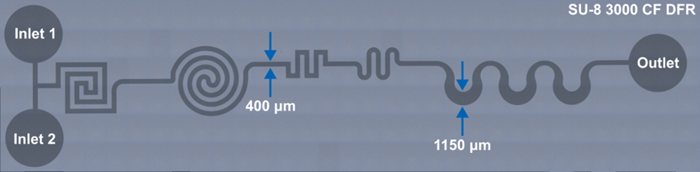
Figure 2. Example microfluidic device patterned using two layers of SU-8 3045CF DFR. Image Credit: Kayaku Advanced Materials
Liquid and Dry Film
Table 3 outlines film-processing parameters for the hybrid liquid- and dry-film microfluidic device, while lamination settings are detailed in Table 4. The final device displays outlet and inlet features, as well as precise fluid flow paths for the microfluidic cell. The channels have a 50 μm depth via the two-layer handling of 3045CF DFR and SU-8 TF 6005 (Figure 3).
Table 3. SU-8 TF 6005 + SU-8 3045CF DFR processing steps for liquid and dry-film stack. Source: Kayaku Advanced Materials
| Process Step |
| Liquid Coating |
SU-8 TF 6005 @ 5 μm film thickness |
| Liquid Soft Bake |
Five minutes @ 110 °C |
| Lamination |
TTS Automatic Laminator DXL2 |
Post Lamination Bake
Recommended for best adhesion |
30 minutes @ 95 °C per stack |
Exposure
365 nm wavelength |
350 mJ/cm2
Verify intensity for the specific tool and filter set-up |
| PEB |
Five minutes @ 65 °C + 10 min @ 95 °C |
| Development |
Dirty/Clean two-bath method with SU-8 Developer: 10 minutes in each bath
To clean any remaining residue, use spray puddle method: three x one-minute spray/puddles followed by N2 dry |
| Hard Bake |
30 minutes @ 150 °C on hotplate |
Table 4. SU-8 3045CF DFR lamination parameters used for 1-layer stack on TTS Automatic Laminator. Source: Kayaku Advanced Materials
| . |
. |
| Stage Temp/Roller Temp |
60 °C/60 °C |
| Speed |
5 mm/second |
| Pressure |
350 kPa |
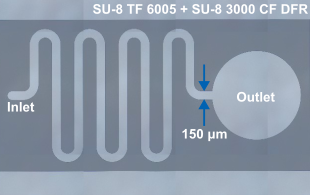
Figure 3. Example microfluidic device patterned using one layer of liquid SU-8 TF 6005 and one layer of SU-8 3045CF DFR. Image Credit: Kayaku Advanced Materials
Industrial Relevance
Dry-film resists are commonly used in applications that require repeatability, strict thickness control, and procedural reliability.1 SU-8 Dry Film Resist enables microfluidic production where feature fidelity and channel uniformity are vital for consistent fluid behavior.
SU-8 DFR is employed in a range of microfluidic applications, such as integrated fluidics, microreactors, point-of-care (PoC) diagnostics, lab-on-chip (LoC), and organ-on-chip (OoC) systems.2,3
These systems frequently integrate varied channel heights and sophisticated three-dimensional structures, making multilayer processing an ideal technique for attaining exact structural control.
Sequential photopatterning and lamination of SU-8 dry-film layers offer a layer-by-layer, additive fabrication technique for creating complicated 3D microfluidic architectures. This process facilitates hybrid fabrication, scalable manufacturing, and fast prototyping by blending spin-coated liquid SU-8 with laminated dry film.
It can also be combined with cutting-edge additive manufacturing methods, such as 3D printing, to further increase the possibilities of microfluidic device design.4–6
Along with its procedural benefits, SU-8 DFR provides chemical resistance, superior mechanical strength, and excellent adhesion to a broad spectrum of substrates.
These characteristics support dependable operation when exposed to liquids, biological media, and harsh environmental features, facilitating repeatable and durable microfluidic device manufacturing.
References and Further Reading
- Zhang, Z. and Nawrocki, D. (2025) Enabling Fast Microfluidic Chips Fabrication: A Practical Guideline for Microfluidics Design and Fabrication Using Photolithography for Fast Prototyping. Journal of Micromanufacturing. DOI:10.1177/25165984251364687. https://journals.sagepub.com/doi/10.1177/25165984251364687.
- Cao, U., et al. (2023) Microfluidic Organ-on-a-Chip: A Guide to Biomaterial Choice and Fabrication. Int. J. Mol. Sci. 24, 3232. DOI:10.3390/ijms24043232. https://www.mdpi.com/1422-0067/24/4/3232.
- Kubicki, W., et al. (2018) Microfluidic Chip for Cyclical Continuous-Flow PCR -Preliminary Results of the Technology. XV International Scientific COE, 1-3. DOI:10.1109/COE.2018.8435152. https://ieeexplore.ieee.org/document/8435152.
- Garland, S., et al. (2014) Print-to-Pattern Dry Film Photoresist Lithography. Journal of Micromechanics and Microengineering, 24 (5):057002. DOI:10.1088/0960-1317/24/5/057002. https://iopscience.iop.org/article/10.1088/0960-1317/24/5/057002.
- Courson, R., et al. (2014) Low-cost Multilevel Microchannel Lab on Chip: DF-1000 Series Dry Film Photoresist as a Promising Enabler. RSC Advances, 4 (97): 54847–54853. DOI:10.1039/c4ra09097g. https://pubs.rsc.org/ra/article/4/97/54847-54853/452469.
- Koucherian, N., et al. (2022) Fabrication of Multilayer Molds by Dry Film Photoresist. Micromachines, 13 (10):1583. DOI:10.3390/mi13101583. https://www.mdpi.com/2072-666X/13/10/1583.

This information has been sourced, reviewed, and adapted from materials provided by Kayaku Advanced Materials.
For more information on this source, please visit Kayaku Advanced Materials.