This article investigates the thermal stability of UniLOR® N for bilayer and single-layer lift-off lithography. Dimensional integrity, scanning electron microscopy (SEM), and process improvement have been demonstrated at deposition temperatures up to 180 °C for photonics, micro-electro-mechanical systems (MEMS), and semiconductor use cases.
Overview
UniLOR® N is a chemically amplified, negative-tone patented copolymer resist designed for UV lithography for MEMS, semiconductors, and related nanofabricated devices.
It is an optimal choice for lift-off applications because it offers straightforward removal with frequently used resist strippers (for example, dimethyl sulfoxide (DMSO), N-methyl-2-pyrrolidone (NMP)).
High thermal stability of the resist is crucial for particular deposition procedures. This article offers guidance on the thermal stability of UniLOR® N spanning a range of temperatures for both bilayer and single-layer purposes, alongside an in-depth examination of an optical filter patterning implementation.
Application
UniLOR® N is a highly adaptable resist employed for lift-off purposes covering photonic, sensing, and imaging devices.
Lift-off is a microfabrication method in which a disposable photoresist layer is first patterned on the substrate, then a chosen material is deposited across the entire surface. The resist can then be dissolved, which selectively removes the material deposited on the resist stack.
This technique facilitates the sharp resolution of dielectric or metal features when etching is not a feasible choice.
For directional metallization procedures, single-layer lift-off is most appropriate. For thicker metal-oxide or dielectric materials deposited by techniques such as sputtering, the bilayer architecture is more appropriate. The contrast between the two lift-off architectures is portrayed in Figure 1.
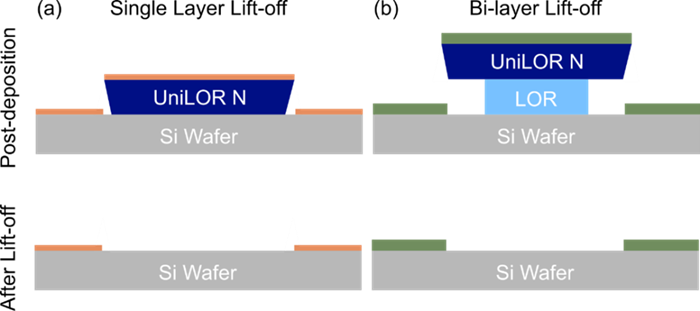
Figure 1. Schematic comparing (a) single-layer lift-off using UniLOR® N and (b) bilayer lift-off using LOR and UniLOR® N layers. Image Credit: Kayaku Advanced Materials
Key Features
- Suitable for both bilayer and single-layer lift-off procedures
- Alterable sidewall profile angle
- Effective on a wide range of substrates (silicon carbide (SiC), gallium arsenide (GaAs), copper (Cu), and silicon (Si))
- Thermal tolerance for structural stability in deposition at high temperatures
Process Conditions and Stability: Single Layer
To examine thermal stability as bake temperature increases, films were prepared according to the parameters in Table 1, and multiple Line/Space (L/S) features were imaged.
Table 1. Process conditions using UniLOR® N 2.5 dilution with variable hard bakes. Source: Kayaku Advanced Materials
| Processing Conditions and Stability: Single Layer |
| Coat |
Dispense 1 mL/inch of HMDS-primed Si substrate
1000–4000 rpm for 30 seconds |
| Soft Bake |
Two minutes @ 115 °C |
| Exposure |
120–200 mJ/cm2 (at 365 nm)
Verify intensity for your specific tool and filter set-up. |
| Post-Exposure Bake |
Two minutes @120 °C |
| Development |
45 seconds with TMAH Developer |
| Hard Bake Conditions |
None, 130 °C, and 150 °C for 30 minutes |
Features were exposed to high-temperature bakes at 130 °C and 150 °C after processing UniLOR® N 2.5 according to typical settings. Figure 2 shows images of 3, 9, 14, and 30 μm features. The sidewall angle in the single-layer procedure is vital for facilitating lift-off.
As shown in Figure 2, sidewall angles were calculated to assess dimensional stability. Smaller features show stability up to 150 °C. Bigger features are not as stable and show a declining sidewall angle as temperature elevates.
This observed effect can be explained by the surface-area-to-volume ratio unique to a given feature's dimensions. If high temperatures are needed, smaller features are optimal for lift-off.
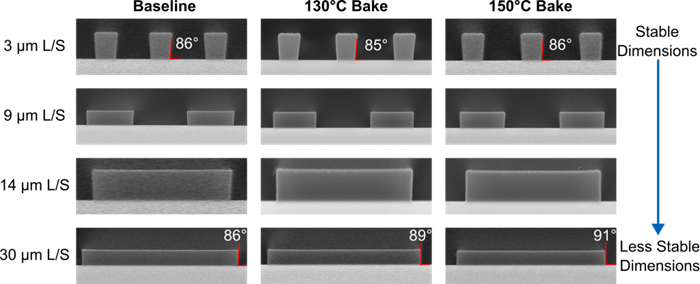
Figure 2. Dimensionality stability of L/S features vs. bake temperature. Image Credit: Kayaku Advanced Materials
Process Conditions and Stability: Bilayer with LOR
The structural stability of the T-shape resist feature is vital for effective lift-off during bilayer lift-off.
As shown in Figure 3(a), standard resists exhibit glass-transition-driven flow or softening when subjected to increased temperatures (≤180 °C), causing the resist to bend by angle θBend. As featured in Figure 3(b), resist distortions can be induced by the deposition of multi-layered, high-stress materials in certain sputtering processes that require them.
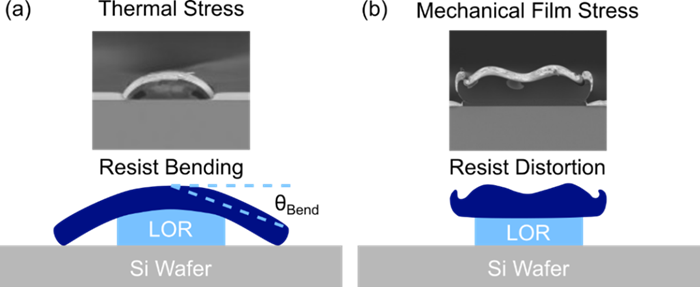
Figure 3. (a) Resist bending caused by thermal stress, (b) Layer distortion caused by high mechanical film stress. Image Credit: Kayaku Advanced Materials
A high-temperature procedure was developed to address this challenge using UniLOR® N, which significantly reduced the effects of mechanical and thermal stress up to 180 °C. Utilizing the high-temperature process in Table 2, the resist angle was measured (Figure 4) and improved by approximately 70%.
When using this method, development time must be adapted to the user's application. A 1:1–2:1 ratio of undercut length to LOR height was suitable for the majority of applications and can be used as a starting point.
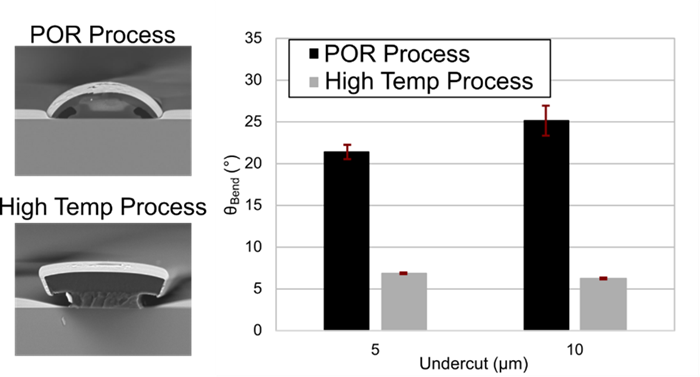
Figure 4. Comparison of θBend after 180 °C deposition for POR process and high-temperature process. Image Credit: Kayaku Advanced Materials
Table 2. Bi-layer process conditions using LOR C and UniLOR® N for high temperature applications. Source: Kayaku Advanced Materials
| Processing Conditions for Stability Study - Optimized for High Temperature |
| Coat LOR 30C |
Dispense 1 mL/inch of substrate
1000–4000 rpm for 30 sec |
| Soft Bake LOR 30C |
Three minutes @ 65 °C
Five minutes @ 200 °C |
| Coat UniLOR® N |
Dispense 1 mL/inch of substrate
1000–4000 rpm for 30 seconds |
| Soft Bake UniLOR® N |
Three minutes @ 125 °C |
| Exposure |
400–600 mJ/cm2 (at 365 nm)
Verify dose for the specific tool and filter set-up |
| Post-Exposure Bake |
Four minutes @ 120 °C |
| Development |
TMAH-based developer
Typical times from 150–400 seconds, but will depend on desired undercut |
| Deposition |
Deposit desired metal or dielectric material in chamber ≤180 °C |
| Lift-Off |
30 minutes in NMP- or DMSO-based remover @ 50 °C
Rinse with fresh remover and dry with N2 |
Industrial Relevance
High-performance optics use cases require dielectric films that are stoichiometrically stable, low-absorption, and dense. These films are frequently composed of metal oxides, for example Nb2O5, Al2O5, TiO2, and SiO2, which demand high-temperature sputtering to attain the controlled refractive index and required stoichiometry.
Standard deposition temperatures in advanced sputtering instrumentation, such as the Bühler Leybold Optics HELIOS 800 system employed here,1 range from 150 °C to over 180 °C depending on the target material and coating design. Strong lift-off resist materials like UniLOR® N are required to pattern materials deposited in this range of temperatures.
By utilizing the high-temperature procedure outlined in this article, optical filters sputtered with the HELIOS 800 system were effectively lifted without flagging, fencing, or other lift-off defects. 2–4
A sequence of SEM images captured during the bilayer lift-off procedure for optical-grade materials is shown in Figure 4 to showcase the LOR C and UniLOR® N system.
This technique can be adapted to a range of lift-off materials and applications by changing the process and T-shape parameters. Kayaku Advanced Materials can offer advice on particular applications.
References and Further Reading
- Lumeau, J., et al. (2025). PARMS-based nanolaminates for UV-applications. Optica OIC - Optical Interference Coatings Conference 2025, p.WE.4. DOI:10.1364/oic.2025.we.4. https://opg.optica.org/abstract.cfm?URI=OIC-2025-WE.4.
- Elshenety, A., et al. (2025) High Thickness Material Lift-Off Using Multi-Layer Photoresist. Journal of Micromechanics and Microengineering, 35, 025012. DOI:10.1088/1361-6439/adac6b. https://iopscience.iop.org/article/10.1088/1361-6439/adac6b.
- Fuchs, A., et al. (2024) Lift-Off Process for Patterning of a Sputter-Deposited Thick Metal Stack for High Temperature Applications on 4H-SiC. Solid State Phenomena, 359, 71-77. DOI:10.4028/p-i1Arj1. https://www.scientific.net/SSP.359.71.
- Cheng, K. (2020) Elimination of Metal Fencing by Optimizing Evaporator Dome Alignment. IEEE Transactions on Semiconductor Manufacturing, 33, 564-568. DOI:10.1109/TSM.2020.3008604. https://ieeexplore.ieee.org/document/9138479/.
- Rendos, A., et al. (2026) Lift-Off Resist for Optical Filters Using High-Temperature Sputtering. Proc. of SPIE, 13899. DOI:10.1117/12.3079850. https://www.spiedigitallibrary.org/conference-proceedings-of-spie/13899/3079850/Lift-off-resist-for-optical-filters-using-high-temperature-sputtering/10.1117/12.3079850.full.

This information has been sourced, reviewed, and adapted from materials provided by Kayaku Advanced Materials.
For more information on this source, please visit Kayaku Advanced Materials.