This article assesses the compatibility of TempKoat® P plating with tin (Sn), nickel (Ni), and gold (Au) plating media, demonstrating residue-free resist removal, high-aspect-ratio patterning, and chemical resistance.
Overview
TempKoat® P is a temporary, positive-tone, chemically amplified resist designed for micro-electro-mechanical systems (MEMS) and advanced packaging use cases. TempKoat® P delivers high-aspect-ratio features with single, thick coatings.
The rare mix of clean removal, superior chemical resistance, and resolution makes it well-suited to critical electroplating applications.
Application
TempKoat® P is an adaptable resist used in plating applications ranging from wafer bump to redistribution layer (RDL) and beyond. Figure 1 outlines the steps involved in plating, which is an electrochemical deposition technique.
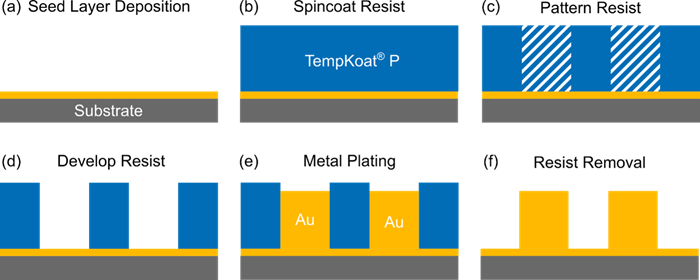
Figure 1. Process flow for TempKoat® P. (a) Substrate with metal seed layer. (b) Substrate coated with TempKoat® P. (c) TempKoat® P is patterned. (d) Exposed areas are developed away. (e) Metal is plated in patterned areas. (f) TempKoat® P is removed, leaving plated metal behind. Image Credit: Kayaku Advanced Materials
This technique delivers targeted, residue-free fabrication of metal features, eliminating the requirement to etch back undesired material. The deposition of various metal types means the photoresist must withstand a broad range of harsh chemical environments.
TempKoat® P is suitable for a range of plating media, including tin, nickel, gold, and copper (Cu). This article demonstrates the compatibility of TempKoat® P with Sn, Au, and Ni, particularly Technic’s Elevate® Tin D5011, Elevate® Ni 5950, and Elevate® Au 7934.
Key Features
- Easy removal
- Well-suited to a range of plating media
- Superior chemical resistance
- Fine pattern fidelity and reliability
- Post-exposure, no latency or rehydration delay
- Three-to-one height-to-width aspect ratio
- Wide range of film thickness
Processing Parameters
Table 1. Processing Guidelines – TempKoat® P on Cu Substrate for Ni and Sn Plating. Source: Kayaku Advanced Materials
| Processing Guidelines for Ni and Sn |
| Coat |
Dispense 1 mL/inch of substrate
Spin at 3000 rpm for 30 seconds |
| Soft Bake |
Three minutes @ 120 °C |
| Exposure |
350 mJ/cm2 (at 365 nm)
Verify dose for your specific tool and filter set-up |
| Post-Exposure Bake |
Two minutes @ 120 °C |
| Development |
Four 60s puddles with TMAH Developer |
| Plating pre-treatment |
Rinse with DI Water
Two minutes in Elevate Cu 6300 Cleaner: 90 °F (23 °C)
• 15% v/v in DI Water
Rinse with DI Water
One minute in Sulfuric Acid 10%
Rinse with DI Water |
Table 2. Processing Guidelines – TempKoat® P on Au Substrate for Au Plating. Source: Kayaku Advanced Materials
| Processing Guidelines for Au |
| Coat |
Dispense 1 mL/inch of substrate
Spin at 3000 rpm for 30 seconds |
| Soft Bake |
Three minutes @ 120 °C |
| Exposure |
150 mJ/cm2 (at 365 nm)
Verify dose for your specific tool and filter set-up |
| Post-Exposure Bake |
Two minutes @ 95 °C |
| Development |
Four 60s puddles with TMAH Developer |
| Plating Pre-treatment |
Rinse with DI Water
Two minutes in Elevate Cu 6300 Cleaner: 90 °F (23 °C)
• 15% v/v in DI Water
Rinse with DI Water
One minute in Sulfuric Acid 10%
Rinse with DI Water |
Table 3. Process conditions used to plate the Au, Ni, and Sn on the substrates. Source: Kayaku Advanced Materials
| Metal |
Plating Solution |
pH |
Temperature |
Current Density (ASF) |
Time (minutes) |
| Gold |
Elevate® Gold 7934 |
5.8–6.4 |
122 °F (50 °C) |
3 |
30 |
| Nickel |
Elevate® Nickel 5950 |
4.5–4.9 |
125 °F (52 °C) |
20 |
13 |
| Tin |
Elevate® Tin D5011 |
<0.5 |
77 °F (25 °C) |
20 |
6.5 |
Metal plating and removal were effective when processed using the outlined conditions.
High-performance liquid chromatography (HPLC) was used to analyze the extractables from each plating bath, which fell below detectable limits, establishing TempKoat® P as a reliable option for a range of plating chemistries (Table 4). Figure 2 shows scanning electron microscopy (SEM) of different pattern types after plating and resist removal utilizing Sn, Ni, and Au.
Table 4. HPLC results table of extractables from TempKoat® P in plating media at temperature for 24 hours. Source: Kayaku Advanced Materials
| Solution |
Temperature (°C) |
Time (hours) |
Extractables |
| Elevate Gold 7934 |
50 |
24 |
Below detection |
| Elevate Ni 5950 |
52 |
24 |
Below detection |
| Elevate Tin D5011 |
25 |
24 |
Below detection |
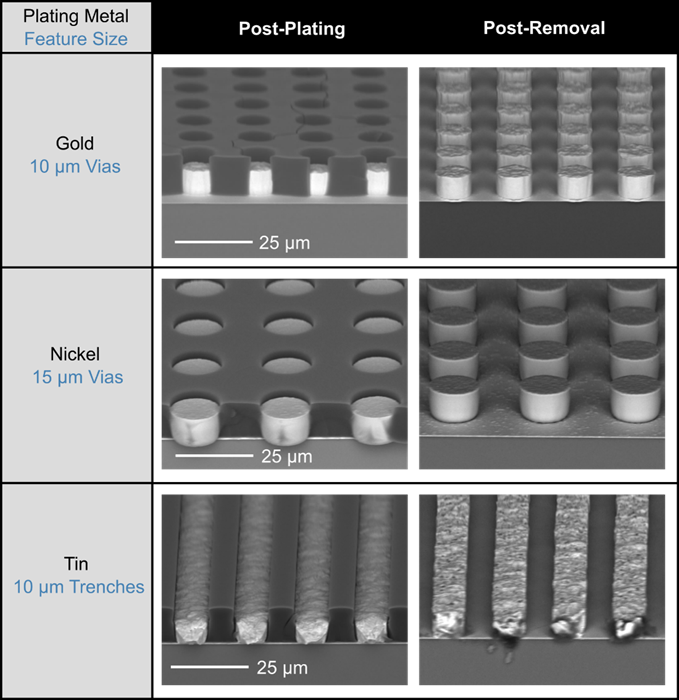
Figure 2. SEM images of Au, Ni, and Sn features before and after liftoff using 15 μm thick TempKoat® P as a plating mask. Image Credit: Kayaku Advanced Materials
Industrial Relevance
Tin, gold, and nickel are among the most widely used coatings in the semiconductor sector, each preferred for its unique characteristics. Electroplated gold has excellent mechanical wear resistance and conductivity, making it ideal for switches, connectors, and wire bonding.2
In contrast, nickel is prized for its capability to act as a barrier across various device layers during large temperature variations.1 Tin has effective anti-corrosive features along with excellent solderability and electrical conductivity, which make it well-suited for the creation of highly dependable electrical connections.3
Crucially, each metal needs a unique plating medium, which often includes aggressive chemistries. The plating media for gold is typically cyanide-based, which has a high attraction to gold ions, demanding extended plating times and restricting the rate of plating.4
Nickel plating media should remain free of contamination and strictly regulated to manage the consistency, purity, and stress of the deposition. Tin plating media is typically highly acidic, with pH values below one. These challenging parameters demand a plating resist that can tolerate severe environments without delaminating, deforming, or breaking down.
TempKoat® P is proven to be a durable resist when subjected to a range of plating media and facilitates these essential metallization processes for MEMs, semiconductors, and additional devices.
References and Further Reading
- Shalyt, E., et al. (2014). Advanced process control of nickel electrodeposition for packaging in semiconductor industry. ECS Meeting Abstracts, MA2014–02(33), pp.1714–1714. DOI:10.1149/ma2014-02/33/1714. https://iopscience.iop.org/article/10.1149/MA2014-02/33/1714.
- Okinaka, Y. and Hoshino, M. (1998). Some recent topics in gold plating for electronics applications. Gold Bulletin, 31(1), pp.3–13. DOI:10.1007/bf03215469. https://link.springer.com/article/10.1007/BF03215469.
- Noble Metal Coatings Inc. (2024). Primary Applications of Tin Electroplating in Electronics. Available at: https://www.noblemetalcoating.com/blog/what-are-the-primary-applications-of-tin-electroplating-in-electronics/.
- Morrissey, R. (2011) Technic Inc. Gold and Silver Plating Basics, Products Finishing

This information has been sourced, reviewed, and adapted from materials provided by Kayaku Advanced Materials.
For more information on this source, please visit Kayaku Advanced Materials.