This article describes a procedure for large-undercut single-layer lift-off using UniLOR® N 5.0 for non-directional oxide and metal deposition.
Conditions during soft bake, exposure, post-exposure bake, and development can be tailored to control the undercut profile dimensions and achieve reliable lift-off in micro-electro-mechanical systems (MEMS) and semiconductor structures.
Overview
UniLOR® N is a chemically amplified, negative-tone-exclusive co-polymer lift-off photoresist series for ultraviolet (UV) photolithography in MEMS, semiconductors, and additional nanofabricated devices.
Its composition is tailored for large undercut lift-off procedures, offering strong thermal stability and adjustable wall profiles across a wide range of film thicknesses.
This large undercut lift-off technique facilitates precise pattern transfer during non-directional oxide and metal deposition while allowing simple removal through the use of N-methyl-2-pyrrolidone (NMP) or dimethyl sulfoxide (DMSO)-based removers.
Key Features
- Variable profile
- High thermal-profile retention
- Superior adhesion to a range of substrates like silicon carbide (SiC), silicon (Si), and gallium arsenide (GaAs)
- Suitable for standard tetramethylammonium hydroxide (TMAH) developers
- Simple to remove with DMSO- or NMP-based removers
Application
Single-layer lift-off is a technique used to pattern oxide and metal layers in semiconductor or other nanofabricated systems. Lift-off resists need to feature an undercutting or inward sloping wall profile to achieve this (Figure 1).
When this kind of profile is not used, the deposited material can entirely cover the resist, which can lead to defects in the deposited material or make removal more challenging. For directional techniques, a subtly tapered wall profile will stop the resist from becoming sealed entirely (Figure 1a).
A large undercut profile is preferred for effective lift-off when utilizing uncollimated techniques (Figure 1b). Because of the UniLOR® N 5.0 dilution’s thickness, the resist can be produced with a large undercut by altering the procedural conditions as outlined in this article.
For lift-off of multi-layered, very thick materials, or materials that need high-temperature deposition, the UniLOR® N can be configured into a bilayer procedure.
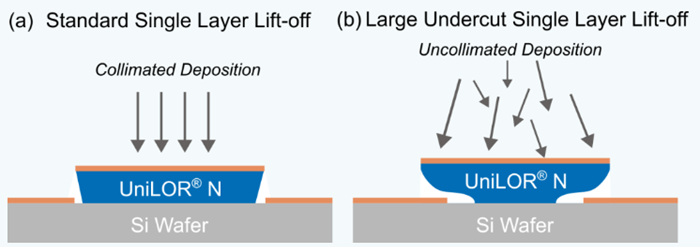
Figure 1. Schematic for (a) typical single-layer lift-off for collimated deposition and (b) large undercut single-layer lift-off for uncollimated deposition. Image Credit: Kayaku Advanced Materials
Processing Conditions
Process changes strongly influence the UniLOR® N 5.0, particularly concerning the undercut profile for thicknesses greater than 5 μm. The soft-bake stage provides the best control of the undercut rate.
During the development stage, elevated soft-bake temperatures will slow the undercut rate, yielding more accurate final undercut width and, in turn, requiring a longer development time. Development time is the primary mechanism for controlling undercut width.
The post-exposure bake (PEB) and exposure dose provide additional options for controlling the undercut width and height. Elevating the PEB temperature, time, or dose will reduce the undercut width and height as the resist essentially crosslinks from the top down.
In this case, a lower-than-normal dose is used to expose the top of the resist, while the bottom remains partially exposed. Figure 2 portrays the undercut profile produced by this. Large undercut process parameters are outlined in Table 1.
Table 1. Typical processing conditions used for large undercut single-layer processing of UniLOR® N 5.0. Source: Kayaku Advanced Materials
| Processing Conditions |
| Coat |
Dispense 1 mL/inch of HMDS-primed Si substrate
1000–2000 rpm for 30 seconds |
| Soft Bake |
Three minutes @ 115 °C |
| Exposure (at 365 nm) |
200 mJ/cm2
Verify dose for the specific tool and filter set-up. |
| Post-Exposure Bake |
Three minutes @120 °C |
| Development |
TMAH-based developer
Time depends on desired undercut |
| Deposition |
Deposit desired material for patterning |
| Removal |
30 minutes in NMP- or DMSO-based remover
Heat to 50 °C and/or sonicate for faster removal |

Figure 2. Undercut profile of UniLOR® N 5.0 when development time is increased from one to two minutes in TMAH developer. Image Credit: Kayaku Advanced Materials
Kayaku Advanced Materials suggests an undercut width-to-height ratio of 2:1 to prevent the resist from being sealed off when deposition occurs. An encapsulated resist can impede or halt removal and can cause defects in the deposited layer.
Kayaku Advanced Materials is available to answer any questions regarding lift-off for specific applications.

This information has been sourced, reviewed, and adapted from materials provided by Kayaku Advanced Materials.
For more information on this source, please visit Kayaku Advanced Materials.