The SU-8 3000CF dry-film resist provides corrosion-resistant protection for radio-frequency (RF) filter packaging, micro-electro-mechanical systems (MEMS), and complex semiconductor packaging.
This article explores how to achieve superior adhesion, low-halogen chemistry, consistent dry-film processing, high-aspect-ratio patterning, and high-accelerated-stress-testing (HAST) reliability for complex microelectronics applications.
Overview
SU-8 3000CF Dry Film Resist (DFR) is an antimony-free, low-halogen formulation created to reduce the production of corrosion-causing chlorine species. This corrosion-free resist facilitates high-aspect-ratio features, such as structural characteristics, capping layers, and cavity walls in MEMS and complex microelectronic systems.
Dry-film processing offers adaptable control of total film thickness using hybrid liquid-resist or dry-film resist, multi-layer or single-layer techniques. To create thicker structures, dry-film layers can be stacked sequentially while maintaining mechanical stability, vertical sidewalls, and resolution.
SU-8 3000CF is provided in dry-film layer thicknesses of 20, 30, and 45 μm.
Application
SU-8 3000CF is ideal for cases where extended reliability, high adhesion, and dimensional precision are crucial. Applications cover microfluidic devices, RF filter cavity packages like bulk acoustic wave (BAW) or surface acoustic wave (SAW), passivation layers, MEMS sensors, and wafer-level packaging.
SU-8 3000CF is engineered to be corrosion-free, making it ideal for applications where components are exposed to corrosive conditions throughout their life cycle.
Key Features
- Three-to-one aspect ratio resolution
- Superb thermal stability up to ~250 °C and low process temperature
- Low halogen and antimony-free formulation
- Verified reliability after HAST
- Minimal water absorption
Corrosion Testing
SU-8 3000CF was handled following the recommended parameters outlined in the HAST Technical Data Sheet on an aluminum (Al)-coated silicon (Si) wafer (Figure 1). This component replicates cavity packaging to test the shielding and corrosion-resistant behavior of SU-8 3000CF.
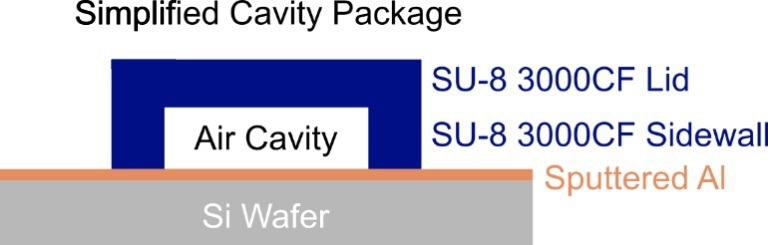
Figure 1. Schematic of simplified cavity package used for corrosion stress testing. Image Credit: Kayaku Advanced Materials
The HAST was performed at 85 °C with 85% relative humidity (RH) for 100 to 1000 hours to model a harsh environment.
The standard SU-8 3000 composition demonstrates corrosion after 100 hours of testing, while the SU-8 3000CF resist endures 1000 hours of testing with no observable delamination or corrosion (Figure 2). The shielded, sealed area shows no signs of contamination in this stress test, as shown upon removal.
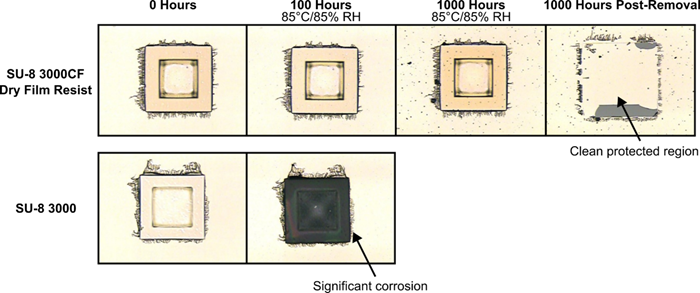
Figure 2. HAST corrosion testing comparison showing SU-8 3000CF dry-film resist maintaining corrosion-free protection for up to 1000 hours, while conventional SU-8 3000 exhibits significant corrosion after 100 hours. Image Credit: Kayaku Advanced Materials
Industrial Relevance
Dry-film resist is typically chosen for applications where thickness control and uniformity are critical. Even when thicker applications require the stacking of multiple dry-film resist (DFR) layers, edge bead thickness variation stays very low, which maximizes usable wafer area for improved yield.1 This is a major benefit for high-volume manufacturing readiness.
The composition of SU-8 3000CF provides packaging protection in environments where corrosion is a challenge, while preserving the uniformity benefits of a dry film. In particular, the protection of acoustic wave filters for RF devices like BAW or SAW filters can be achieved with SU-8 3000CF.2–3
It is also highly effective in microfluidic devices and sensors that are likely to encounter fluids or humidity.4–6 The strong substrate adhesion and high thermal stability of the material enable it to tolerate fluctuating environmental factors for reliable advanced packaging solutions.
References and Further Reading
- Farjana, S., et al. (2021). Dry film photoresist-based microfabrication: A new method to fabricate millimeter-wave waveguide components. Micromachines, 12(3), p.260. DOI:10.3390/mi12030260. https://www.mdpi.com/2072-666x/12/3/260.
- Honda, N., et al. (2017) CS MANTECH Conference. 22-25.
- Liu, X., et al. (2025). A review of wafer-level packaging technology for SAW and BAW filters. Micromachines, 16(3), pp.320–320. DOI:10.3390/mi16030320. https://www.mdpi.com/2072-666x/16/3/320.
- Zhang, Z. and Nawrocki, D. (2025). Enabling fast microfluidic chips fabrication: A practical guideline for microfluidics design and fabrication using photolithography for fast prototyping. Journal of Micromanufacturing. DOI:10.1177/25165984251364687. https://journals.sagepub.com/doi/abs/10.1177/25165984251364687.
- Kubicki, W., Sasowski, M. and Wala, A. (2018). Microfluidic chip for cyclical continuous-flow PCR - Preliminary results of the technology. 2018 XV International Scientific Conference on Optoelectronic and Electronic Sensors (COE), pp.1–3. DOI:10.1109/coe.2018.8435152. https://ieeexplore.ieee.org/document/8435152/.
- Hirata, Y., et al. (2017) IEEE 30th International Conference on MEMS, 13-16.

This information has been sourced, reviewed, and adapted from materials provided by Kayaku Advanced Materials.
For more information on this source, please visit Kayaku Advanced Materials.