Sponsored by TOFWERKReviewed by Olivia FrostNov 18 2026
Controlling airborne molecular contamination (AMC) is fundamental to semiconductor fabrication, especially at cutting-edge technology nodes where trace-level chemical contaminants can affect yield and device performance.

Image Credit: fadil051922/Shutterstock.com
Time-of-flight mass spectrometry (TOFMS) is commonly employed for live AMC surveillance because of its high sensitivity and ability to acquire full mass spectra simultaneously, providing a detailed chemical overview of the atmospheric composition.
Due to the chemical diversity of fabrication settings, precise detection of AMC species is fundamentally reliant on the mass resolving power of the TOF mass analyzer.
Mass Resolving Power in TOFMS
Mass resolving power (R) is expressed as M/ΔM, where M represents the mass-to-charge ratio (m/Q), and ΔM corresponds to the peak’s full width half maximum (FWHM).
This value explains the mass spectrometer’s capability to differentiate ions with narrowly spaced m/Q values. This feature is crucial for separating isobaric compounds, species that have an equivalent nominal mass but vary in elemental makeup, yielding subtle variations in precise m/Q values.
In AMC investigations, complex gas mixtures with chemically overlapping species are often observed. Inadequate resolving power results in improper source attribution, misidentification, and peak overlap.
In a fabrication setting, this can lead to delayed or irrelevant contamination-control responses during excursion events, which directly affects yield and process uptime.
The Effect of Resolving Power: Examples of Isobaric AMC Species
Example 1: Volatile Organic Compounds (VOCs), PGME Versus TMS
Propylene glycol monomethyl ether (PGME) and trimethylsilanol (TMS) are chemically unique AMC compounds arising from distinct sources of contamination: photolithography solvent backgrounds and silicon-derived process chemistry, respectively.
In chemical ionization mass spectrometry (CIMS) using an acetone reagent ion, both compounds emerge at a nominal mass of 149 Th as protonated acetone adducts: C4H10O2·(C3H6OH)+ for PGME and C3H10OSi·(C3H6OH)+ for TMS, having precise m/Q values of 149.1189 Th and 149.0961 Th, respectively.
As illustrated in Figure 1 (left), at R = 1000, these compounds fail to resolve and appear as a single overlapping feature. At an R value of 10,000, they are fully resolved, facilitating precise measurement and identification of each compound individually.
Example 2: Organic Acids, Lactic Acid Versus Oxalic Acid
Oxalic acid (C2H2O4) and lactic acid (C3H6O3) are organic acid AMCs routinely found in cleanroom and industrial settings. In CIMS utilizing an iodide reagent ion, both compounds generate adducts at a nominal m/Q of 217.
The peaks merge at an R value of 1000, while at an R value of 10,000, they are cleanly separated, allowing precise identification of each species and accurate source tracing (Figure 1, right).
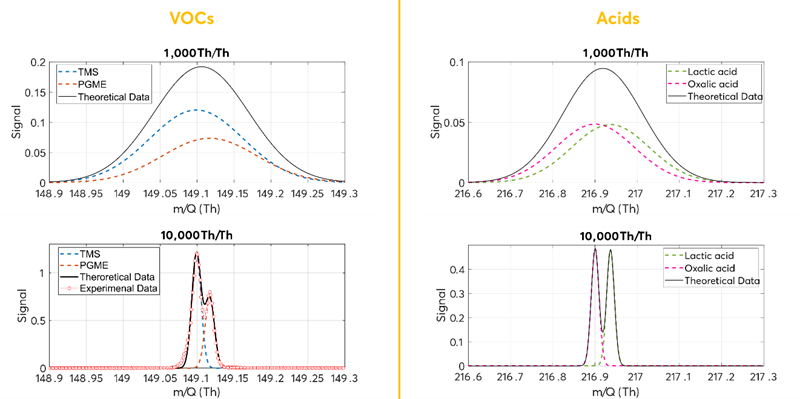
Figure 1. Effect of mass resolving power on the separation of isobaric AMC species. (Left) Trimethylsilanol (TMS, blue) and propylene glycol monomethyl ether (PGME, orange) at R = 1000 (top) and R = 10,000 (bottom). The theoretical combined signal is shown in black, and experimental data at high resolving power is shown as red circles. (Right) Lactic acid (green) and oxalic acid (pink) at R = 1000 (top) and R = 10,000 (bottom). Image Credit: TOFWERK
Choosing Analyzer Resolving Power According to Chemical Matrix Complexity
The necessary mass resolving power for AMC surveillance primarily depends on the chemical diversity in the sampled matrix, particularly the number of chemically unique species coexisting at the point of collection and the extent of isobaric overlap among them.
This is driven by equipment type, process chemistry, and the quantity of unique chemical inputs overlapping in a specific fabrication section.
Air purity is established in ISO 14644-1 cleanroom standards based on the concentration of airborne particles,1 and even though a reduced ISO class generally suggests that the environment is more controlled, it does not reliably predict AMC chemical complexity.2,3
This nuance is especially critical at complex technology nodes, where particles directly emerge from gas-phase precursors: molecular acid gases outgassing from post-processing wafers (such as silicon tetrafluoride (SiF4), hydrogen bromide (HBr), hydrogen chloride (HCl), or hydrogen fluoride (HF) from dry-etched wafers) that interact with base impurities like ammonia (NH3) found within the cleanroom environment to create microscopic salt particles in situ.2
Under these conditions, a strictly regulated particle count can coexist with a chemically diverse gas-phase atmosphere, and particle monitoring alone fails to capture the actual contamination problem.3
Given the instrumentation used for AMC monitoring, cleanroom classification cannot be used directly to define resolving power requirements. Rather, a distinction must be made between chemically diverse environments and chemically simple clean environments at the sampling zone:
- Chemically diverse atmospheres exhibit high spectral congestion. This includes combined tool bays integrating deposition, etch, lithography, and chemical-mechanical planarization (CMP) chemistries, or front-opening unified pod (FOUP) mini-atmospheres gathering compounds from various upstream process steps. Numerous chemically unique compounds have an equal nominal mass, and only resolving capabilities in the range of R ≈ 10,000 provide clear identification and precise measurement.
- Cleaner settings (process sections with reduced chemical complexity, well-defined AMC profiles, or after purging with nitrogen gas (N2)) offer more basic gas-phase matrices with fewer co-eluting compounds. In these environments, moderate resolving power (R value of approximately 1000) can be adequate to characterize and measure the appropriate AMC compounds without substantial isobaric interference.
Conclusion
Mass resolving power is a vital metric in TOFMS-based monitoring of AMCs.
Increased resolving power decreases spectral uncertainty, facilitates the isolation of isobaric compounds, and increases certainty in contaminant detection and source tracing. These features directly lead to quicker, more dependable contamination control actions in semiconductor fabrication settings.
Acknowledgments
Produced from materials originally authored by Priyanka Bansal and Carla Frege from TOFWERK.
References and Further Reading
- ISO (2016). ISO 14644-1:2015. Cleanrooms and associated controlled environments – Part 1: Classification of air cleanliness by particle concentration. International Organization for Standardization. ISO. Available at: https://www.iso.org/standard/53394.html.
- Li, S.-N., et al. (2007). Case study of micro-contamination control. Aerosol and Air Quality Research, 7(3), pp.432–442. doi:10.4209/aaqr.2007.05.0030. https://link.springer.com/article/10.4209/aaqr.2007.05.0030.
- Den, W., et al. (2020). Review–Airborne molecular contamination: Recent developments in the understanding and minimization for advanced semiconductor device manufacturing. ECS Journal of Solid State Science and Technology, 9(6), p.064003. DOI:10.1149/2162-8777/aba080. https://iopscience.iop.org/article/10.1149/2162-8777/aba080/meta.

This information has been sourced, reviewed, and adapted from materials provided by TOFWERK.
For more information on this source, please visit TOFWERK.