Discover modern workflows for targeting, trimming, and alignment, along with practical guidance for reliable ultrathin sectioning across EM, CLEM, polymers, and volume EM.
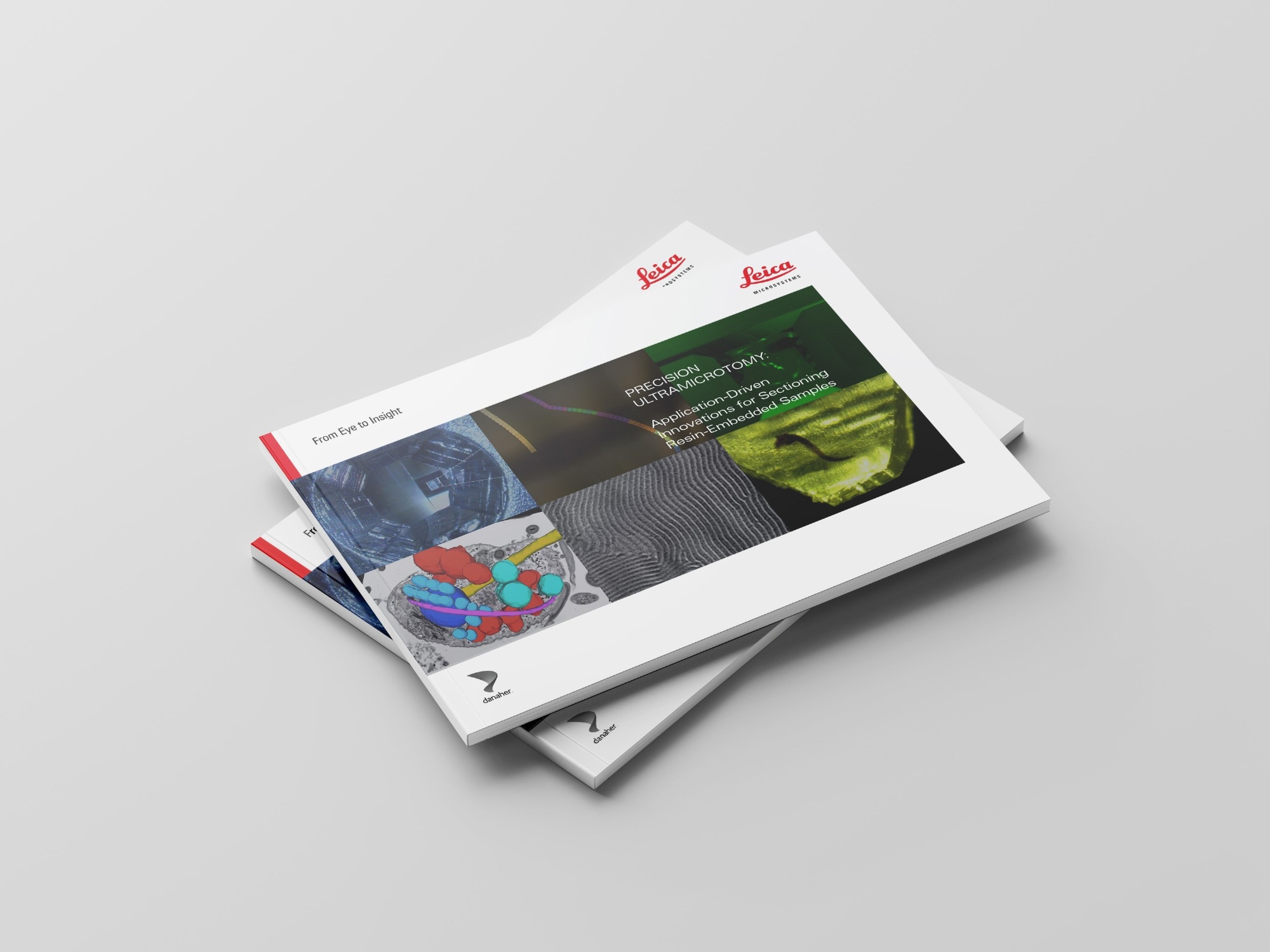
Ultramicrotomy is evolving rapidly, and today’s microscopes demand high-quality sections, precise targeting, and reproducible workflows.
This eBook brings together expert application notes, automated approaches, and practical guidance to help every user, from trainees to advanced microscopists, achieve consistent, reliable ultrathin sections for EM, CLEM, and volume EM workflows.
Get practical workflows, expert insights, and step-by-step guidance to improve your ultramicrotomy results, from targeting and trimming to alignment and advanced EM applications.
What you Will Learn
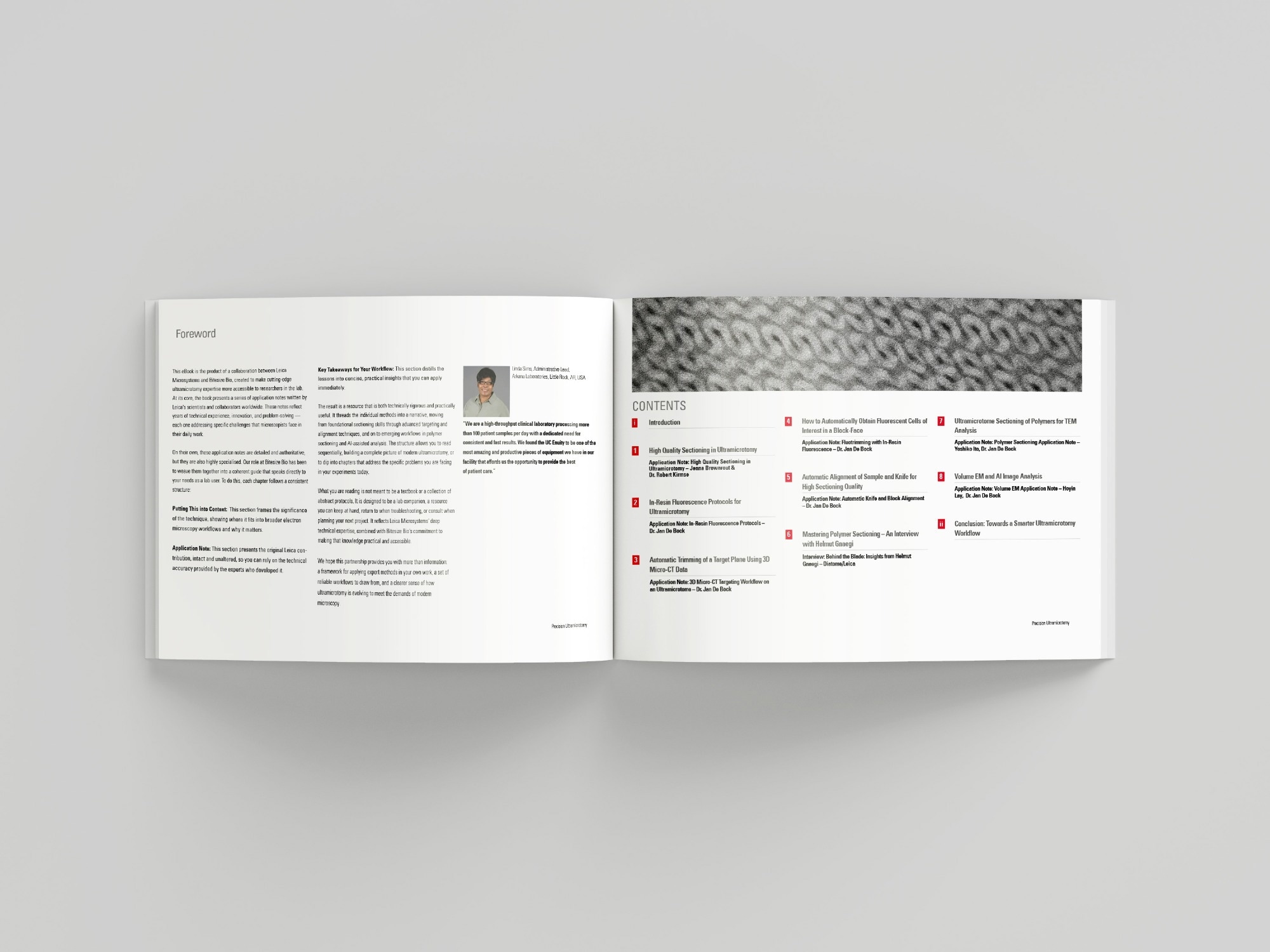
- Produce consistent, high-quality ultrathin sections: The eBook explains how uniform section thickness underpins TEM, SEM, array tomography, and 3D reconstruction. It shows how section thickness correlates with interference colors and how balanced feed and cutting speed help generate stable, clean ribbons.
- Target labeled or hidden structures with confidence: Readers learn two modern strategies for reaching regions of interest: in-resin fluorescence for visualizing labeled cells directly in the block face and micro-CT for mapping buried structures before trimming begins. These methods reduce guesswork and help expose targets efficiently.
- Streamline workflows through guided trimming and alignment: The eBook highlights how guided trimming routines and camera-supported alignment help users prepare reproducible block faces and achieve reliable knife-to-sample geometry. This reduces variability and makes sectioning more accessible for new and occasional users.
- Apply ultramicrotomy across biology, materials science, and volume EM: The eBook provides practical examples showing how precise trimming, alignment, and sectioning can be applied across diverse samples and imaging goals, including fluorescence-guided CLEM workflows, polymer sectioning, and serial sectioning for volume EM.
- Build skills progressively with structured, real-world guidance: Each chapter follows a clear sequence of context, application note, and workflow takeaways, making it easier to adopt new techniques step by step, whether you are trimming toward a fluorescent target or preparing delicate polymers for cryo-sectioning.

This information has been sourced, reviewed, and adapted from materials provided by Leica Microsystems GmbH.
For more information on this source, please visit Leica Microsystems GmbH.