Under the motto “Science meets industry”, the analytica conference covers the broad spectrum of analytical chemistry and bioanalytics. From March 24 to 26, researchers from all over the world will present their latest findings in Munich, at the same time as analytica, the world’s leading trade fair for laboratory technology, analysis and biotechnology.
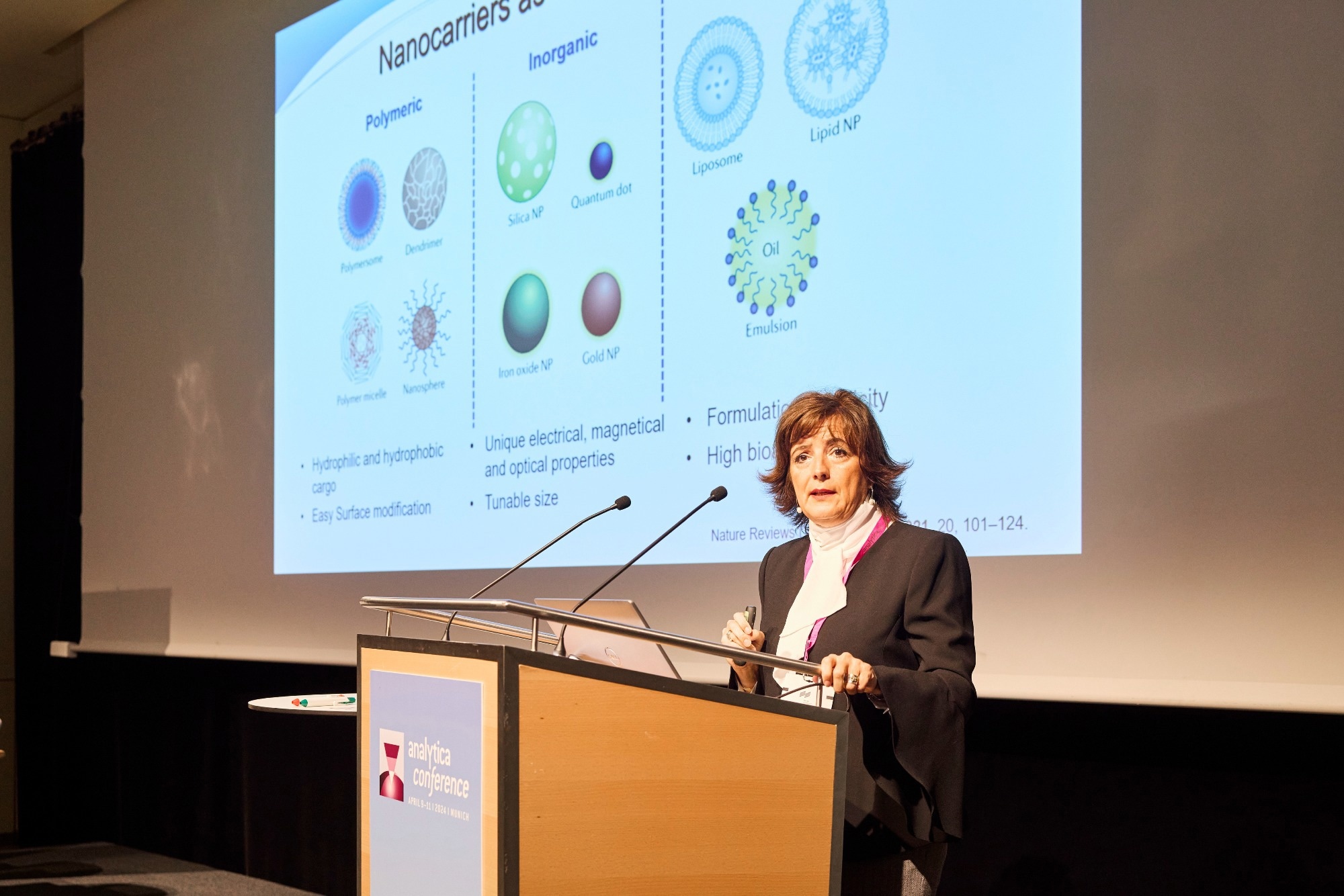
At the analytica conference, renowned speakers from around the world will give presentations on the entire spectrum of analytics and the industry's top topics.
Image Credit: Messe München GmbH
With around 190 lectures in 45 sessions, award ceremonies and a poster show, the analytica conference provides information on new developments and trends in the analytical sciences. Digitalization is a recurring theme throughout the program, this year with the notable addition of AI methods. “The progress is remarkable, and the industry is looking forward to the update,” says Susanne Grödl, analytica Exhibition Director, adding: “The analytica conference combines scientific expertise with practical knowledge, thus accelerating the transfer from research to application.”
More AI in the lab?
The “Digital analytical sciences” (March 25, 9:30–11:30) and “The next generation (analytical) laboratory” (March 26, 9:30–11:30) sessions, for example, clearly show that autonomous laboratories have long since ceased to merely be a bold vision. That is also a challenge, as throughput and the flood of data are constantly growing in the face of increasing digitalization and automation. How can the volume of information be managed, evaluated and protected against external attacks? Questions like these will be answered in the lecture series “Laboratory data – the hidden treasure” (March 24, 12:30–14:30), “Use cases in data science” (March 26, 12:30–14:30) and “Open source and data security” (March 26, 15:00–17:00). The latter will provide a special insight: Niklas Beierl from Attacking-Lab, a company focusing on cybersecurity, will look at digital sovereignty from a hacker’s perspective.
Food laboratories are also undergoing change. In the “Food analysis and science supported by AI and digital innovations” session (March 24, 9:30–11:30), Prof. Christian Krupitzer from the University of Hohenheim will explain the benefits of digital food twins. Prof. Katharina Scherf from the Leibniz Institute for Food Systems Biology in Freising, will, in turn, describe how proteomics methods predict the baking quality of wheat. ?
When it comes to nutrition, the analytica conference already has a lot to offer: from fat analysis in archaeological food remains to microplastics in drinking water and the botanical origin analysis of honey. Even unknown ingredients that cannot be searched for specifically can now be characterized. British chemist Dr. James Marshall from the food company Mars will be focusing on non-target analysis in the “Behind foodomics” session (March 24, 12:30–14:30).
In the service of health
Refined analytical methods are also essential for detecting diseases at an early stage. Clinical mass spectrometry (March 25, 12:30–14:30), for example, helps with newborn screening, while flow cytometry provides an accurate diagnosis of leukemia (March 26, 15:00–17:00). Modern bioanalytics also decodes our metabolism. Under the heading “Metabolomics/Lipidomics” (March 26, 9:30–17:00), researchers from China, Germany, Great Britain, Austria, Poland, Spain and Switzerland will present their findings. Prof. Víctor González-Ruiz from the CEU San Pablo University in Madrid will explain the connection between metabolic products and infertility.
The sessions by the Society for Toxicological and Forensic Chemistry (March 25, 09:30–17:00) will be particularly exciting. They will deal, among other things, with detecting lethal doses of insulin, the opioid situation in Europe, and nitazene, designer opioids that are 500 times more potent than morphine.
There will also be news on special methods in instrumental analysis, such as chromatography (March 24, 10:00-17:00) and spectroscopy (March 26, 12.30–17:00), as well as a series on the green laboratory of the future (March 25, 15:00–17:00) and a host of other lectures providing inspiration for daily work in research or routine labs.
The diversity and high scientific standard of the lectures are thanks to the three professional societies responsible for organizing the program: the German Chemical Society (GDCh), the Society for Biochemistry and Molecular Biology (GBM), and the German Society for Clinical Chemistry and Laboratory Medicine (DGKL). A conference planner is available at www.gdch.de/analyticaconf2026