Smaller particles are harder to measure and can pose greater biological risks. Fine and ultrafine airborne particles can penetrate deep into the lungs, and some can reach the bloodstream. Understanding their chemistry demands spatial resolution, sensitivity and accurate targeting.
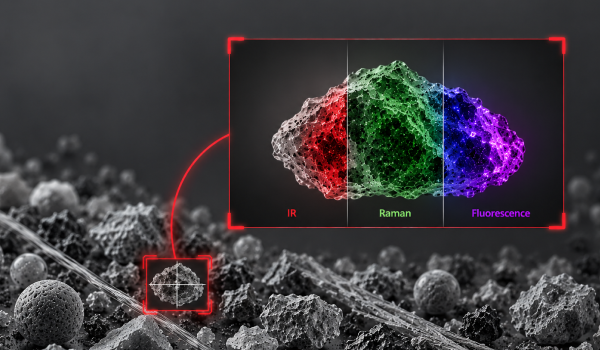
Join Prof. Andrew Ault of Uni of Michigan and Dr. Mustafa Kansiz of Photothermal Spectroscopy Corp to explore particle characterization with submicron IR (Optical Photothermal Infrared, O-PTIR) spectroscopy, simultaneous Raman and co-located fluorescence, from micro-nanoplastics and aerosols down to particles a few hundred nanometers across.
Register now
Dr. Kansiz will introduce O-PTIR and high-speed laser scanning, focusing on micro-nanoplastics and pharmaceutical particulates. He will preview LasIRScan™ laser-guided particle localization, which rapidly refines each measurement position immediately before spectral acquisition. By compensating for registration errors, stage inaccuracies and drift, it delivers more consistent spectra, demonstrated on 275 nm particles, significantly improving successful chemical identification.
Prof. Ault will present research on atmospheric aerosols, bioaerosols and microplastic characterization, showing how complementary measurements reveal particle chemistry - including O-PTIR analysis when fluorescence obscures Raman spectra.
What you will Learn
- How submicron IR, Raman and fluorescence provide complementary particle information.
- Why precise localization is critical for submicron particles and extended measurement runs.
Can’t attend live? Register anyway to receive access to the recording.
See you there on Thursday, November 12, 2026.
Guest Speaker:
Andrew P. Ault, University of Michigan
Host:
Dr. Mustafa Kansiz, Photothermal Spectroscopy Corp
Register now