Carbon is among the most versatile elements, and two of its most remarkable forms - graphite and graphene - are transforming industries across the globe. Although they share the same fundamental structure, their differences give rise to distinct properties and applications.
This article explores what sets each material apart, their unique advantages, and the ways they are shaping modern technology.
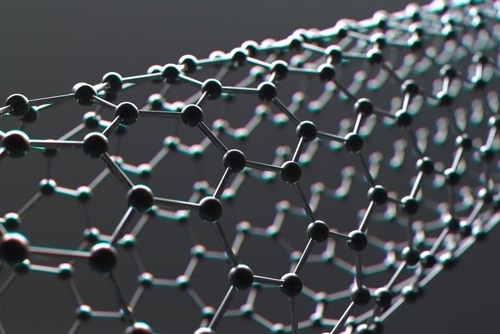
Image Credit: Dabarti CGI/Shutterstock.com
Graphite: A Trusted Performer
Graphite is a naturally occurring form of carbon composed of carbon atom layers stacked on top of each other. These layers are loosely bonded, allowing them to slide past one another and giving graphite its characteristic slippery texture. This layered structure provides graphite with its exceptional thermal and electrical conductivity, as well as its stability at elevated temperatures.
Practical Uses and Advantages
Graphite is commonly employed for thermal management in electronics and industrial systems.
With a thermal conductivity of up to 2000 W/m·K along its layers, it efficiently transfers heat away from components in devices such as heat sinks and thermal pads. It is also an excellent electrical conductor, with a conductivity of approximately 2.5 × 10⁴ S/m, making it a critical material in batteries and fuel cells.
Due to its ability to endure temperatures up to 3000 °C in inert atmospheres, graphite is also utilized in high-temperature applications, including industrial furnaces and heat-resistant coatings (Pierson, 1993).
Its role in energy storage is just as valuable. As the primary anode material in lithium-ion batteries, graphite provides a theoretical specific capacity of 372 mAh/g, making it a dependable and affordable option for powering devices.
Graphene: A Material of the Future
Graphene is a single layer of carbon atoms arranged in a hexagonal pattern. This ultra-thin structure is responsible for its remarkable characteristics, including considerable strength, versatility, and conductivity. Since its discovery in 2004, graphene has been at the center of technological innovations across numerous sectors.
Key Benefits and Applications
Graphene is one of the strongest known materials, with a tensile strength of 130 GPa - around 200 times stronger than steel by weight. Despite its toughness, it remains significantly lightweight and versatile, making it optimal for a variety of sophisticated applications.
It also exhibits excellent electrical conductivity, reaching up to 108 S/m, making it an ideal candidate for high-speed transistors, versatile electronics, and ultra-thin conductive coatings.
Graphene’s thermal conductivity is equally remarkable at ~5000 W/m·K, making it one of the best heat-conducting materials on the market. This feature is especially important for cutting-edge cooling solutions in electronics.
Another unique property is its transparency. Graphene absorbs just 2.3 % of visible light, making it an outstanding choice for touchscreens, flexible displays, and even solar cells.
Graphene also excels in energy storage. Graphene-based supercapacitors have demonstrated energy densities of 85.6 Wh/kg, offering the potential for faster-charging, longer-lasting power sources.
In medicine, researchers are also exploring graphene’s biocompatibility and electrical properties for applications such as biosensors, drug administration, and regenerative medicine.
Graphite vs. Graphene: A Side-by-Side Comparison
Although graphite and graphene share the same underlying carbon structure, their properties differ dramatically. Graphite is a bulk material composed of many stacked layers, while graphene consists of just a single atomic layer. This structural distinction gives graphene exceptional strength, conductivity, and flexibility, whereas graphite remains the more practical and cost-effective choice for large-scale applications.
Source: Materials Direct
| Property |
Graphite |
Graphene |
| Structure |
Multiple Layers of carbon atoms |
Single layer of carbon atoms |
Thermal
Conductivity |
Up to 2000 W/m·K (basal plane) |
~5,000 W/m·K |
| Electrical Conductivity |
2.5 × 10⁴ S/m |
Up to 108 S/m |
Mechanical
Strength |
Moderate
(brittle in bulk form) |
130 GPa (extremely strong) |
| Transparency |
Opaque |
Nearly transparent (2.3 % absorption) |
| Flexibility |
Rigid in bulk form |
Highly flexible |
Why Graphite Still Matters
Despite graphene’s rising popularity, graphite continues to play a crucial role in various sectors. It is cost-effective, abundant, and easy to produce, making it the optimal choice for thermal management, energy storage, and industrial applications. Its resistance to extreme heat and chemical degradation ensures its continued importance across numerous industries for years to come.
The Future of Graphene
From ultra-efficient electronics to next-generation medical devices, graphene has the potential to reshape technology. However, its widespread adoption remains limited by challenges in large-scale manufacturing and cost reduction. As research advances, graphene could break new ground that redefines industries and improves everyday products.
Conclusion
Although both graphite and graphene consist of the same element, they serve very different purposes. Graphite’s reliability and cost-effectiveness make it indispensable for today’s technologies, while graphene’s innovative features pave the way for exciting new advancements.
Together, these two materials are transforming the future of science and industry, demonstrating that even the most common elements can have remarkable potential.
Acknowledgments
Produced from materials originally authored by James Stratford, Technical Director, Universal Science and Materials Direct.
References and Further Reading:
- Zhang, X., et al. (2018). Current development of materials science and engineering towards epidermal sensors. https://doi.org/10.1016/j.pmatsci.2022.100962
- Geim, A. K., & Novoselov, K. S. (2007). The rise of graphene. Nature Materials. (online) Available at: https://www.nature.com/articles/nmat1849
- Pierson, H. HANDBOOK OF CARBON, GRAPHITE, DIAMOND AND FULLERENES Properties, Processing and Applications. (online) Available at: https://chemistlibrary.wordpress.com/wp-content/uploads/2015/05/handbook-of-carbon-graphite-diamond-and-fullerenes-1993-pierson.pdf.
- Goodenough, J.B. and Kim, Y. (2010). Challenges for Rechargeable Li Batteries†. Chemistry of Materials, 22(3), pp.587–603. https://doi.org/10.1021/cm901452z.
- Lee, C., et al. (2008). Measurement of the Elastic Properties and Intrinsic Strength of Monolayer Graphene. Science. (online) Available at: https://www.science.org/doi/10.1126/science.1157996
- Novoselov, K. S., et al. (2012). A roadmap for graphene. Nature. (online) Available at: https://www.nature.com/articles/nature11458
- Balandin, A. A., et al. (2008). Superior Thermal Conductivity of Single-Layer Graphene. Nano Letters 8, 3, 902-907. (online) Available at: https://pubs.acs.org/doi/10.1021/nl0731872
- Nair, R. R., et al. (2008). Fine Structure Constant Defines Visual Transparency of Graphene. Science. (online) Available at: https://www.science.org/doi/10.1126/science.1156965
- Stoller, M. D., et al. (2008). Graphene-based ultracapacitors. Nano Letters 8, 11. (online) Available at: https://pubs.acs.org/doi/10.1021/nl802558y

This information has been sourced, reviewed and adapted from materials provided by Materials Direct.
For more information on this source, please visit Materials Direct .