Sea urchin spines show how gradient porous materials can convert motion into electrical signals.
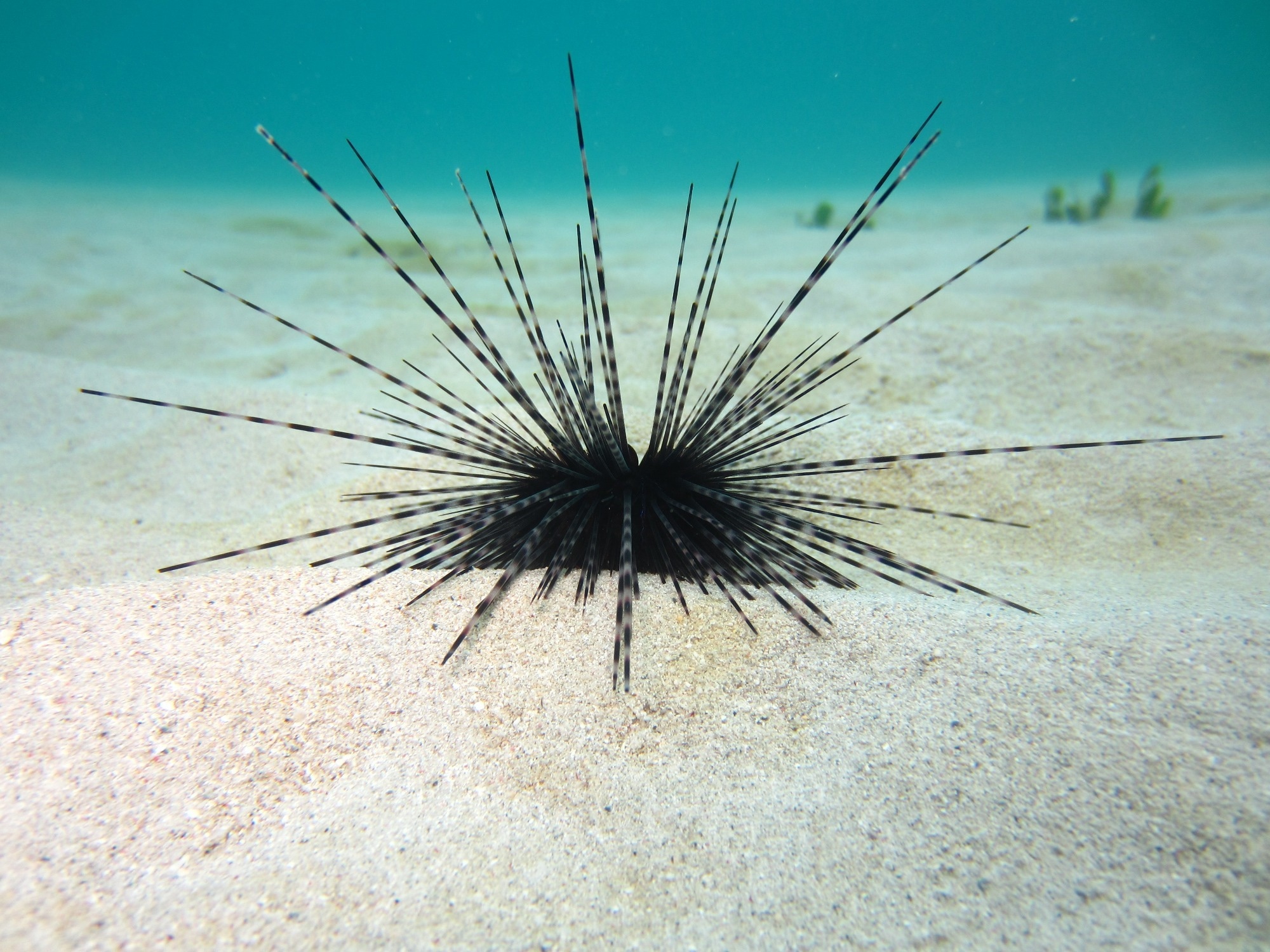
Study: Echinoderm stereom gradient structures enable mechanoelectrical perception. Image Credit: SvenG83/Shutterstock.com
A Nature study reports that the biomineralized spines of the long-spined sea urchin Diadema setosum can generate measurable electrical signals when struck by droplets or exposed to flowing seawater.
This fast mechanoelectrical response is linked to the spine’s gradient “stereom” cellular architecture rather than nerves or living cells.
Saving this for later? Download a PDF here.
Stereom is the borous, foam-like calcium carbonate material that sea urchin spines are made of, a common feature in echinoderms.
In D. setosum, the stereom changes gradually along the spine’s [001] direction, combining an interconnected porous network with hollow channels and a dense outer layer.
That continuous gradient changes how water moves through and around the structure and how electrical charge builds up at the solid-liquid interface.
Fast Motion and Fast Electrical Response
The team examined spines measuring 5-8 cm in length with a spike-like shape. In situ, a seawater droplet striking near the tip triggered a rotation of about 10° at the apex within one second, with a measured response time of around 88 milliseconds.
To capture the electrical signal, the researchers connected conductive electrodes at two locations along the spine (including apex and base) and recorded voltage differences during controlled stimuli, including droplet application and continuous seawater flow.
The strongest signals occurred during droplet impact in air, when spines generated peak electrical potentials up to 116 mV, then rapidly returned to baseline after the stimulus ended.
Underwater, during continuous seawater flow stimulation, the response was smaller but still clear: transient signals with peak potentials around ~30 mV were recorded from submerged spines.
These droplet-response potentials were similar in both live and dead spines, supporting the conclusion that the effect does not depend on living tissue or neural activity.
What Generates the Voltage?
The paper ties the signals to streaming potentials – voltages produced when fluid moves through or across a charged, porous solid.
Electric double layer (EDL) physics drives this: ions accumulate near the mineral surface, and flow can shear or compress that ion layer, producing a measurable voltage difference between two points.
The spine’s gradient structure seems to amplify the effect. Near the apex, smaller void-phase diameters and higher specific surface area can increase local flow velocity and pressure differences, strengthening EDL distortion and boosting charge interactions at the interface.
The paper also notes that seawater’s higher ionic strength compacts the EDL, influencing charge mobility compared with lower-ionic-strength conditions, which is an important detail when interpreting the underwater signal levels.
Sea Urchin-Inspired Hardware
With this behavior evaluated, the researchers built 3D-printed, spine-like gradient lattice structures inspired by the stereom geometry.
In tests, the bio-inspired gradient designs produced roughly ~3× higher voltage output and ~8× greater amplitude differential than comparable gradient-free samples.
They then demonstrated a 3×3 underwater “metamaterial mechanoreceptor” array capable of mapping the location of a flow impact and tracking time-resolved signals. This was shown using directed (including randomised) water injection in the experimental setup, without relying on conventional external sensors.
Looking Forward with Biodesign
The work links a specific biological architecture, a functionally graded porous mineral, to measurable mechanoelectrical sensing.
This combination could inform design strategies for underwater monitoring, soft robotics, and self-powered sensing, where converting mechanical disturbances into electrical signals is valuable.
It strengthens the case for gradient cellular solids as more than lightweight structural materials. Here, geometry tunes both mechanics and electrokinetic response.
Journal Reference
Chen, A. et al. (2026). Echinoderm stereom gradient structures enable mechanoelectrical perception. Nature. DOI: 10.1038/s41586-026-10164-9
Disclaimer: The views expressed here are those of the author expressed in their private capacity and do not necessarily represent the views of AZoM.com Limited T/A AZoNetwork the owner and operator of this website. This disclaimer forms part of the Terms and conditions of use of this website.