In scientific practice, tools alone are never enough. What distinguishes raw measurements from actionable understanding is perception; forethought in experimental design, discipline in data interpretation, and a willingness to question what you think you see.
Thermo Fisher Scientific has developed the Materials Science Learning Center (MSLC), an expertly curated platform designed to support your journey from measurement to meaningful understanding. Whether your concern is microstructure, surface chemistry, composition, or failure analysis, the MSLC offers a comprehensive library of resources to help you master material characterization and accelerate your breakthroughs.
Below, we highlight the four major sections of the MSLC platform, each offering a different avenue into materials science mastery.
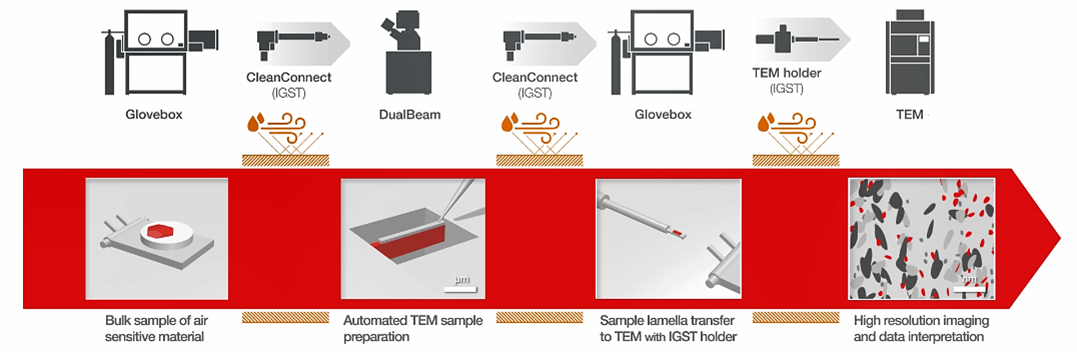
Thermo Fisher Inert Gas Transfer System. Image Credit: Thermo Fisher Scientific - Electron Microscopy Solutions
A Peek into Real Stories and Real Progress
One of the most compelling parts of the MSLC is its collection of interviews and podcasts with researchers, industry leaders, and Thermo Fisher Scientific experts. These conversations reveal how advanced analytical tools have shaped real scientific progress from battery research and nanomaterials to environmental and industrial applications.
Rather than relying on abstract case studies, these firsthand accounts explain how complex challenges were confronted, how methods evolved, and how dedicated experimentation led to breakthroughs. They offer practical insight into how the global materials science community approaches problem-solving and continues to advance the field.
Webinars for Dialogue, Depth, and Methods
For deeper learning, MSLC’s webinars provide structured, methodical explorations of key materials characterization techniques, from battery research workflows to advanced microscopy and spectroscopy.
These sessions clarify why specific methods are chosen, what constraints to anticipate, and how sample-preparation or environmental factors can shape results. They are a practical way for researchers and engineers to strengthen their technical competence and proactively address analytical challenges.
Webinars span a wide range of analytical needs, from particle analysis with SEM in battery and additive manufacturing workflows to steel-inclusion characterization, cryo-EM diagnostics for next-generation batteries, advanced FIB-SEM tomography, and “damage-free” TEM specimen preparation.
Moreover, surface-analysis sessions walk through XPS instrumentation, software workflows, and combined SEM-XPS strategies for efficient, multi-technique characterization.
Resources on Materials Characterization and Analysis: Focused Guidance When it Matters
The MSLC Resources section provides a growing library of eBooks designed to spark curiosity and deepen practical understanding in key areas of materials characterization. Each title focuses on a specific workflow or application challenge, providing accessible explanations and method-selection guidance grounded in real laboratory experience.
Available eBooks explore a broad range of topics, including nanoparticle imaging and analysis, integrated SEM-EDS workflows, advanced mineral-processing characterization, and methods for maintaining quality control by translating raw data into actionable answers.
Additional volumes address battery-materials analysis and correlative approaches that combine microscopy and surface spectroscopy to yield richer insights.
These resources help you evaluate which technique to use, how to prepare samples appropriately, and how to interpret results with confidence, all of which means you will be better equipped to make informed decisions at every step, from experiment planning through analysis.
Particle Analysis Learning Center: Where Small Details Matter
In many industries and research areas, particle characteristics (size, shape, composition, and distribution) are critical to product performance, quality control, and regulatory compliance. The Particle Analysis Learning Center within the MSLC is dedicated to those needs.
Here, you will find articles, eBooks, and webinars focused on particle analysis applications, ranging from mineral processing and additive manufacturing powders to battery quality control, automotive industry cleanliness standards, and forensic workflows such as gunshot residue (GSR) analysis.
Of particular note is how particle analysis benefits from electron microscopy combined with elemental analysis (e.g., SEM-EDS), enabling detailed information on morphology and composition at the individual-particle level.
To support real-world workflows, the Particle Analysis Learning Center also highlights software solutions, such as integrated SEM-EDS analysis tools, that enable automated, standardized, recipe-based workflows for tasks like quality control, contamination detection, and inclusion analysis.
In short, by carefully examining even the smallest details, you can uncover essential insights to ensure consistency, compliance, and confidence in quality-critical environments.
Connecting Resources, Experts, and Community: Your Access to Support and Insight
Beyond curated content, the MSLC also makes it easy to connect with technical support, experts, and community discussions. Through the site, you’ll find links to contact Thermo Fisher Scientific specialists for tailored advice; guidance that helps you align instrumentation choices, workflows, and analytical strategies to your project’s demands.
In addition, the MSLC links to blogs and social media channels, including Thermo Fisher Scientific’s X feed, which offers ongoing updates, thought leadership, and peer insights.
MSLC Supports Data to Discovery
In materials science precision instruments are essential – but their true value can only be realized when they are applied with context and purpose.
The Materials Science Learning Center supports that journey by offering practical guidance on when and how to use specific analytical techniques and on interpreting results rigorously.
Through its library of application notes, case studies, white papers, eBooks, and technical videos, the MSLC connects you to the collective expertise needed to move beyond raw measurement, helping researchers analyze particles, probe surfaces, understand microstructures, and design workflows that produce reliable conclusions.
However, please note that the resources in the Materials Science Learning Center are intended for research use and not for diagnostic procedures.
If you’re ready to expand the impact of your materials analysis, the MSLC is here to support every step of the process. Contact a member of our team today and get started!
This information has been sourced, reviewed, and adapted from materials provided by Thermo Fisher Scientific – Electron Microscopy Solutions North America.
For more information on this source, please visit Thermo Fisher Scientific – Electron Microscopy Solutions North America.