A four-sample European study shows why finding rare earth elements in mining waste is only the first step toward building a viable secondary supply.
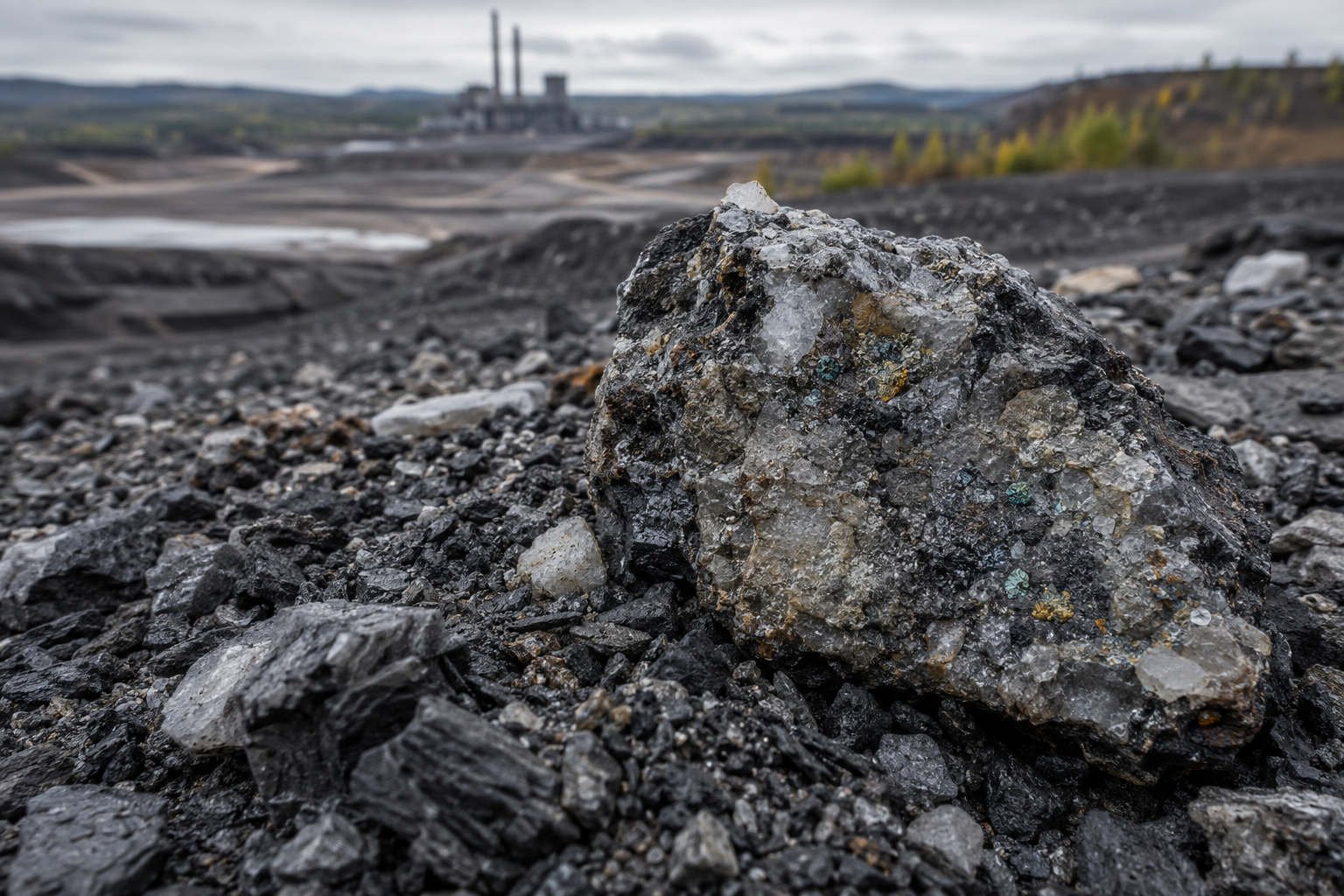
Paper: Recovery of rare earth elements from European coal mining waste. Image credit: AI-generated image created using ChatGPT/OpenAI
A recent study accepted for publication in the journal Scientific Reports and available online as an unedited 'Article in Press' investigates the potential of European coal mining waste as a secondary source of rare earth elements (REEs). The researchers evaluated the abundance of REEs in four fine coal-waste samples from three European mining regions and examined their recoverability in one Spanish sample. The study provides valuable insights into the technical challenges of recovering critical raw materials from coal waste and their potential role in circular economy strategies.
European Coal Waste Contains Rare Earth Elements, but Recovery Remains Difficult
Rare earth elements (REEs) are essential for technologies ranging from electric vehicles and wind turbines to advanced electronics and defense systems. However, global REE production remains concentrated in a few countries, making supply chains vulnerable to disruption. To reduce this dependence, researchers are exploring alternative sources that can supplement conventional mining while supporting circular economy goals.
Coal mining waste has emerged as a potential low-grade secondary source. Coal preparation plants generate large volumes of fine waste that remain stored in ponds and waste dumps across many former and active mining regions. Instead of treating these materials solely as environmental liabilities, researchers are investigating whether they contain economically valuable critical minerals.
Previous studies have identified significant REE enrichment in coal combustion products such as fly ash, where combustion concentrates mineral-bound elements. This study instead examines untreated coal mining waste in Europe, for which concentration data alone cannot establish recoverability. Moreover, many studies quantify REE concentrations without examining whether conventional processing technologies can recover them efficiently.
This study addresses those gaps by evaluating fine coal waste from Spain, Poland, and Slovenia. In addition to measuring REE concentrations, the researchers assessed the market-weighted REE profiles of the samples and, using the La Matona sample, tested conventional physical mineral separation (also known as beneficiation) and leaching techniques, and investigated how REEs occur within the mineral matrix.
Evaluating Recovery Pathways
The researchers analyzed four case-study coal waste samples collected from three European mining regions. Two originated from Spanish hard-coal operations, while the remaining samples came from a Polish hard-coal mine and a Slovenian lignite mine. After drying and homogenization, each sample was separated into different particle-size fractions to determine whether REEs preferentially accumulated within specific size ranges.
The team quantified individual REEs using ICP-based trace-element procedures and fusion XRF for REE oxides. They also calculated rare earth oxide (REO) basket prices, which weight the proportion of each rare earth oxide within the total oxide assemblage by its market price. This approach provides a measure of compositional attractiveness rather than recoverable revenue because it does not account for bulk grade, recovery, product purity, processing costs, or price volatility. High-value oxides of elements such as terbium, dysprosium, scandium, and lutetium can contribute disproportionately to the calculated value.
Among the four samples, the La Matona waste from Spain contained the highest REE concentration and provided sufficient material for detailed laboratory testing. The researchers therefore selected it for beneficiation experiments that included gravity, magnetic, electrostatic, and froth flotation separation to evaluate the effectiveness of conventional mineral processing.
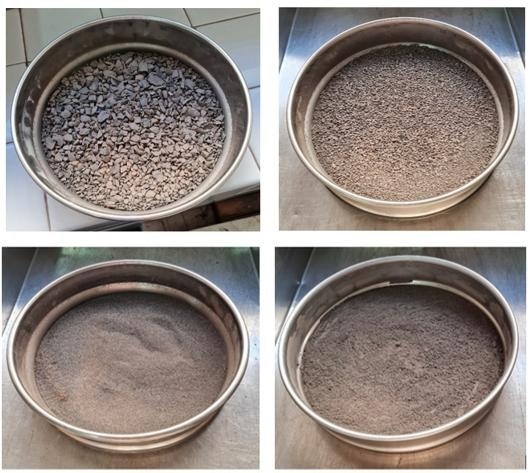
Granulometric fractions of the La Matona sample: >2.0 mm (top left), 2.0–0.5 mm (top right), 0.1–0.5 mm (bottom left), and <0.1 mm (bottom right).
Assessing the Recovery Potential of Coal Waste
Chemical analysis showed that all four coal waste samples contained measurable REE concentrations, ranging from approximately 160 to 222 ppm. The La Matona sample exhibited the highest concentration (221.89 ppm), followed closely by the Slovenian and Polish materials. The researchers also found that REEs generally showed only modest variation across different particle-size fractions, indicating that size classification alone would provide little enrichment. The Slovenian material was the main exception, with a lower REE concentration in its finest fraction.
The basket price analysis offered a different perspective on resource quality. The Polish and Slovenian samples had higher calculated basket prices because scandium and yttrium accounted for more than 24% of their REO assemblages, while individual high-priced heavy rare earth oxides also influenced the weighting. This finding highlights that compositional attractiveness depends not only on total REE concentration but also on elemental composition. Conventional beneficiation techniques, when applied to La Matona, proved largely ineffective; gravity, magnetic, electrostatic, and flotation separation produced only minimal REE enrichment.
For La Matona, XRD identified quartz, muscovite, kaolinite, chlorite, and calcite as the dominant minerals, while SEM-EDS detected localized REE-bearing areas. The authors interpreted these results as indicating that the REEs were likely present as fine inclusions, coatings, or intergrowths within quartz- and aluminosilicate-rich particles. The inferred textural association of REEs with the surrounding mineral matrix likely helps explain both the limited physical concentration and weak chemical extraction under the tested conditions. Exploratory leaching of fine La Matona material produced negligible or very low REE dissolution with distilled water and 1 N acetic acid. Although 1 N hydrochloric acid at 60 °C produced the largest increase, dissolved concentrations remained in the parts-per-billion range and were insufficient for a practical recovery route.
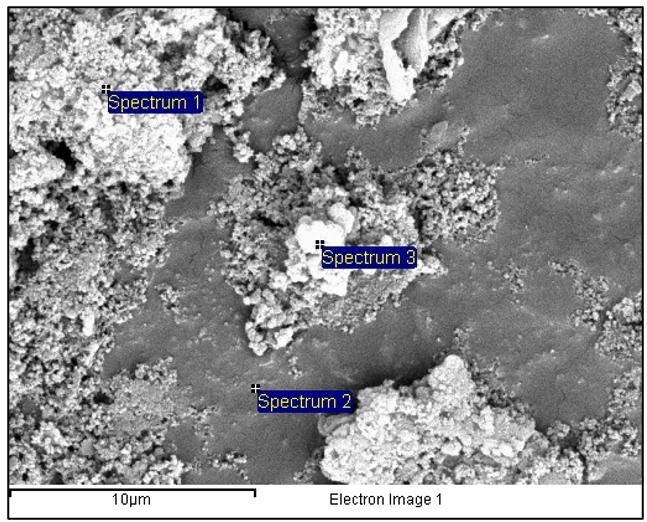
Scanning electron microscopy (SEM) image of the La Matona sample.
Implications for Critical Raw Material Recovery
The study demonstrates that the four sampled European coal mining waste materials contain measurable REE concentrations, supporting their consideration in inventories of potential secondary critical raw material resources. However, the results also show that resource viability depends on far more than elemental concentration. For La Matona, mineralogical occurrence, liberation characteristics, and processing behavior limited the prospect of economically viable recovery under the tested conditions.
Many existing waste deposits are environmentally problematic, potentially creating opportunities to combine selective metal recovery with waste remediation, land rehabilitation, and the production of secondary construction materials. Future research should focus on more advanced extraction technologies, including stronger mineral-acid treatments, alkaline digestion, salt-assisted roasting, thermal activation, pressure leaching, bioleaching, and improved mineral liberation strategies. However, these processes must remain both economically and environmentally sustainable, since excessive reagent consumption or secondary waste generation could offset the benefits of recovering critical minerals from mining residues.
Overall, the study provides a case study of four European coal-mining waste samples as potential secondary REE sources. By integrating regional resource characterization with beneficiation experiments, leaching studies, and mineralogical analysis of La Matona, it illustrates an approach for evaluating similar waste streams. Detailed processing was limited to one Spanish sample, so the recovery findings cannot be extrapolated across the three regions. The study did not assess deposit tonnage, spatial variability, product purity, or full economic and environmental performance. As a result, it could not establish commercial viability. The authors caution that the studied wastes should not be treated as substitutes for primary rare earth ores, although integrated waste-reprocessing projects could contribute to future resource diversification strategies. They may also support mine rehabilitation and Europe's transition toward a more circular and resilient critical raw materials supply chain.
Disclaimer: The views expressed here are those of the author expressed in their private capacity and do not necessarily represent the views of AZoM.com Limited T/A AZoNetwork the owner and operator of this website. This disclaimer forms part of the Terms and conditions of use of this website.