OkyayTechALD specializes in the provision of custom and lab-scale Atomic Layer Deposition (ALD) systems designed to meet an array of advanced research and application-specific challenges.
The company recently conducted a unique in-house study in response to an increasingly prevalent question: whether ALD can be used to coat the inner walls of extremely long metal tubes (up to 8 meters) while maintaining excellent reliability and high coating uniformity.
This challenge initially arose in the context of parabolic trough solar thermal power plants, which must transport heat transfer oil to power megawatt-scale turbines via 4 to 8-meter-long tubes (generally around 5 cm in diameter).
Routine operating temperatures within these tubes can reach up to 350 °C to 400 °C, with surface peaks as high as 450 °C when the tubes are exposed to concentrated solar input.
Ions from the high-temperature working fluid start to diffuse into the steel walls over time, eventually causing the tube’s structural integrity to be compromised. This thermal degradation results in unplanned shutdowns, significant energy loss, and costly repairs.
The industry sought a cost-effective solution to mitigate this issue for a long time.
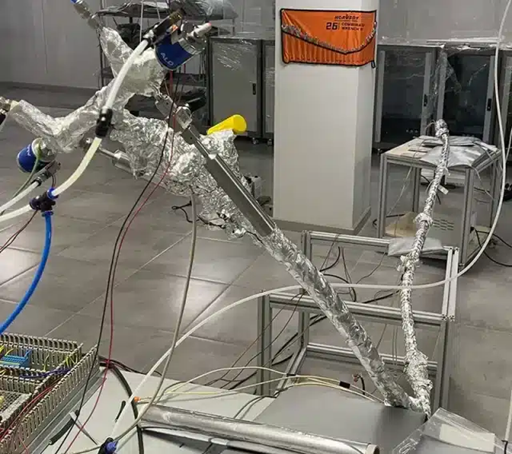
Image Credit: OkyayTech ALD
Advantages of ALD Diffusion Barriers
Atomic Layer Deposition offers a clear advantage when it comes to creating conformal, pinhole-free coatings at the nanometer scale, making it especially well-suited for mitigating ion diffusion.
Al2O3 (aluminum oxide) is especially well-studied as an ALD material and has been shown to offer excellent chemical stability and density. It has even been shown to block hydrogen diffusion, making it an ideal candidate for inner-tube coatings in parabolic trough solar thermal power plants.
That said, coating the inner surfaces of tubes with aspect ratios greater than 100:1 is technically very challenging. Traditional methods like CVD, PVD, or dip-coating tend to fall short here as they struggle to maintain uniform coverage along such long, narrow geometries.
The Experiment: ALD Inside a 6-Meter Pipe
OkyayTechALD engineered a custom reactor setup designed to test ALD coating performance inside 6-meter-long pipes, with this setup employing trimethylaluminum (TMA) and water as ALD precursors at 150 °C and a base pressure of 6 mTorr.
Multiple experimental conditions were run, with silicon wafer samples placed at different lengths (50 cm, 200 cm, and 350 cm) inside the tube to monitor film growth.
The experimental setup was:
- Tube length: 6 meters
- Tube diameter: 5 cm
- Carrier gas flow: 20 sccm
- Temperature: 150 °C
- Precursor: TMA / H2O
- Base pressure: 6 mTorr
Results Summary
The results of the three tests performed were as follows.
Test 1
100 ms TMA / 30 s purge / 100 ms H2O / 30 s purge – 100 cycles
- 50 cm: 8 nm
- 200 cm: ∼3 nm
- 350 cm: ∼3 nm
Test 2
500 ms TMA / 30 s purge / 500 ms H2O / 30 s purge – 100 cycles
- 50 cm: 6 nm
- 200 cm: 5.57 nm
- 350 cm: 6.04 nm
Test 3
500 ms TMA / 10 s purge / 1000 ms H2O / 10 s purge – 100 cycles
- 50 cm: 2.89 nm
- 200 cm: 3.36 nm
- 350 cm: 3.06 nm
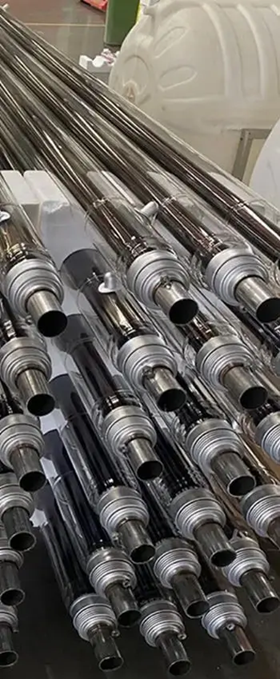
Image Credit: OkyayTech ALD
Analysis
ALD was shown to demonstrate excellent conformality, even deep into the pipe, when applied with longer precursor pulses and adequate purge times.
Growth variation was found to be within an acceptable range for diffusion barrier applications.
It was also determined that process conditions could be fine-tuned depending on commercial needs, for example, to balance uniformity versus throughput.
Conclusion
This study highlighted that ALD can be used to coat the inner surfaces of ultra-long tubes while maintaining cost-effectiveness.
Preliminary calculations show that the operational cost per tube is just a few hundred USD, meaning that this solution is economically feasible for deployment in solar thermal installations.
Custom ALD barrier coatings offer a scalable and high-performance option for industries looking for next-generation thermal reliability, particularly where traditional methods have failed to deliver.

This information has been sourced, reviewed and adapted from materials provided by OkyayTech ALD.
For more information on this source, please visit OkyayTech ALD.