Laser-Induced Breakdown Spectroscopy (LIBS) has evolved from a laboratory technique to a widely used solution for fast elemental analysis in industries ranging from metals manufacturing to energy, environmental monitoring, recycling, and advanced materials.
This transition has been fueled by advances in compact, high-performance components, particularly lasers and spectrometers, enabling portable LIBS devices to maintain laboratory-level precision.
Hamamatsu's new WS Series spectrometers serve the latest generation of LIBS instruments by providing excellent resolution, broad spectral coverage, remarkable speed, and the stability required in rugged small systems.
Why Spectrometer Performance is Critical in LIBS
LIBS is a versatile analytical technique that generates a microplasma on a sample's surface using a brief, intense laser pulse.
As the plasma cools, excited species relax to lower energy states, producing discrete spectral lines unique to each element. A spectrometer can capture these emissions and identify the material's elemental fingerprint in seconds, frequently without the need for sample preparation.
Early plasma emission (during the first hundred nanoseconds) is dominated by powerful broadband light; hence, detectors typically detect emissions after a brief delay of around one microsecond, when sharp atomic and ionic lines become apparent.
Choosing the appropriate spectrometer is so critical. It must resolve precise spectral characteristics, capture extremely short-lived signals, and provide broad coverage to encompass the emission lines of interest.
Several aspects distinguish LIBS from other elemental analysis approaches:
No Sample Preparation
LIBS can analyze raw, in-place materials that have not been ground, dissolved, or chemically treated.
Speed
A thorough measurement usually just takes a few seconds.
Access to Light Elements
Elements such as hydrogen, lithium, beryllium, carbon, nitrogen, and oxygen are easily recognized. This is an area where other portable approaches fail.
Flexible Measurement Strategies
LIBS can scan a surface, probe multiple depths, and evaluate thin coatings without interference from underlying substrates.
Broad Applicability
The approach is applicable to metals, polymers, glasses, soils, biological matrices, ceramics, paints, semiconductors, and other materials.
A typical detection limit for many heavy metals is in the low parts-per-million range, making LIBS useful for both qualitative and quantitative evaluation.
Advances that Enabled LIBS in the Field
For many years, LIBS was limited to laboratory settings due to the bulky, power-hungry, and environmentally sensitive hardware required. The turning point came with advances in small-laser technology.
Today's field-ready devices rely on compact, battery-powered lasers that can deliver several millijoules of energy in nanosecond pulses at high repetition rates while maintaining stability across a wide temperature range. This level of performance is required for quick, repeatable plasma creation to obtain high-quality field data.
Modern handheld LIBS systems now meet or exceed the capabilities previously limited to mobile spark-optical emission spectroscopy (spark OES) equipment, and in many cases, they complement or outperform handheld X-ray fluorescence (XRF).
These instruments have been widely used in industries such as welding, petrochemical processing, alloy manufacturing, and natural resource exploration.
Where Laser-Induced Breakdown Spectroscopy is Used Today
LIBS has proven itself as an effective tool in industries that require rapid, on-site elemental analysis.
One of its most significant advantages is its ability to detect carbon in steels and stainless alloys, which is especially useful in industries such as oil and gas, petrochemicals, and metal fabrication, where weldability, corrosion resistance, and material certification are required.
Operators may check alloy chemistry directly on pipelines, valves, and fabricated components, determine carbon equivalency in seconds, and inspect materials throughout the manufacturing and maintenance process.
The same advantages make LIBS invaluable in scrap recycling, where rapid sorting, differentiation between grades such as 316 and 316L, and detection of trace pollutants directly impact profitability and regulatory compliance.
Beyond standard alloy analysis, LIBS has become indispensable in the electric vehicle and battery materials industries.
Its unique ability to assess lithium in soils, rocks, and brines in real time has established it as a critical tool for both exploration and recycling as worldwide demand for battery metals grows. These features also apply to academic and research settings.
The WS Series: Spectrometers Designed for the Future of LIBS
LIBS technology naturally benefits from spectrometers that can be configured to meet individual analytical requirements. Because each application depends on specific emission lines, many developers prefer instruments tailored to specific wavelength regions rather than relying on a single, full-range device.
Targeted configurations are becoming more prevalent, such as equipment optimized for fluorine detection in PFAS screening, beryllium in soils and dust, and combinations of light elements like sodium and boron in mineral analysis. Focusing on the most important spectral windows enhances sensitivity while simultaneously lowering costs and system complexity.
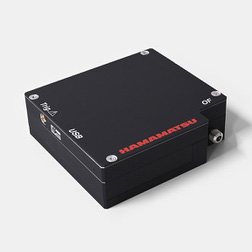
Hamamatsu Mini-spectrometer WS series, C16449MA-01. Image Credit: Hamamatsu Photonics Europe
Hamamatsu's WS Series spectrometers were designed with this flexibility in mind, combining the performance attributes required for modern LIBS with the ability to select the spectrum coverage and resolution that best suit each application.
The series includes a broadband variant, the C16449MA-01, which covers 190 to 1100 nm with 1 nm resolution, and a high-resolution version, the C16449MA-02, which covers 200 to 600 nm with 0.45 nm resolution, for applications requiring finer spectral discrimination.
Aside from these conventional models, Hamamatsu may alter wavelength range and resolution, allowing LIBS developers to achieve optimal performance for their target elements.
The WS Series brings together the features most important for LIBS applications and beyond.
High Spectral Resolution
IBS is based on resolving narrow emission lines from complicated plasmas. WS spectrometers provide the precise resolution needed to discern closely spaced transitions, thereby improving both qualitative and quantitative accuracy.
Broad Wavelength Coverage
With options spanning crucial UV, visible, and NIR ranges, the WS Series can capture emission lines for almost any element, including the light elements that constitute LIBS' distinct capabilities.
High Throughput for Faint, Fast Signals
The plasma emission window is short. The WS Series has great optical efficiency, allowing more photons to reach the detector and lowering detection limits.
Exceptional Speed and Dynamic Range
LIBS signals vary greatly in intensity. The WS platform accommodates both strong and weak lines in a single test, allowing for enhanced chemometric analysis and reliable field performance.
Outstanding Wavelength Stability
Stable calibrations are required for real-world LIBS deployments. Despite shifting climatic circumstances, the WS Series retains its wavelength precision.
Compact and Robust Form Factor
WS spectrometers are designed for incorporation into handheld, portable, and industrial systems, combining durability with small size, making them perfect for field-ready LIBS equipment.
A New Generation of LIBS Enabled by Better Spectroscopy
Over the last decade, LIBS has evolved into a robust, field-deployable technology that serves traditional sectors while also extending into energy, environmental stewardship, and innovative materials. As applications expand, the demand for compact, stable, high-performance spectrometers grows.
Hamamatsu's WS Series is designed to meet these requirements, delivering the performance and dependability needed for precise elemental analysis in portable and integrated LIBS systems.
It is designed for versatility and long-term stability, allowing developers to create instruments that perform consistently in both lab and field settings.

This information has been sourced, reviewed and adapted from materials provided by Hamamatsu Photonics Europe.
For more information on this source, please visit Hamamatsu Photonics Europe.