Spectroscopy helps researchers explore how matter interacts with electromagnetic radiation, revealing its composition, structure, and physical properties. This vital technique is widely utilized in chemistry, physics, astronomy, and biology, with applications ranging from water analysis and chemical composition identification to the study of celestial objects.
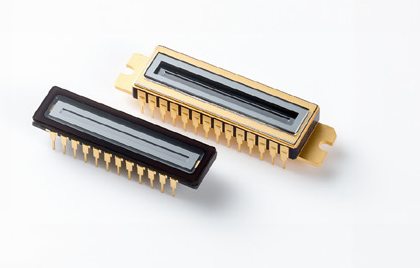
Image Credit: Hamamatsu Photonics Europe
The image sensor is an essential component of spectroscopy equipment and techniques, such as Raman spectroscopy, with CMOS sensors gaining popularity for their ease of integration, high sensitivity, and high-speed data acquisition.
This has made the CMOS image sensor more common in spectroscopy.
Introduction to CMOS Image Sensors
An image sensor is a device that detects light and converts it into digital signals that can be processed, stored, and reproduced as an image.1 They are made up of a pixel board that converts photons into electrical impulses, a sensing node that amplifies the charge, and an analog-to-digital converter.
The charge is transferred to the sensor node using the serial register. CMOS (Complementary Metal-Oxide-Semiconductor) technology is a form of image sensor that integrates digital and analog circuits onto a single chip.
In other words, each pixel is equipped with its own transistor and amplifier, allowing it to independently transform light into an electrical signal. This design is more integrated and power-efficient. Figure 1 shows a schematic of the CMOS structure.
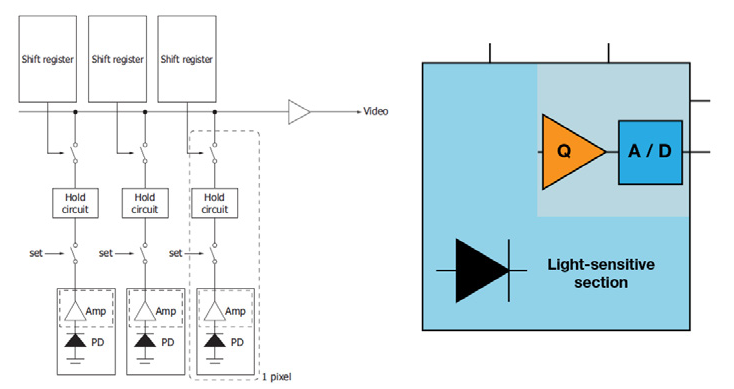
Figure 1. Typical CMOS structure: The light-sensitive part (photodiode) and charge amplifier are integrated into each pixel. Image Credit: Hamamatsu Photonics Europe
CMOS Sensors in Spectroscopy
The distinctive structure of CMOS technology offers particular advantages for spectroscopy, such as high sensitivity and fast data acquisition. Because of these characteristics, CMOS sensors can detect faint signals commonly observed in spectroscopy and are suitable for real-time spectroscopic applications.
Sustainability in spectroscopy and advances in on-chip technology are key drivers of the growing adoption of CMOS sensors. CMOS sensors are more energy-efficient than traditional sensors and easier to integrate, making them adaptable to changing applications.
In addition, the cost-effective manufacturing processes used to develop CMOS technology make CMOS-based spectroscopic devices more accessible.
Applications Using Hamamatsu CMOS Image Sensors
Hamamatsu Photonics is a prominent provider of high-quality, high-performance, and cost-effective CMOS technology for industrial, analytical, and spectroscopic applications. With considerable knowledge of photonics technology, encompassing optics, electronics, mechanics, and software, Hamamatsu offers a diverse product line.
Spectroscopy tools with CMOS image sensors have become indispensable in a variety of fields.
Raman spectroscopy, which is used in medical diagnostics to detect biomarkers, is one of the most well-known applications of CMOS technology.2 Other spectroscopy tools, sometimes known as spectrometers, are used to monitor water quality, assess food composition, and oversee manufacturing operations.
CMOS sensors for spectroscopy and high-speed in-line scanning are available. In addition, Hamamatsu can customize products to meet specific requirements.
Monitoring Water Quality
UV-Vis spectroscopy is an effective technology for real-time water analysis and quality monitoring. Physical methods include spectral remote sensing technology in the ultraviolet and visible bands.
UV-Vis spectrophotometry assumes that a substance's absorption of specific wavelengths of light is proportional to its concentration.3
Because particle adjustment is software-based, spectrophotometry typically does not require sample filtration. It requires no reagents and enables rapid, real-time assessments of water quality.
In recent years, this approach has become more widely used for quick water quality monitoring. The Hamamatsu CMOS image sensor S10123-1024Q-0 is specifically designed for precision in water analysis and provides excellent water-quality monitoring.
Industrial Processes – Position Detection
Hamamatsu has developed a range of photosensors and light emitters for distance measurement, including for AGVs. AGVs (Automatic Guided Vehicles) avoid collisions with objects or workers by measuring distances around them using lasers, optical sensors, MEMS mirrors, and other devices while moving autonomously.
These devices contain CMOS linear image sensors. The triangulation method uses inexpensive, compact, and thin CMOS linear image sensors to detect position and measure objects. Hamamatsu's S10121-256Q-01 sensor is an excellent example of this.
Food Inspection
Hamamatsu provides a range of CMOS image sensors in linear and area arrays for UV-VIS imaging in food inspection. These image sensors are simple to use because all necessary signal-processing circuits are built into the sensor chip, and they require only basic input pulses and a single power supply to function. Special features include:
- Sensitivity from UV to near-infrared up to 1100 nm. They are available in a wide range of pixel combinations (from 128 to 4096 pixels), sensitivity, and line rates.
- Available in array sizes ranging from 30 × 30 to 1280 x 1024 pixels. CMOS area arrays are designed to be integrated into cameras and provide image capability across a wide spectral range from UV to NIR.
CMOS sensors for spectroscopy and high-speed in-line scanning are available. Hamamatsu can also customize products to meet your individual needs. Examples include Hamamatsu’s S9226-03 CMOS linear image sensor and the S16101 CMOS image sensor.
More Information on CMOS Technology
The use of CMOS technology in spectroscopy has greatly improved the performance, affordability, and versatility of spectroscopic devices. CMOS sensors have been essential in the advancement of numerous scientific and industrial applications, owing to their on-chip integration.
Its applications are projected to expand, fueling additional breakthroughs and discoveries. Engineers from Hamamatsu Photonics are available to discuss the best CMOS image sensors for your project or application.
References
- Hamamatsu Photonics. (2026). Image sensors | Hamamatsu Photonics. (online) Available at: https://www.hamamatsu.com/eu/en/product/optical-sensors/image-sensor.html.
- Hamamatsu Photonics. Raman spectroscopy | Hamamatsu Photonics. (online) Available at: https://www.hamamatsu.com/us/en/applications/analytical-equipment/raman-spectroscopy.html.
- Hamamatsu Photonics. Monitoring water quality: a challenge for spectroscopic technology | Hamamatsu Photonics. (online) Available at: https://www.hamamatsu.com/content/dam/hamamatsu-photonics/sites/documents/21_HPE/21_02_HPE_Brochures/Hamamatsu-Photonics-Monitoring-water-quality.pdf
- Hamamatsu Photonics. (2026). Water quality inspection | Hamamatsu Photonics. (online) Available at: https://www.hamamatsu.com/eu/en/applications/analytical-equipment/water-quality-inspection.html.
- Hamamatsu Photonics. (2026). Photonics Solutions for Industrial Equipment | Hamamatsu Photonics. (online) Available at: https://www.hamamatsu.com/eu/en/applications/industrial-equipment.html.
- Hamamatsu Photonics. Spectroscopy for food safety. (online) Available at: https://www.hamamatsu.com/us/en/applications/spectroscopy-for-food-safety.html.

This information has been sourced, reviewed and adapted from materials provided by Hamamatsu Photonics Europe.
For more information on this source, please visit Hamamatsu Photonics Europe.