Pilot pressure can be understood as the pneumatic control signal that defines the setpoint of a regulator. This pilot signal is generated by a separate pilot device in pressure control systems that employ dome-loaded pressure regulators, directly determining how the regulator opens and closes in order to maintain the desired process pressure.
A dome-loaded pressure regulator (DLPR) is typically the preferred solution in applications with extreme pressures and temperatures, mixed fluid phases, severe chemistry, or other challenging operating conditions.
Dome-loaded designs differ from conventional spring-loaded regulators in that they use a flexible diaphragm and an externally applied control pressure to balance against process pressure. This operating principle allows dome-loaded designs to accommodate significant pressure differentials while maintaining repeatable and stable control across a wide range of flows.
Common conditions where DLPR valves shine are ideally suited include:
- Operating pressures over 1000 PSI, where spring-based regulators typically struggle with hysteresis and stability
- Extreme process temperatures, including settings that degrade mechanical springs or elastomers
- High flow rates with wide turndown requirements
- Reactive or corrosive materials, where it is essential to isolate the control device from the process
Dome-loaded regulators are unable to generate their own setpoints, meaning that their performance is primarily determined by the device that supplies pilot pressure to the dome. Pilot pressure may be provided by a fixed pressure source or a manual regulator in simple systems.
Electronic pilot pressure control is often required in applications requiring tight pressure tolerances, dynamically adjustable setpoints, or integration into automated control systems, however. These devices are key to fully realizing the regulator’s responsiveness, precision, and repeatability in more complex applications.
Raising the Equilibar
Alicat® flow and pressure instruments benefit from pairing with Equilibar® regulators and valves in applications working with extreme temperatures and pressures, mixed phase fluids, and ASME BPE sanitary requirements.
Equilibar flow control valves (FCVs) and back pressure regulators (BPRs) offer stable control across a vast range of flow rates, with models offering control of valve flow coefficients (Cv) as low as 1e-9. Some models of Equilibar valves also offer chemical resistance and high temperature tolerances of up to 450 ºC.
The dome-loaded, multiple orifice design delivers exceptional precision and instant control for highly complex applications. With its only moving part being a flexible mechanical diaphragm, ensuring frictionless and stable operation, Equilibar valves also provide superior repeatability and precision, particularly when working with low flow rates, corrosive media, mixed phase fluids, and extreme pressures and temperatures.
Equilibar valves and Alicat precision instruments complement one another when used together. Both offer extremely high resolution, allowing each device to benefit from the other’s high precision control.
Pairing an Equilibar BPR and an Alicat Pressure Controller
PCD-Series dual-valve pressure controllers from Alicat can regulate pressure for closed volumes up to 3000 PSI, making them ideally suited to use as electronic pilot pressure sources for dome-loaded back pressure regulators.
The PCD’s high resolution provides genuine 1:1 control of dome pressure, facilitating precise pressure regulation down to hundredths of a PSI when paired with an Equilibar BPR or similar dome-loaded regulator.
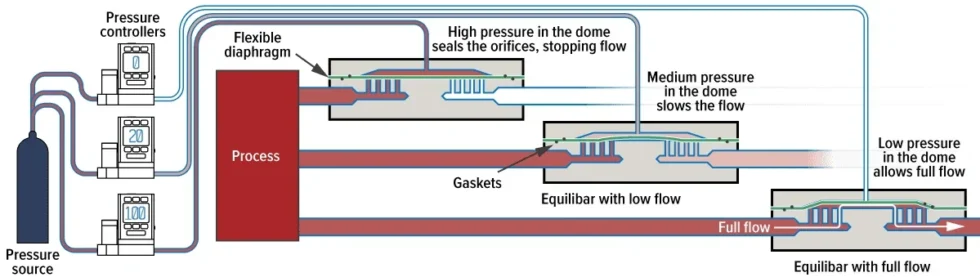
Pressure control loop using Alicat and Equilibar devices. Image Credit: Alicat Scientific
When used in this configuration, the Alicat PCD functions as an electronic pilot pressure controller within a closed-loop system with the Equilibar BPR communicating via a PID controller, PLC, or computer interface.
Actively controlling the pressure applied to the regulator’s dome allows the PCD to define the operating setpoint of the regulator, making it possible to dynamically and repeatably adjust pressure, even in processes featuring quickly changing conditions or large pressure differentials.
This approach also simplifies system design by allowing pilot pressure to be safely vented to the atmosphere in applications using non-toxic pilot or backpressure gas, such as air or inert gases.
The PCD incorporates both inlet and exhaust control valves, meaning that it can actively increase or bleed pilot pressure as required to maintain the required setpoint.
When employed in tandem with system-level pressure protection devices such as pressure relief valves, this controlled venting minimizes overshoot, improves system response, and helps stabilize pressure during transient conditions or setpoint changes.
The PCD facilitates the smoother and more predictable control of dome-loaded regulators in demanding applications, actively managing pilot pressure as opposed to solely relying on passive elements.
Pressure Control in Hazardous Locations
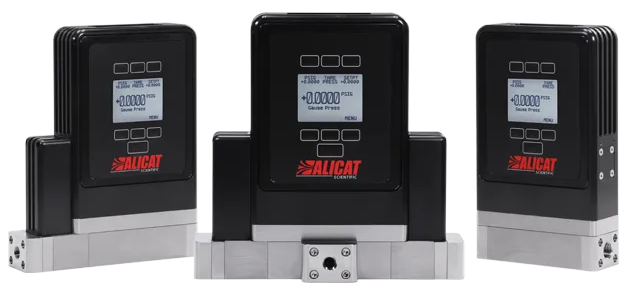
IS-Pro™ Series pressure controller, PCD, and meters. Image Credit: Alicat Scientific
Processes involving hazardous vapors, flammable gases, or classified environments may restrict or even prohibit atmospheric venting. Pilot pressure control must comply with hazardous Class 1, Division 1, or Division 2 requirements in such cases, while continuing to deliver the responsiveness and precision required by dome-loaded regulators.
Alicat’s intrinsically safe series of electronic pressure controllers has been specifically designed for use in classified environments where traditional purge systems or enclosures may be impractical.
These controllers deliver closed-loop electronic pilot pressure control while accommodating applicable hazardous area requirements, ensuring precise regulation without the introduction of potential ignition risks.
As an example, a North American gas company designing a pressure control system for pressurized vessels used an IS-Pro™ PCD to pilot a dome-loaded pressure regulator. The ISPCD enabled high-resolution, closed-loop control of the DLPR as it allowed the pilot pressure to be adjusted proportionally, allowing vessel pressure to be automatically regulated in a Class I, Division 1 hazardous location.
The system was configured to maintain vessel pressure between 0 and 100 PSIG (0 to ~6.9 bar), with inlet pressures between 120 and 150 PSIG (8.3 to 10.3 bar). The system operated across an ambient temperature range of 20 to 115 °F (−6.7 to 46.1 °C) with pilot exhaust vented to the atmosphere.
Summary
Applications employing dome-loaded pressure regulators benefit from the use of electronic pilot control, ensuring precise and accurate setpoint control and stable flow delivery, even as downstream conditions change. Alicat Scientific pressure controllers are ideally suited to such applications, providing exceptional accuracy and repeatability, as well as improved data visibility and rapid control response for tighter, more reliable performance.
The company’s range of controllers is:
- Compatible with a diverse array of corrosive and non-corrosive fluids.
- Available in gauge, absolute, or differential pressure.
- Able to offer ± 0.125 % of full-scale accuracy.
- Able to offer ± 0.08 % of full-scale repeatability.
- Able to accommodate 0.01–100 % measurement and control range (10,000:1 turndown).

This information has been sourced, reviewed, and adapted from materials provided by Alicat Scientific.
For more information on this source, please visit Alicat Scientific.