Sponsored by InterpowerReviewed by Olivia FrostApr 22 2026
Iowa considers itself a pro-business state, which led Interpower® to open its headquarters in Oskaloosa, Iowa, in 1992. Having left the more business-restrictive state of California, the Iowa facility included manufacturing space to develop cutting-edge North American power cords, cord sets, and components.
In 1993, Interpower opened a distribution center in the UK to bolster its presence in the European market. In 1996, Interpower manufactured its first North American cord set, and in 2000, constructed a cable- and cord-making facility in Lamoni, Iowa.
A new building was added to the company’s portfolio in 2002, in Ames, Iowa, which became home to the company’s marketing department and its innovative cord and component testing facility, similar to a UL testing laboratory. Years of dedication then allowed Interpower to roll out its one-week lead times by 2008.
The One-Week Unique
Everyone in the company is committed to our 1-week lead times. It requires having dedicated people in place as well as the high-grade raw materials we use to keep the machines running. We also make sure we carry sufficient stock of our most popular cords. This creates a buffer, allowing us to keep those lead times on most of our country-specific cord sets.
Mike Boyle, Vice President of Manufacturing and Logistics, Interpower
Plug patterns and cord sets are required to meet country-specific and/ or international standards, including raw materials and size specifications. ‘One-week lead times’ may sound unspectacular, but each continent and country has its own unique plug designs for its mains power, not to mention variances in amperages and voltages. For example, North America uses 60 Hz while the rest of the world uses 50 Hz. Japan is the singular outlier, using both 60 Hz and 50 Hz in two separate regions.
There is also a range of plug bridges that take blades and/or pins, which have variability in their dimensions. Further considerations include: the size of AWG or international cable that the plug will be molded onto; necessary approvals for the cable; and packaging and labeling requirements. Furthermore, when exporting power cord sets to Europe, they must be RoHS and REACH compliant.
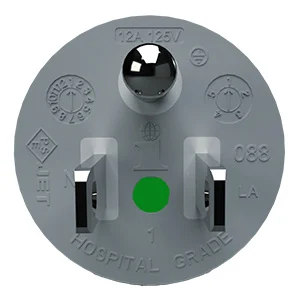
Image Credit: Interpower
In addition, each component must carry the markings of a country-specific agency, which shows that proper testing has been conducted to meet compliance. This requires the manufacturing of steel inserts, carrying the appropriate approval marks, which can be fitted inside the mold cavity to engrave the mark onto the component.
Approval is obtained by ensuring each product is tested by the relevant agencies representing the countries to which the components are being exported. This requires financial investment to pay for testing and approval, as well as bearing the cost of making the steel inserts that carry the country-specific marks.
Two important examples of approval markings are Ul, used in North America, and VDE, used in Europe. Some UL testing labs do the testing as well as determining the North American standards. Other countries around the world employ agencies for testing, while a government-associated agency will write the standards.
This makes it important to know how each country conducts its approval process before exporting products. Generally, a testing agency’s mark is required along with the country-specific mark. For instance, when manufacturing British plugs for the UK market, UK approval and the appropriate stamps are required: ASTA and BSI.
ASTA is the testing-certification agency, and BSI refers to the entity responsible for writing the standards. When manufacturing a British cord set, VDE could also be stamped onto the IEC connector, since VDE is a globally accepted safety agency.
The approval process can be expensive and time-intensive, but it is absolutely crucial to produce country-specific products that are more universal for exporting. Interpower produces a vast range of IEC 60320 inlets, outlets, connectors, plug connectors, and jumper cords.
We have both large and small orders come in – it’s common for us to change out 40 molds per week. We can do this because of our quick-change molding process using spring-loaded washers and quick-disconnect waterlines. This not only allows for multiple country-specific orders each week, but also replenishes stock quickly when rebuilding inventory.
Mike Boyle, Vice President of Manufacturing and Logistics, Interpower

This information has been sourced, reviewed, and adapted from materials provided by Interpower.
For more information on this source, please visit Interpower.