Sponsored by LabmanReviewed by Maria OsipovaApr 14 2026
When leading formulation experts Micropore Technologies approached Labman to collaborate on a cutting-edge automation platform, both organizations shared an objective: to enable researchers to innovate faster, smarter, and sustainably.
The outcome was Pathfinder™: a compact, automated benchtop apparatus that merges Micropore's established AXF™mini technology with Labman's proficiency in tailored automation and smart control.
Collectively, Micropore Technologies and Labman have engineered a tool that could fundamentally alter the methodology of creating nucleic acid therapeutics, vaccines, and nanoparticle formulations.
Addressing a Growing Demand for More Intelligent Formulation Instruments
Prior to joining forces with Labman, Micropore identified a market void for a high-throughput, low-waste solution capable of accelerating the discovery and refinement of nanoparticle-based products.
“We wanted to offer a system that not only expands on our AXF-mini capabilities but also allows users to trial a wide range of parameters efficiently, while minimizing raw material use,” stated Dewi Lewis, Business Development Manager at Micropore Technologies.
The Pathfinder was born from this aspiration, combining Micropore's expertise in membrane emulsification with Labman's automation engineering to produce a genuinely user-friendly platform for discovery and development.
A Partnership Founded on Creativity and Regional Cooperation
Micropore connected with Labman due to their extensive background in laboratory automation and their shared origins in northeast England. From the outset, the partnership was characterized by open dialogue and collaborative problem-solving.
"Labman prioritized consistent communication and troubleshooting throughout the process. Whether it was an early customer call or a site visit, they were always happy to help and keep the lines of contact open," said Andy Stonehouse, Applications Engineer at Micropore Technologies.
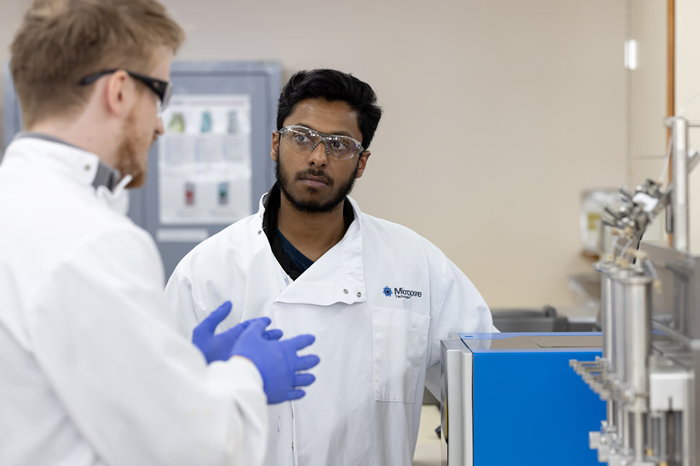
Image Credit: Labman
Working in close concert, both teams focused on customization, precision, and ease of use. They’ve developed an automation system that enhances Micropore's product portfolio and delivers tangible benefits to end users in both R&D and manufacturing settings.
Pathfinder: Compact, Powerful, and Revolutionary
The Pathfinder grants researchers unparalleled adaptability through two primary operational modes: Discover and Develop.
In Discover Mode, users can achieve exceptionally low waste and sample volumes, with initial waste as minimal as 400 μL and sample quantities as small as 200 μL.
In Develop Mode, the identical system scales up to 250 mL, preserving consistency from Design of Experiments (DOE) screening through to clinical production on a single device.
This adaptability, facilitated by Labman’s precision automation and Micropore’s formulation acumen, enables high-throughput screening of up to 96 samples in under sixty seconds, with no waste generated during operations.
The intuitive software interface, co-developed with Labman, permits instant monitoring, data exchange, and optimized workflow management – ensuring experimental progress is efficient and reproducible.
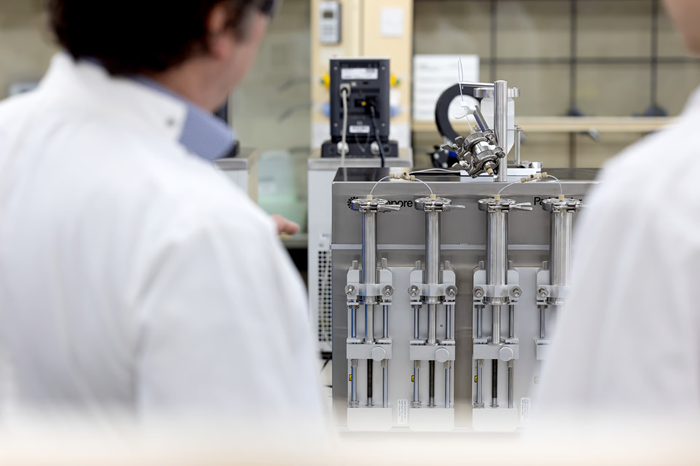
Image Credit: Labman
Expanding Capabilities: From Pathfinder to Horizon™
Building on the success of the Pathfinder, the collaboration is continuing through RAPIDD, an initiative funded by Innovate UK and CPI to develop the Horizon™ system.
Designed for continuous production and improved throughput, Horizon extends the Pathfinder's functionalities into GMP-ready manufacturing.
Unlike conventional high-pressure apparatuses, the Horizon operates at high throughput but low pressure, keeping the same consistent performance as the AXF-mini. With flow rates spanning from 3-450 mL/min, it provides closed-loop control, portability, and chemical resistance, all within a compact, interchangeable configuration.
This fluid transition from laboratory to production scale, obviating the need for tech transfer, represents a significant leap forward for formulation development.
Advancing the Industry
The influence of the Pathfinder and Horizon systems extends beyond Micropore's client base. Through collaborations such as the MILORNA Innovate UK grant with the University of Strathclyde, researchers are already using the Pathfinder for lipid nanoparticle production. It’s a pivotal technology underpinning next-generation therapeutics and vaccines.
"We’re now seeing how these systems can bridge the gap between research and manufacturing. The automation Labman helped us build doesn’t just save time or materials; it changes how quickly ideas can move from concept to clinic, " said Lewis.
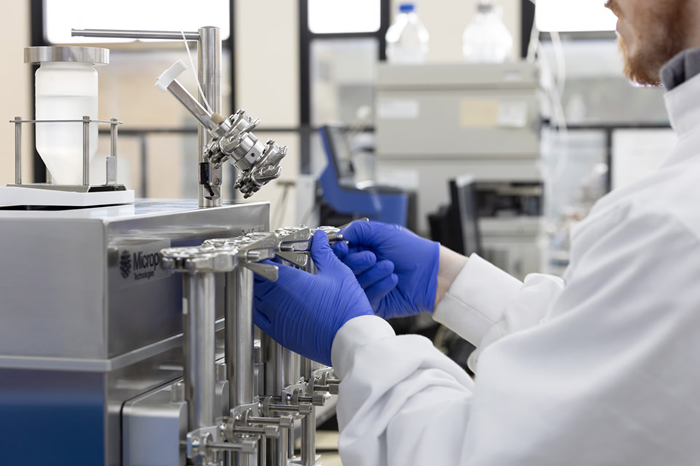
Image Credit: Labman
With reduced waste, enhanced reproducibility, and effortless scalability, the joint technologies developed by Labman and Micropore are establishing a new standard for formulation science and automated process advancement
A Shared Outlook for the Future
For both Micropore and Labman, this alliance serves as an illustration of what can be achieved when engineering innovation converges with scientific aspiration.
As the Horizon system progresses toward full implementation, both teams continue to investigate novel avenues to make sophisticated formulation automation more accessible, more environmentally sound, and more capable than ever before.
"Working with Labman has made customized, scalable solutions a reality for our customers. And that’s only the beginning,” Lewis concluded.
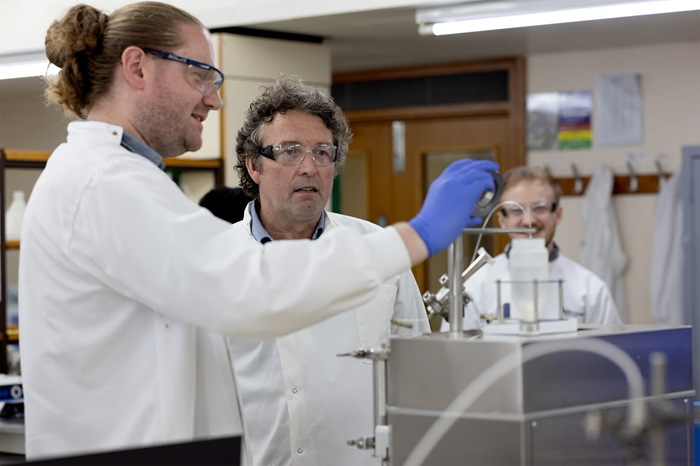
Image Credit: Labman

This information has been sourced, reviewed, and adapted from materials provided by Labman.
For more information on this source, please visit Labman.