High-shear mixing and high-pressure homogenization are two methods for particle size reduction, homogenization, and emulsification. Each approach is primarily dependent on shear force, but they provide various benefits depending on the application.
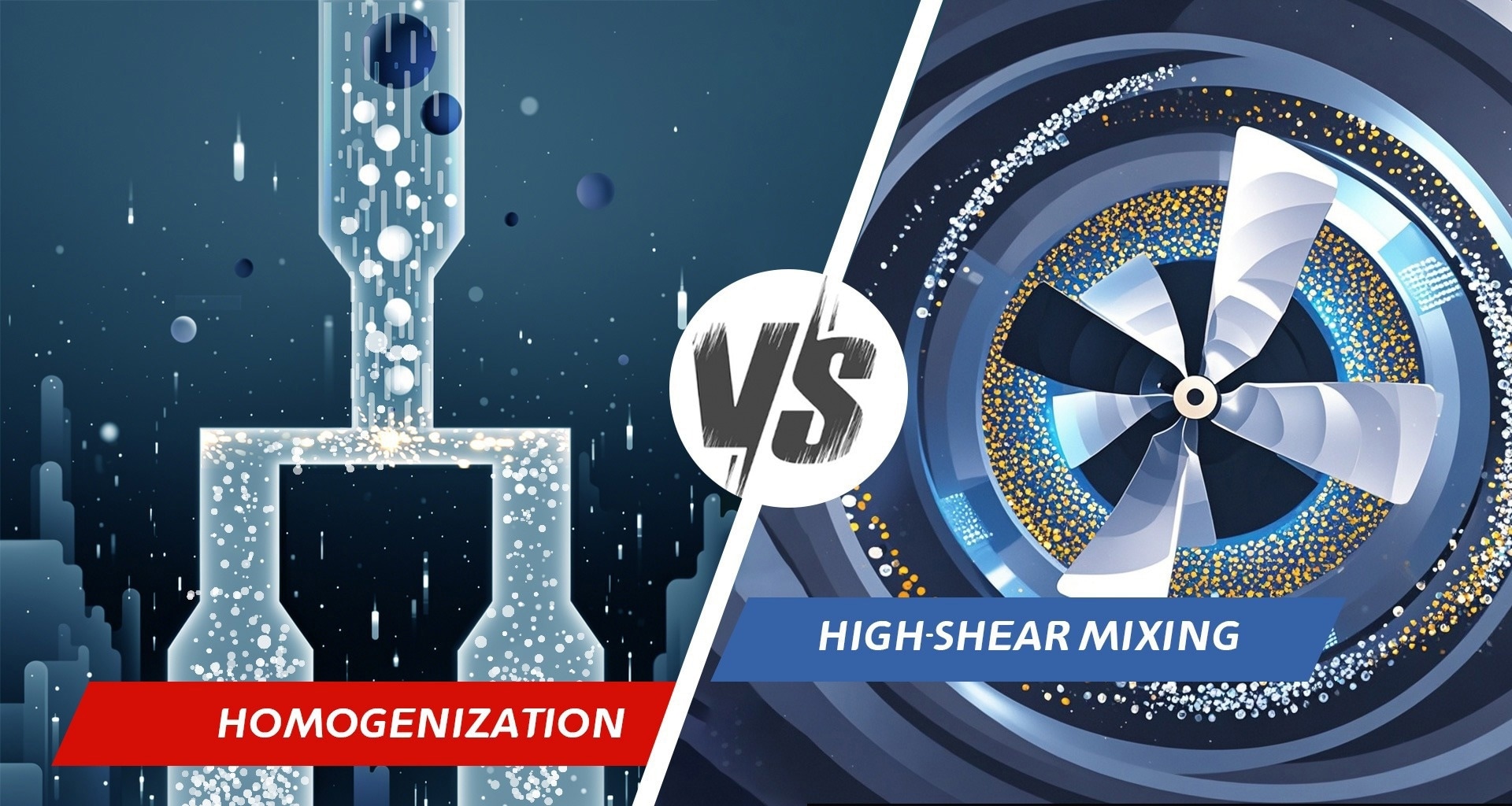
Image Credit: Genizer LLC
Understanding Shear Force
Shear force refers to any force that acts on a material's surface. In liquids, for example, this causes friction between fluid particles, resulting in particle size reduction.
High-shear mixing generates shear force by employing techniques such as rotor-stator or high-speed blades. A rotor-stator is made up of two elements that work together to generate shear force. The stator is stationary and sits around a revolving rotor.
High-pressure homogenization creates shear by forcing the material through a narrow tube. A Y-shaped diamond interaction chamber can be used to divide a liquid sample before colliding the sample with itself. The small section before the impact causes shear.
Homogenization generates extra forces, such as cavitation and the impact of samples colliding.
Advantages and Disadvantages of High Shear Mixing and High-Pressure Homogenization
High-shear mixing can handle more viscous materials and bigger quantities than high-pressure homogenization, and it is often less expensive. However, high-pressure homogenization has a narrower dispersion and smaller particle size, meaning it is often more precise.
Though high-shear mixing can handle a larger starting particle size, high-pressure homogenization can produce smaller final particle sizes.
Some applications start by processing samples using high-shear mixing or sonication, then finish with high-pressure homogenization. This method can help lower the initial particle size for high-pressure homogenization, resulting in faster processing time.
High-pressure homogenization provides faster processing and more consistent results since the entire sample is subjected to the same processing procedures. High-shear mixing affects the sample differently depending on its distance from the rotor-stator or blades.

This information has been sourced, reviewed and adapted from materials provided by Genizer LLC.
For more information on this source, please visit Genizer LLC.