The monolithic integration of RF-MEMS with SiGe-BiCMOS technology opens the door to the creation of low-cost, highly integrated circuits. From there, the technology can power radar and imaging applications.
Laser Doppler Vibrometry (LDV) and Coherence Scanning Interferometry (CSI/WLI) have enabled the development of high-performance and reliable RF-MEMS switches.
BiCMOS RF-MEMS Switch Integration
SiGe-BiCMOS technologies are increasingly popular for mm-wave applications such as WLAN, radar, and imaging.
These applications often call for reconfigurable integrated circuits (ICs) for different frequency bands, switches to control the signal path between transmitter, receiver, and antenna, and phased-array systems, all of which can be realized with RF-MEMS and benefit from improved RF performance (Figure 1).
The capacitive RF-MEMS switch is monolithically incorporated into the backend-of-line (BEOL) of IHP's SiGe-BiCMOS technology (Figure 2). In doing so, you can achieve the shortest links between transistors and MEMS and reduce or eliminate high-frequency parasitic effects.
The switch is implemented inside the first three BEOL metallization layers. Metal 1 produces high-voltage electrodes for electrostatic actuation; metal 2 serves as the RF signal line; and metal 3 houses the suspended membrane.
By applying a voltage to the electrodes, the membrane's position can be altered, thereby changing capacitive coupling between the signal line and the suspended membrane, enabling efficient switching of high-frequency signals.
Experimental Setup
The development of RF-MEMS switches requires a variety of mechanical, electrical, and RF characterization techniques. Electromechanical performance analysis is critical because it significantly impacts RF performance.
Optical characterization methods are preferred because they enable high-resolution measurements without affecting device behavior.
The MSA-500's LDV is used for automated 200 mm wafer-level electromechanical motion characterization of RF-MEMS switches, while the WLI is used to analyze static deformation. LDV is an excellent measurement technology for process control, as it can detect "out-of-plane” motions with nm-range displacement resolution and μm spatial precision.
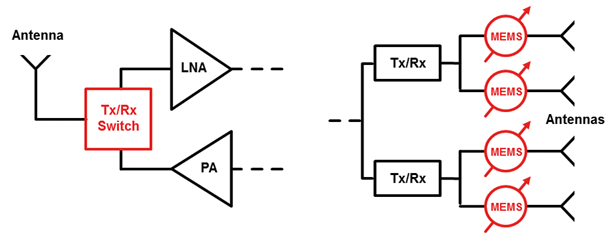
Figure 1. RF-MEMS switch used as Tx/Rx-switch (left) or phase shifter (right). Image Credit: Polytec
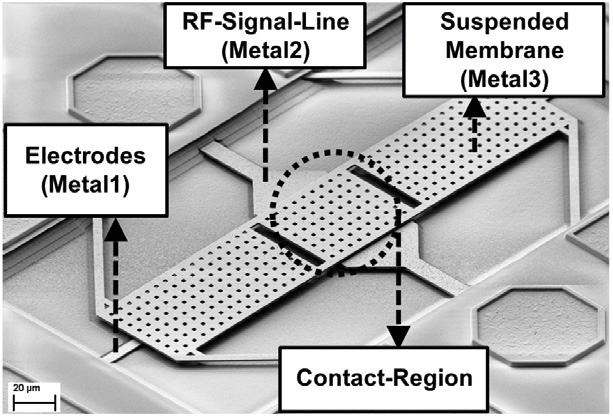
Figure 2. Scanning electron microscopy picture of an RF-MEMS switch. Image Credit: Polytec
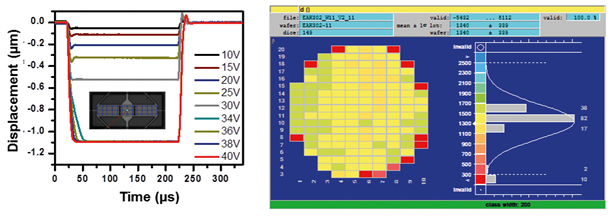
Figure 3. LDV measurement shows membrane displacement with different actuation voltages (left) and wafer-level homogeneity (right). Image Credit: Polytec
Results
Applying varying actuation voltages allows you to extract parameters such as the pull-in voltage and switching time. The exhibited RF-MEMS switch technique achieves very good uniformity (Figure 3).
The membrane displacement enables us to infer the mechanical spring constant and the influence of residual stress. The latter has a substantial impact on mechanical, electrical, and RF performance and so requires regular monitoring (Figure 4).
Reliability is a major barrier to the successful implementation of RF-MEMS, as charging and fatigue can cause device failure. Because numerous switches can be tested concurrently, LDV can be valuable for detecting reliability and leading to design improvements (Figure 5).
Conclusion and Outlook
In recent years, the monolithic integration of RF-MEMS switches has improved in performance, process stability, yield, and reliability, thanks in large part to the use of LDV and WLI.
These characterization approaches enable fast, cost-effective identification of electromechanical performance at the wafer level, enabling the development of reliable mm-wave systems. In Figure 6, for example, an intelligent antenna array has been created with integrated RF-MEMS switches.
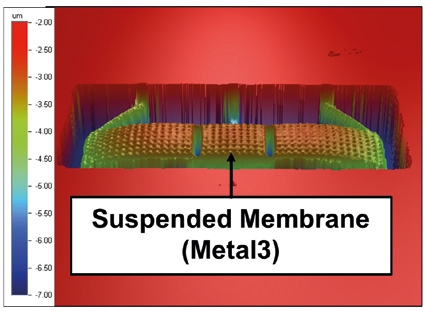
Figure 4. WLI of an RF-MEMS switch shows the influence of residual stress inside the thin layers. Image Credit: Polytec
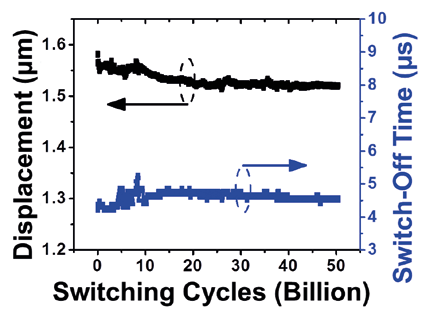
Figure 5. RF-MEMS switch reliability test using LDV. Image Credit: Polytec
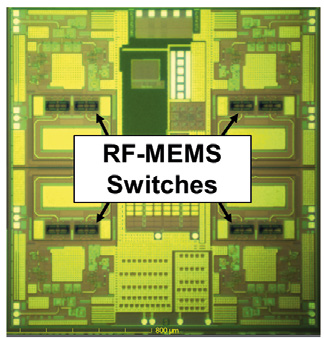
Figure 6. Transceiver quad-chip for intelligent antenna-arrays. Image Credit: Polytec

This information has been sourced, reviewed, and adapted from materials provided by Polytec.
For more information on this source, please visit Polytec.