Sponsored by LuxorReviewed by Ify IsiborJun 23 2026
Recently, ArcelorMittal in Belgium replaced its old sputter coater with a brand-new LUXORAu gold coating system.
This article describes how the LUXORAu gold coater was used to improve image resolution in SEM imaging in the Micro-Research and Defectuology lab while also enhancing the safety of the SEM column and the operator.
ArcelorMittal Gent is a Belgian steel company founded in 1962 and headquartered near Zelzate. Today, the company produces over five million tons of flat steel each year, with the automotive industry being a key market.
Flat steel can be hot-rolled, cold-rolled, galvanized, or plastic-coated. ArcelorMittal manufactures steel from ore and operates coking plants, sinter plants (blast furnace raw material manufacturing), blast furnaces, zinc galvanizing and organic coating lines, and hot and cold rolling facilities.
Why Use a SEM Coater for Steel Applications?
At first glance, one might not expect a steel plant lab to need metal coating as a sample-preparation step for SEM. Steel is a good conductor of heat and electricity, so presumably, charging in the electron beam of the microscope should be no problem.
Frank Medina-Diaz, Head Laboratory Micro-Research and Defectuology (Department of Quality and Products), explains:
“You would indeed think that for research in the steel industry using SEM, metal coating is not needed. Our activities in the lab broadly fall under the broad heading of defectuology. On the one hand, that involves investigation of quality problems in and around our own production facilities, which are outside the standard QC work carried out at ArcelorMittal.
As examples, he cites unique or unexpected corrosion phenomena, small amounts of ‘exotic’ contaminants in an end product, or customer complaints about a visual problem with a coating applied to the company’s products.
The parts received by the department of quality and products are often prepared using the universal ‘sample preparation chain’ of cutting, mounting/embedding, and polishing. During the mounting steps, conductive resins can be used, but Medina-Diaz’s team learned that non-conductive resins were easier to use. As long as they were coated, they provided more accurate information in the SEM.
One method consists of coating samples twice to assess the thickness of an organic coating. After step 1 (the cutting step), a gold coating is applied to the complete sample surface. After embedding and polishing a second gold coating is applied on the resin embedded sample.
Medina-Diaz explains the rationale behind this:
“As a result, the thickness of the organic coating between the metal sample and the first gold coating is clearly visible. Should we not apply the first gold coating, the contrast between the organic coating and the resin would be too small. So, in this case, we use the first coating step to visually determine coating thickness, and the second to prevent charging of the resin.”
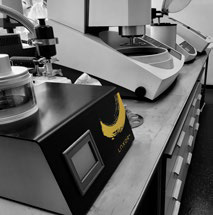
The LUXORAu metal coater at the end of the cutting – mounting – polishing chain in the sample preparation lab. Image Credit: Luxor
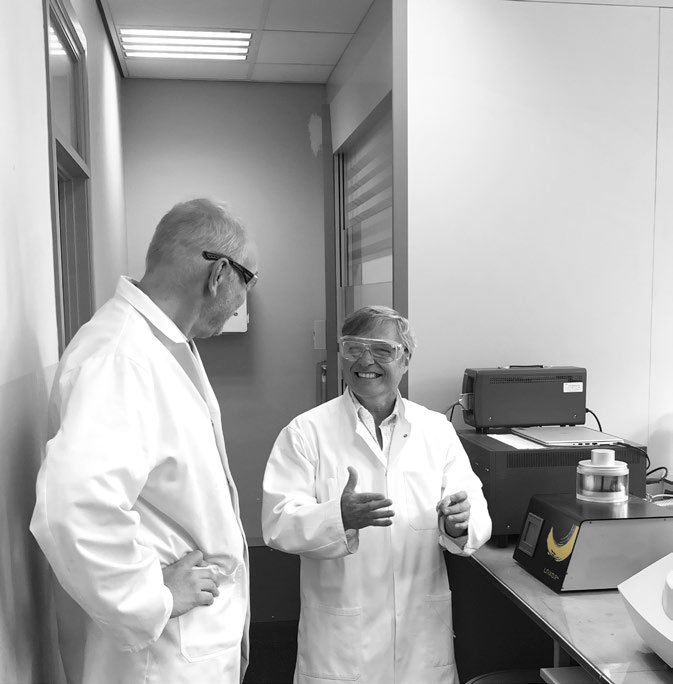
Frank Medina-Diaz from ArcelorMittal Defectuology lab with Jan De Munck from LUXOR at the LUXORAu coater. Image Credit: Luxor
Determining the Thickness and Homogeneity of an Organic Coating on Metal Strips
A 10 nm gold coating is applied to the sample before it is embedded, and the thickness of the organic covering is calculated from this coating. After embedding and polishing, the cylindrical sample is given a second gold coating to prevent charging in the SEM.
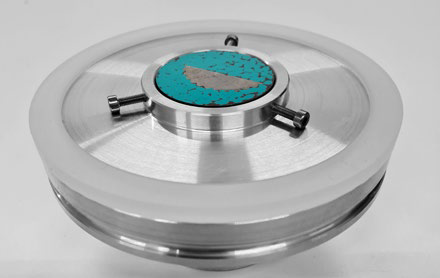
The LUXOR holder for mounted/embedded samples. Image Credit: Luxor
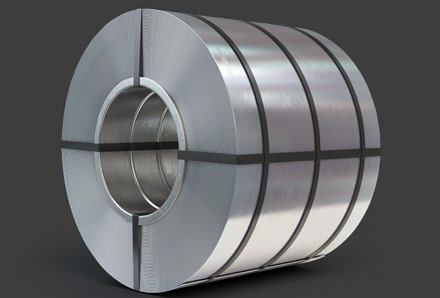
Metal sheet rolls held together with metal strips. Image Credit: Luxor
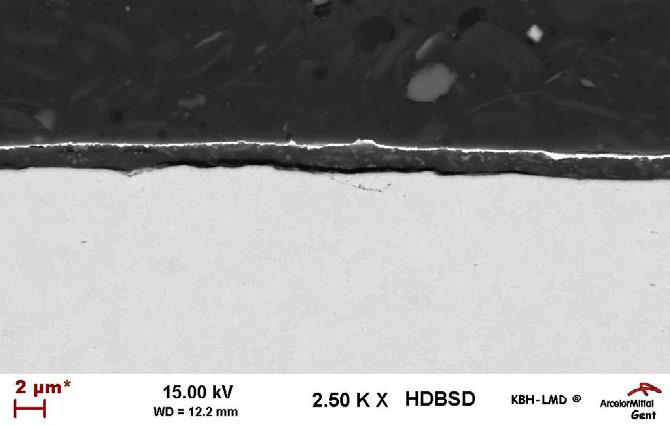
BSD images at 2.500x and 10.000x magnification from ArcelorMittal’s Zeiss Sigma 500 VP FE-SEM. Image Credit: Luxor
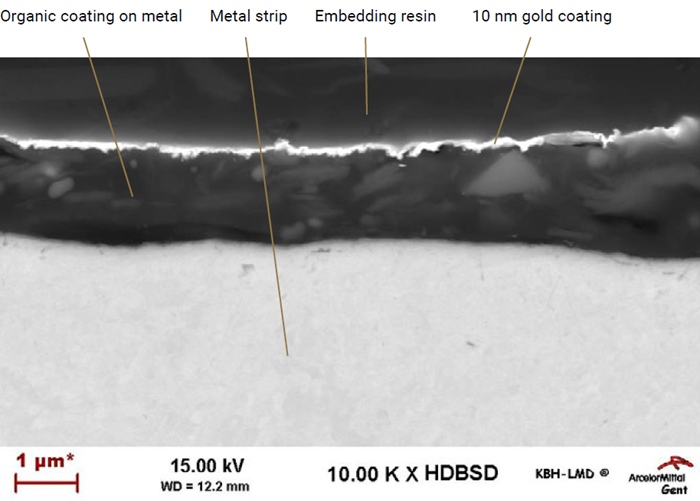
Image Credit: Luxor
Other lab research initiatives include responding to complaints or concerns from local citizens or businesses. As a result, the lab is occasionally commissioned to study the composition of an unknown powder discovered on a roof surface or garden furniture.
Alternatively, it may be asked to determine whether any type of corrosion on an automobile, metal, or plastic surface may be traced back to ArcelorMittal. In such circumstances, a technician travels on-site to collect a sample using swabs or cloths. These must also be coated before entering the SEM.
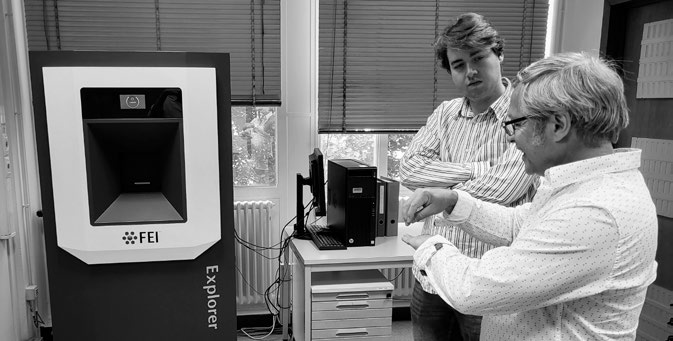
In front of ArcelorMittal’s Thermo FEI Explorer automated SEM: “The one that never sleeps.” Image Credit: Luxor
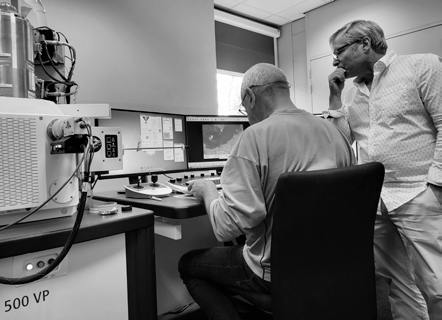
Digging deep into the secrets of metallography with the Zeiss Sigma 500 VP FE-SEM. Image Credit: Luxor
LUXORAu SEM Coater in the Lab
After a few weeks of use in the lab, the LUXORAu coater has yielded positive results. Here are some initial impressions:
“As far as the LUXORAu gold coater is concerned, we can already say that this device represents an important step forward for sample preparation in the lab. The previous device needed replacement due to its age, manual operation, and difficulty in controlling coating thickness.
Users appreciate that the coater is compact and fully automated: “All we need to do is enter the coating thickness and push start.” This also implies that the operator does not have to stay near the coater.
The system checks the layer thickness with high precision, and users notice that, unlike in previous experiences, the gold coating is nearly transparent, indicating it is within the requested range.
They also enjoy the unique upside-down setup, which reduces contamination from loose particles in the expensive SEM column. Another key feature is the running time: the entire coating process, from sample insertion to end venting,takes no more then five minutes for simultaneously coating up to 7 samples.
This information has been sourced, reviewed and adapted from materials provided by Luxor.
For more information on this source, please visit Luxor.