In this interview, industry expert Dr. Nicholas Randall explores how small-scale testing accelerates nuclear materials development, enabling mechanistic insights, safer irradiated-material analysis, and more efficient qualification workflows across extreme environments and advanced reactor systems.
Why is nuclear materials development so demanding?
Nuclear materials development is demanding because materials are asked to perform for long periods in extreme environments: radiation damage, high temperatures, thermal cycling, corrosion, mechanical stress, transmutation products, and sometimes chemically aggressive coolants. These effects interact in tandem.
Radiation can change defect populations, swelling, segregation, hardening, embrittlement, phase stability, and creep behavior, while temperature and stress determine how those defects evolve over time. Public safety and regulatory expectations also mean that results must be reliable, traceable, and conservative. That makes the field both scientifically complex and qualification-intensive.
In the context of nuclear materials, what can small-scale testing answer that larger-scale tests often cannot?
Small-scale testing enables the isolation of mechanisms. Instead of measuring the averaged response of a large specimen, researchers can probe a specific grain, grain boundary, phase, coating, weld region, oxide layer, ion-irradiated layer, or crack-tip process zone.
This is especially valuable for nuclear materials, where damage is often highly localized or microstructurally heterogeneous. Small-scale methods such as nanoindentation, micro-compression, micro-tension, bending, creep, fatigue, and fracture tests can provide answers to questions, such as: Which microstructural feature controls yielding? Where is the damage initiated? How does an irradiated surface layer differ from the unirradiated substrate? How does a specific orientation or interface respond?
Video Credit: Alemnis
How does small-scale testing improve safety, efficiency, or cost?
The biggest advantages are sample volume and speed. With neutron-irradiated materials, smaller specimens reduce the amount of radioactive material that must be handled, transported, stored, and tested. With ion irradiation, the damaged region may be only microns deep, so conventional bulk testing is often unsuitable. Small-scale testing, conversely, can directly interrogate that shallow irradiated zone. Ion irradiation can also accelerate damage studies compared with reactor exposure, and small-scale methods make those accelerated studies mechanically meaningful.
For practical research programs, this means fewer hot-cell operations, lower activated inventory, faster screening, and more data from scarce materials.
How important is real-time observation during small-scale mechanical testing of nuclear materials?
It is extremely important. Mechanical data alone can tell you when load changes, stiffness changes, or failure occurs, but it may not tell you why. In situ observation enables researchers to connect a mechanical event to a physical event, such as slip band formation, dislocation channeling, crack initiation, crack deflection, phase boundary failure, oxide cracking, delamination, or localized plastic collapse.
For nuclear materials, that link is especially valuable because irradiation often changes deformation from relatively homogeneous plasticity to highly localized behavior. Seeing the event unfold helps distinguish true material behavior from artifacts caused by geometry, compliance, surface preparation, or testing conditions. A good example is the compression of a single nuclear fuel particle, where it is important to understand the deformation characteristics.
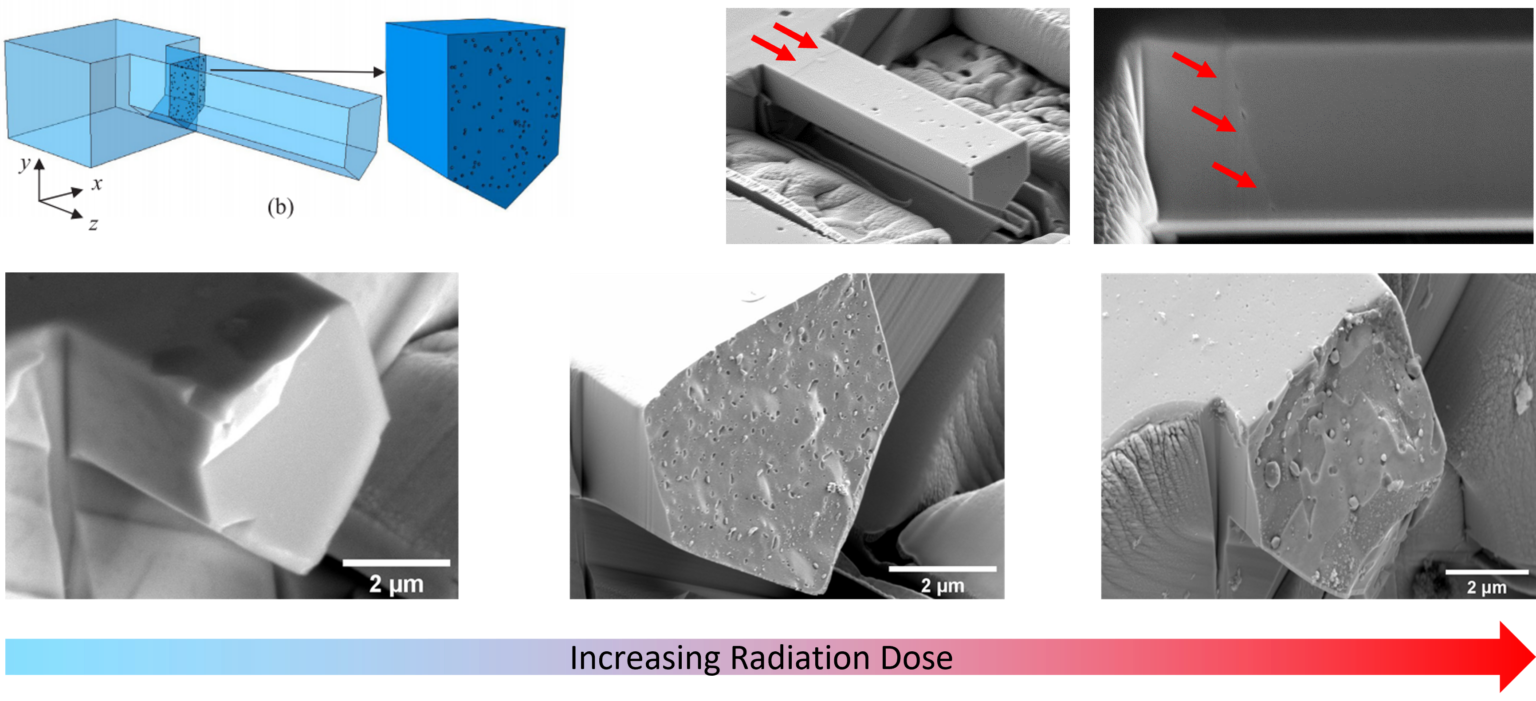
Henry, R., et al. (2020). Irradiation effects on the fracture properties of UO2 fuels studied by micro-mechanical testing. Journal of Nuclear Materials, 536, 152179. Image Credit: Science Direct/https://www.sciencedirect.com/science/article/abs/pii/S0022311520300611?via%3Dihub
How useful is the modularity of the Alemnis ASA across in situ, ex situ, synchrotron, and micro-CT setups?
Very useful - nuclear materials research often requires a sequence of measurements rather than one isolated test. A project may start with ex situ screening, move to in situ SEM to observe deformation, use EBSD or Raman to correlate deformation with structure, go to a synchrotron for diffraction during loading, and finally use tomography or micro-CT to examine internal cracking or damage evolution.
Alemnis describes the ASA as usable in in situ, ex situ, synchrotron, and micro-CT configurations, and also lists combined analysis options including DIC, EBSD, synchrotron/X-ray, tomography, Raman, and electrical testing. This flexibility matters because it allows researchers to maintain greater consistency in the mechanical testing platform while changing the surrounding characterization environment.
Why are true displacement mode, load-drop detection, strain-rate jumps, and sudden load excursions important, especially when evaluating complex nuclear materials' behavior?
Complex nuclear materials often deform in unstable or intermittent ways. Irradiated metals may show localized slip, sudden strain bursts, channeling, cracking, interface failure, or abrupt transitions in deformation mechanisms. If the instrument cannot properly control or resolve those events, a key part of the material response can be missed or misinterpreted.
Alemnis specifically highlights the ASA’s true displacement mode for understanding load drops, compression artifacts, strain-rate jumps, and sudden load excursions in real time. These events are relevant because they are often the signature of mechanism changes: incipient cracking, pop-in, dislocation avalanche activity, strain localization, or failure of a brittle phase or interface.
How important is testing across extreme temperatures and environments?
It is essential, as nuclear materials rarely operate at room temperature. Fission and fusion applications often involve elevated temperatures, thermal gradients, start-up and shutdown cycles, accident-relevant conditions, cryogenic handling environments, or low-temperature embrittlement concerns, depending on the system.
The Alemnis ASA has a wide range of environmental options, including high-temperature capabilities up to 1150 °C, low-temperature capabilities down to -150 °C, humidity control, liquid cell, and other environmental configurations such as gas and vacuum. This range is important because mechanisms like creep, irradiation hardening recovery, oxidation-assisted cracking, brittle-to-ductile transitions, and phase stability are strongly temperature dependent.
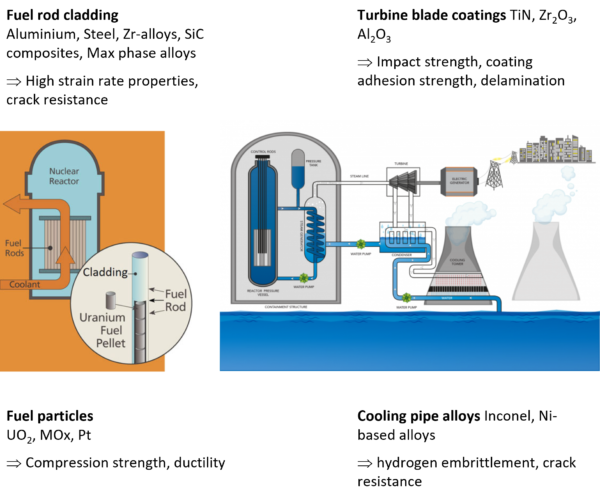
Image Credit: Alemnis
How does in situ micromechanical testing change model validation?
In situ micromechanical testing gives models more discriminating data. Traditional validation often relies on bulk stress-strain curves, creep curves, or fracture toughness values. While these are important, many models for irradiation damage, creep, and fracture depend on local mechanisms, including dislocation-defect interactions, grain boundary sliding, precipitate shearing, void growth, crack-tip plasticity, and strain localization.
In situ micromechanical testing can provide time- and spatially resolved evidence of such mechanisms. This helps validate not just the final property value, but the pathway by which deformation or failure occurs. It is particularly useful for crystal plasticity, finite element, dislocation dynamics, phase-field, and multiscale models, because researchers can compare predicted and observed deformation fields, slip traces, crack paths, strain bursts, or rate sensitivity.
A good example of providing critical data for model validation is shown here in a recent paper where we developed a novel stress-strain experimental methodology, which provided yield stress and strain values across the diffusion bonds of the ITER Tokamak reactor windows at UKAEA.
Which nuclear materials benefit most from small-scale testing?
Small-scale testing is especially transformative for materials where sample volume is limited, damage is localized, or microstructure is heterogeneous. Important examples include:
- Irradiated structural steels and stainless steels: Measure local hardening, embrittlement, creep, and fracture in limited activated material
- Ferritic-martensitic and oxide-dispersion-strengthened alloys: Probe interfaces, precipitates, grains, and anisotropic deformation
- Zirconium alloys and claddings: Study hydride effects, oxide layers, localized cracking, and irradiation response
- Tungsten (W) and fusion-facing materials: Examine brittle fracture, recrystallization, helium (He) effects, and surface damage
- Nuclear fuels and fuel surrogates: Testing of small, heterogeneous, radioactive, or difficult-to-machine regions, as well as single fuel particles
- Coatings, barriers, and accident-tolerant fuel materials: Target thin layers and interfaces that bulk tests cannot isolate
The method is particularly valuable where researchers need to test individual microstructural regions such as grain boundaries, oxide layers, phases, or orientations.
What still needs to improve?
The main challenge is confidence in translating small-scale data into engineering-scale decisions. Small-scale tests are powerful but sensitive to specimen size, geometry, surface preparation, FIB damage, strain rate, temperature control, alignment, machine compliance, oxidation, and statistical scatter. The nuclear community still needs stronger protocols, round-robin studies, reference materials, uncertainty quantification, and better correlations between microscale measurements and bulk properties.
Instrumentation improvements that would help with these challenges include more robust high-temperature testing in controlled atmospheres, better drift correction, higher-throughput automated testing, improved radioactive-sample handling, better integration with hot cells and gloveboxes, and more direct coupling between mechanical data, imaging, diffraction, and chemistry.
How can platforms like the ASA shorten the path from screening to qualification?
A modular micromechanical platform like the ASA allows researchers to screen more alloy variants, heat treatments, coatings, irradiation conditions, and microstructural states using smaller samples and faster test cycles. The ASA’s listed capabilities include nanoindentation, compression/tension, scratch, fatigue, creep, stress relaxation, fracture toughness, mapping, high-strain-rate testing, and operation across multiple in situ and ex situ environments.
This does not eliminate the need for code qualification, surveillance data, reactor exposure, or bulk mechanical testing. However, it can reduce the number of weak candidates that reach expensive late-stage testing, identify mechanisms earlier, and provide richer datasets for models that support qualification.
What role will small-scale testing play in next-generation nuclear materials?
Small-scale testing will likely become a central part of accelerated nuclear materials development. Advanced fission, fusion, accident-tolerant fuels, molten-salt systems, and high-temperature reactors all require materials that survive increasingly demanding combinations of radiation, heat, stress, and chemistry. Small-scale testing helps researchers move faster by extracting meaningful mechanical data from limited, irradiated, highly localized, or difficult-to-handle material volumes.
The most powerful role will be in integrated workflows: targeted irradiation, site-specific sample preparation, in situ mechanical testing, real-time imaging or diffraction, post-test microscopy, and model validation. Platforms like the Alemnis ASA are useful in such contexts because they support multiple test modes, environments, and characterization geometries on a single modular foundation. As well as faster testing, this results in better mechanistic understanding, exactly what is needed to design and qualify the next generation of nuclear materials.
About Nicholas Randall 
Nicholas Randall holds a PhD in Nanotribology and Nanoindentation from the University of Neuchâtel and a BSc in Materials Science and Management from Brunel University London. Since 2019, he has served as Vice President of Business Development at Alemnis AG, supporting growth in advanced materials characterization technologies.
This information has been sourced, reviewed, and adapted from materials provided by Alemnis AG.
For more information on this source, please visit Alemnis AG.
Disclaimer: The views expressed here are those of the interviewee and do not necessarily represent the views of AZoM.com Limited (T/A) AZoNetwork, the owner and operator of this website. This disclaimer forms part of the Terms and Conditions of use of this website.