From electrospinning to melt extrusion, researchers trace how pore architecture, surface chemistry, and scale-up constraints will shape the next generation of PFAS-free membranes.
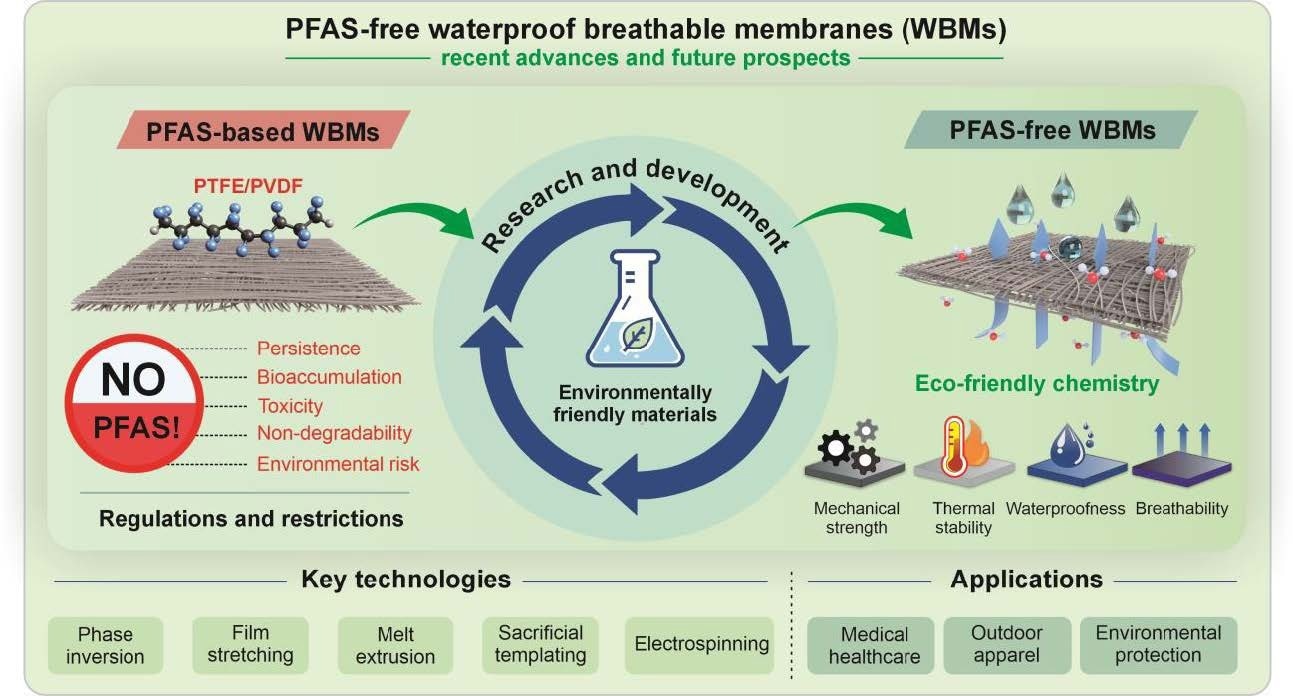
Recent advances and future prospects of PFAS (per- and polyfluoroalkyl substances)-free waterproof breathable membranes, highlighting the environmental motivations, key fabrication technologies, structure-property-performance relationships, and emerging applications. Paper: PFAS-free waterproof breathable membrane technologies
A recent 'article-in-press' review published online in the journal npj Advanced Manufacturing examines emerging waterproof breathable membrane technologies designed to replace conventional materials based on per- and polyfluoroalkyl substances (PFAS).
The review systematically compares major fabrication strategies, highlighting the relationships between membrane structure, processing methods, and functional performance. Overall, the review provides a practical framework for developing sustainable, high-performance, waterproof-breathable membranes for industrial applications.
Why PFAS-Free Membranes Matter
Waterproof breathable membranes combine water resistance with moisture vapor permeability through two principal designs. Porous membranes rely on engineered pore structures and hydrophobic surfaces to block liquid water while permitting vapor transport, whereas non-porous membranes transfer water vapor through a solution-diffusion mechanism.
For decades, fluorinated polymers such as polytetrafluoroethylene (PTFE) and polyvinylidene fluoride (PVDF) have dominated the waterproof-breathable membrane market due to their excellent water repellence, chemical resistance, and durability. However, growing concerns about the environmental persistence, bioaccumulation, and potential health risks of per- and polyfluoroalkyl substances (PFAS) have accelerated efforts to develop PFAS-free alternatives.
Although researchers have proposed a wide range of PFAS-free membrane technologies, differences in fabrication methods and performance metrics make direct comparisons challenging. This review addresses these challenges by systematically comparing current manufacturing approaches and evaluating their strengths, limitations, and performance trade-offs.
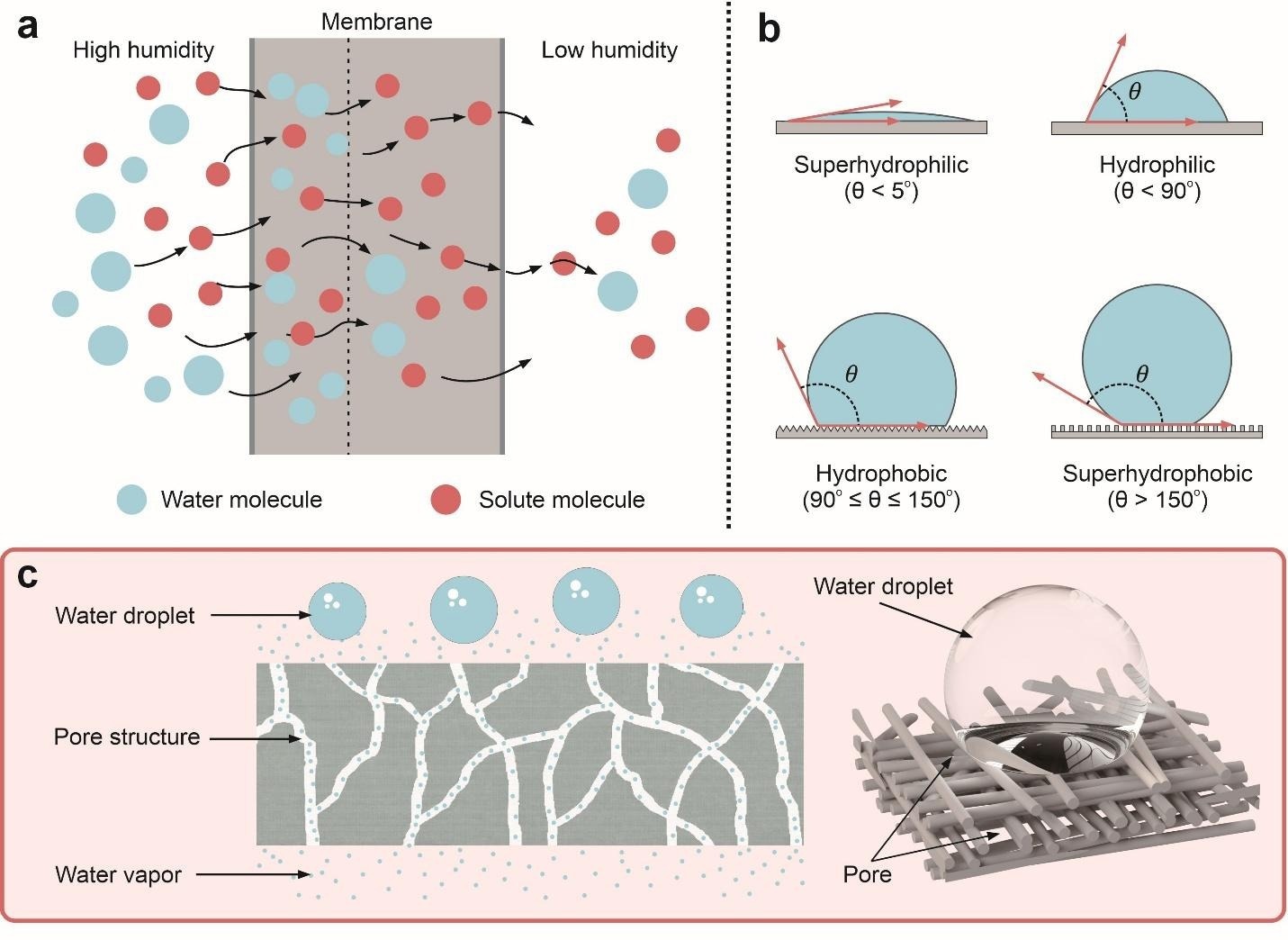
Working principles of waterproof breathable membranes. A. Illustration of the solution diffusion of a non-porous hydrophilic membrane. B. Hydrophobicity classification according to the water contact angle value. C. Illustration of the waterproof and breathable principles of a porous membrane.
Exploring Fabrication Routes for PFAS-Free Membranes
The review examines five widely used fabrication methods: phase inversion, film stretching, melt extrusion, sacrificial templating, and electrospinning. Each technique produces a distinct membrane architecture that influences waterproofness, moisture transport, mechanical strength, and long-term durability.
The phase inversion technique produces porous structures through controlled phase separation induced by non-solvent exchange, solvent evaporation, vapor exposure, or temperature changes, allowing manufacturers to tailor pore morphology for specific applications. Film stretching creates interconnected micropores by mechanically deforming semicrystalline polymers, while melt extrusion offers a solvent-free process well suited to large-scale production.
Sacrificial templating generates well-defined pore networks by removing temporary templates after fabrication. Electrospinning produces ultrafine nanofibrous membranes with exceptionally high porosity, making it particularly effective for applications that require rapid moisture vapor transport.
The authors also note that membrane performance depends on more than the fabrication method alone. Post-processing approaches, including thermal treatment, polymer surface coatings, and self-assembled monolayers, can further improve membrane performance. Heat treatment and polymer coatings can strengthen inter-fiber bonding and mechanical integrity, while coatings and self-assembled monolayers can reduce surface energy and improve water repellence.
Balancing Performance Through Material and Process Design
The review emphasizes that each manufacturing approach offers distinct advantages and limitations. The choice of fabrication method ultimately depends on the intended application, with trade-offs among waterproofness, moisture transport, mechanical durability, thermal stability, and manufacturability.
Among the technologies reviewed, electrospinning stands out for its ability to produce highly porous nanofibrous membranes with interconnected pore networks. This unique architecture promotes rapid moisture vapor transport, enabling electrospun membranes to achieve some of the highest water vapor transmission rates reported for PFAS-free waterproof breathable membranes. Such characteristics make electrospinning particularly attractive for applications requiring high wearer comfort, including outdoor apparel, protective clothing, and medical protection applications.
However, maximizing breathability does not necessarily produce the best overall membrane performance. Increasing membrane porosity or enlarging pore sizes can reduce hydrostatic pressure resistance, making membranes more susceptible to liquid water penetration under demanding conditions. Highly porous structures may also exhibit lower mechanical strength and reduced long-term durability, particularly when exposed to repeated mechanical stress or harsh environmental conditions. Conventional electrospinning can also rely on organic solvents and yield relatively low production rates, complicating industrial-scale up.
Other manufacturing approaches prioritize different performance characteristics. Phase inversion offers versatile control over pore morphology, enabling designers to tailor membrane permeability and waterproofness for specific applications. Film stretching can provide high mechanical strength, while melt extrusion supports continuous, solvent-free manufacturing at scale. Sacrificial templating offers the most precise control over pore size, geometry, and connectivity, although its multistep processing can be difficult and costly to scale. No method can simultaneously maximize every property.
Being PFAS-free does not automatically make a membrane environmentally sustainable because some approaches require organic solvents, high energy inputs, complex templates, or multiple processing steps. Carefully designing material composition, membrane architecture, and surface properties is therefore essential to achieving appropriate trade-offs among waterproofness, breathability, durability, and manufacturability.
The authors also highlight the need for standardized performance testing. The absence of globally unified protocols and performance benchmarks for PFAS-free membranes complicates direct comparisons, validation, certification, and commercialization.
Advancing Next-Generation Waterproof Breathable Membranes
The review concludes that PFAS-free waterproof breathable membranes have made significant progress in recent years, with some laboratory-scale membranes reaching competitive values for individual performance measures. However, no single PFAS-free material yet matches the comprehensive performance profile of PFAS-based membranes, and translating these advances into commercially viable products will require overcoming challenges related to durability, manufacturing scalability, cost, and long-term reliability.
The authors identify continued advances in polymer design and membrane engineering as essential for developing high-performance materials. At the same time, scalable manufacturing technologies capable of producing membranes with consistent microstructures will be critical for enabling widespread industrial adoption.
Overall, the review provides a comprehensive assessment of current fabrication technologies and their influence on membrane performance. By linking processing methods to membrane structure and functional properties, it offers valuable design guidelines for developing next-generation waterproof breathable membranes that reduce reliance on persistent PFAS-based materials and support more sustainable manufacturing practices.
Disclaimer: The views expressed here are those of the author expressed in their private capacity and do not necessarily represent the views of AZoM.com Limited T/A AZoNetwork the owner and operator of this website. This disclaimer forms part of the Terms and conditions of use of this website.