Precise preform heating is essential for high-speed injection stretch blow molding. Temperature deviations can cause structural flaws, irregular wall thickness, or product failure, risking quality and increasing waste in mass production settings.
Solution
Infrared pyrometers and thermal cameras allow for precise, real-time temperature monitoring of preforms during heating.
Their integration into molding machines enables fast deviation detection and correction, ensuring optimal conditions for homogeneous bottle creation even at high production speeds, thanks to non-contact thermometer technology.
Benefits
- Improved bottle quality with regular and uniform preform heating
- Reduced scrap rates due to overheating or insufficient softening
- Improved production stability at high operating speeds
- Faster responses to process variations reduce downtime risks
- Compact sensors integrate seamlessly with existing molding equipment
 Image Credit: Shutterstock.com/Aleksandar Malivuk
High-Speed Manufacturing and the Risk of Temperature Deviations
The injection stretch blow molding process is commonly used for producing plastic containers, particularly PET bottles. This method normally consists of two parts.
Plastic preforms are created during the first stage, which is known as injection molding. These preforms resemble thick-walled plastic tubes with one open end that typically already has the bottle's threaded neck for the cap.
The second stage, stretch blow molding, involves heating the preform before stretching and blowing it into its final shape inside a mold with compressed air.
Temperature control is crucial when heating the preform, as it must achieve a specified temperature to soften properly and be blown uniformly into the mold.
If the temperature is too low, the material may not stretch properly, causing uneven wall thickness or incomplete production. Conversely, if the preform is overheated, the material may thin, resulting in weak points in the bottle. Both scenarios can result in quality issues, such as bottles that do not satisfy structural requirements or leak easily when used.
Given the high speed of modern production lines, which can manufacture hundreds or thousands of bottles in a short period of time, precise and fast temperature measurement is critical to ensuring product consistency and quality.
Infrared temperature sensors are a dependable solution for monitoring and managing the preform heating process, assuring uniform temperature distribution and lowering the risk of manufacturing problems.
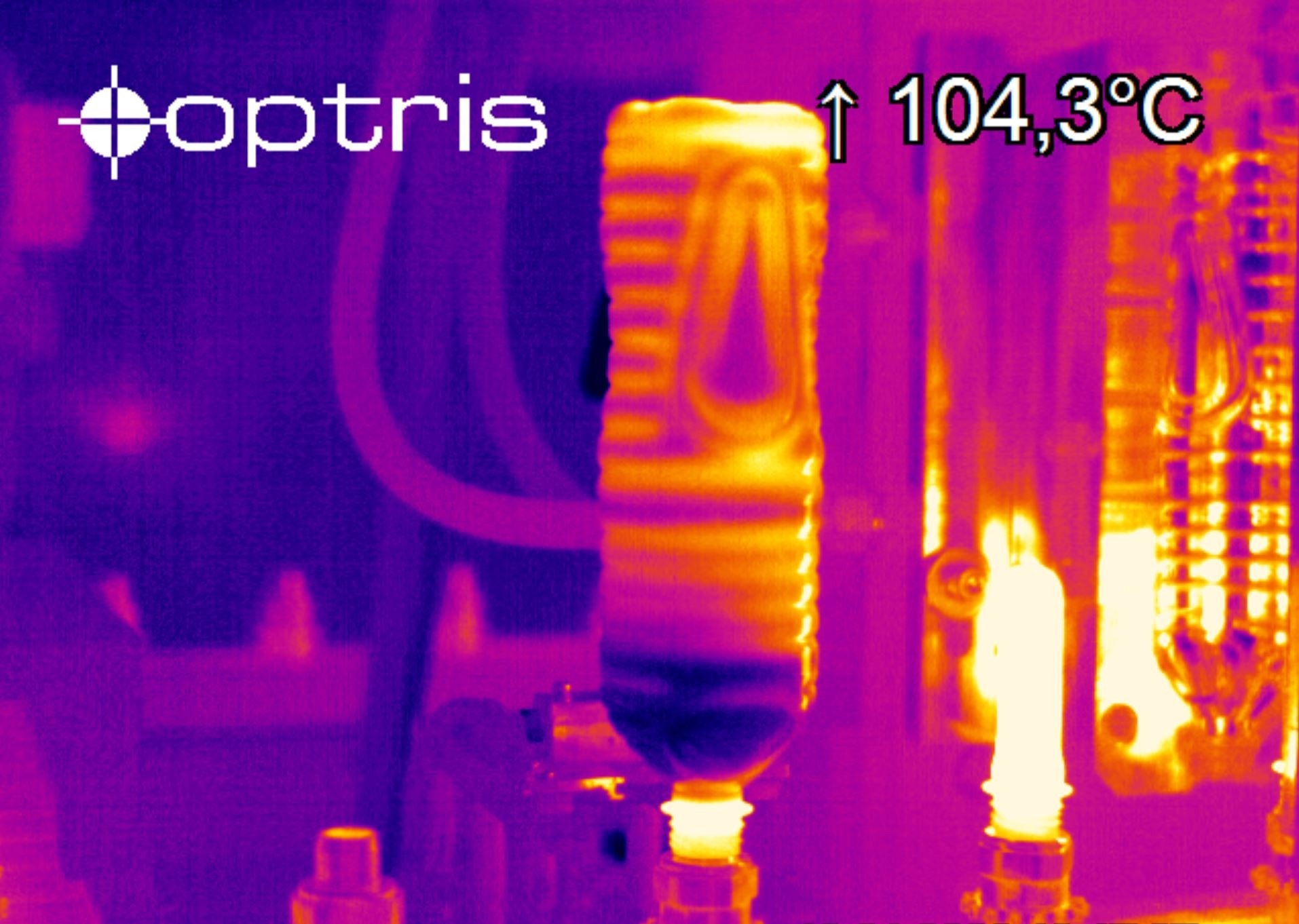 Image Credit:Optris GmbH & Co. KG
Integrating Infrared Sensors into High-Speed Molding Machines
Infrared pyrometers CTi LTfast and CTi 4M are essential for precise temperature control during the injection stretch blow molding process. These sensors are strategically placed to monitor the temperature of preforms as they heat before entering the mold.
The CTi LTfast has an extremely fast response time of under six milliseconds, which is crucial for high-speed production lines. With a temperature range of -50 °C to 975 °C, the CTi LTfast can detect even minor temperature variations, ensuring consistency in bottle manufacture.
The CTi 4M has an even faster response time of 110 microseconds and senses temperatures ranging from 0 to 600 °C. Its diminutive form, with a sensing head of only 14 mm in diameter, allows it to fit into small areas within the machine.
With a spectral range of 2.2 to 6 µm, it is well-suited for measuring temperature accurately in materials with fluctuating emissivity, such as plastic.
Both pyrometers provide real-time data that can be incorporated immediately into the machine's control system via interfaces such as Modbus TCP or EtherNet/IP.
This enables automatic modifications in the heating process when temperatures vary from the optimal range. Their high-speed measurement capabilities and dependability help to maximize manufacturing output while ensuring the quality of the plastic bottles being produced.
The Advantages of Compact, Fast-Response Infrared Sensors
The integration of Optris pyrometers, notably the CTi LTfast and CTi 4M models, into the injection stretch blow molding process provides significant benefits to manufacturers. One of the most notable benefits is improved product quality.
Manufacturers can ensure uniform and accurate heating of each preform by monitoring preform temperatures in real time. This reduces the likelihood of faults such as inconsistent wall thickness or weak points, resulting in stronger plastic bottles that meet both aesthetic and functional requirements.
Another significant advantage is increased production efficiency. The CTi LTfast and CTi 4M's rapid response times enable exact temperature measurements even on fast-moving production lines.
This capacity reduces the likelihood of temperature-related issues causing production delays or resulting in a significant number of damaged items. Manufacturers can increase output while reducing waste by maintaining ideal temperatures throughout the molding process.
The CTi LTfast's capacity to respond in six milliseconds ensures that even minor temperature variations are identified and adjusted instantly. Similarly, the CTi 4M's 110 microseconds response time guarantees that no temperature difference goes unnoticed, enabling quick adjustments to keep the manufacturing process operating smoothly.
In addition to boosting quality and efficiency, the small size of these pyrometers provides a considerable benefit to producers. The CTi LTfast and CTi 4M sensing heads are small enough to fit into tight areas within molding machines, ensuring that they do not interfere with other machine components.
This installation versatility is reinforced by the pyrometers' sturdy construction, which can endure the harsh circumstances of a high-temperature, high-speed industrial environment.
Optris infrared pyrometers also provide a high level of customization and versatility. With features such as adjustable emissivity and multiple interface options, these devices are easily integrated into a variety of control systems, making them handy tools for a wide range of industrial applications.
Their ability to measure temperature without direct touch ensures that they are reliable and accurate over time, lowering maintenance costs and extending equipment life.

This information has been sourced, reviewed and adapted from materials provided by Optris GmbH & Co. KG.
For more information on this source, please visit Optris GmbH & Co. KG.