A process industry equipment manufacturer required a consistent hydrogen supply over capillary-sized tubes for a continuous flow microreactor. The hydrogen process required hazardous area considerations. The manufacturer’s old arrangement used a general purpose mass flow controller within a purge box. While the system worked, it was not particularly efficient.
One New Device, More Process Data
The system integrator replaced general purpose MFC and the purge box with an Alicat® IS-Max™ intrinsically safe mass flow controller. The device was configured to meet their application requirements: 6 SLPM hydrogen, 1 bar g inlet pressure, and vacuum at the outlet.
The Alicat device was installed immediately in the classified area and connected to the current automation system via analog and digital outputs. With precise and reproducible measurements at 1,000 times per second, the instrument responded quickly without exposing the reactor to a rapid surge when vacuum was applied.
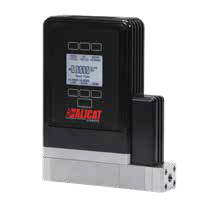
Image Credit: Alicat Scientific, Inc.
Reliable Process Visibility and Control
The IS-MAX provided operators with data and process control in a single, intrinsically safe instrument. They could see flow, pressure, temperature, totalized flow, and received a few other advantages:
- 30 ms to achieve consistent gas input across reactor channels
- 0.2% reproducibility of hydrogen flow from run to run
- Fewer components with a single meter and control valve
- Reduced fittings and leak pathways, saving space
- Eliminated the purge box and associated gas supply
- Up to 13 process parameters can be supplied to PLC
- Accuracy as good as ± 0.1% of full scale or ± 0.5% of reading
It was an advancement that gave system engineers a better view of the system at large. The increase in data reported gave more control over the process.
What Alicat Scientific Learned From the Customer’s Experience
Safety Hardware Can Slow Automation
The outcomes of retrofitting hazardous areas depend on the strengths and weaknesses of the components that comprise the system's architecture. Explosion-proof enclosures require access planning and inspection. They often necessitate changes to signal barriers, tubing, fittings, conditioners, and layout, which means additional work before the system is ready to run.
For this client, IS-Max MFCs improved the system by providing three desirable and critical features:
- Limit ignition energy at the device
- Control and measure the process
- Transfer data to the network

This information has been sourced, reviewed and adapted from materials provided by Alicat Scientific, Inc.
For more information on this source, please visit Alicat Scientific, Inc.