A new national-scale prospectivity model points explorers toward underexplored Australian basins that could help diversify supplies of the heavy rare earths needed for electric vehicles, wind turbines, and defense technologies.
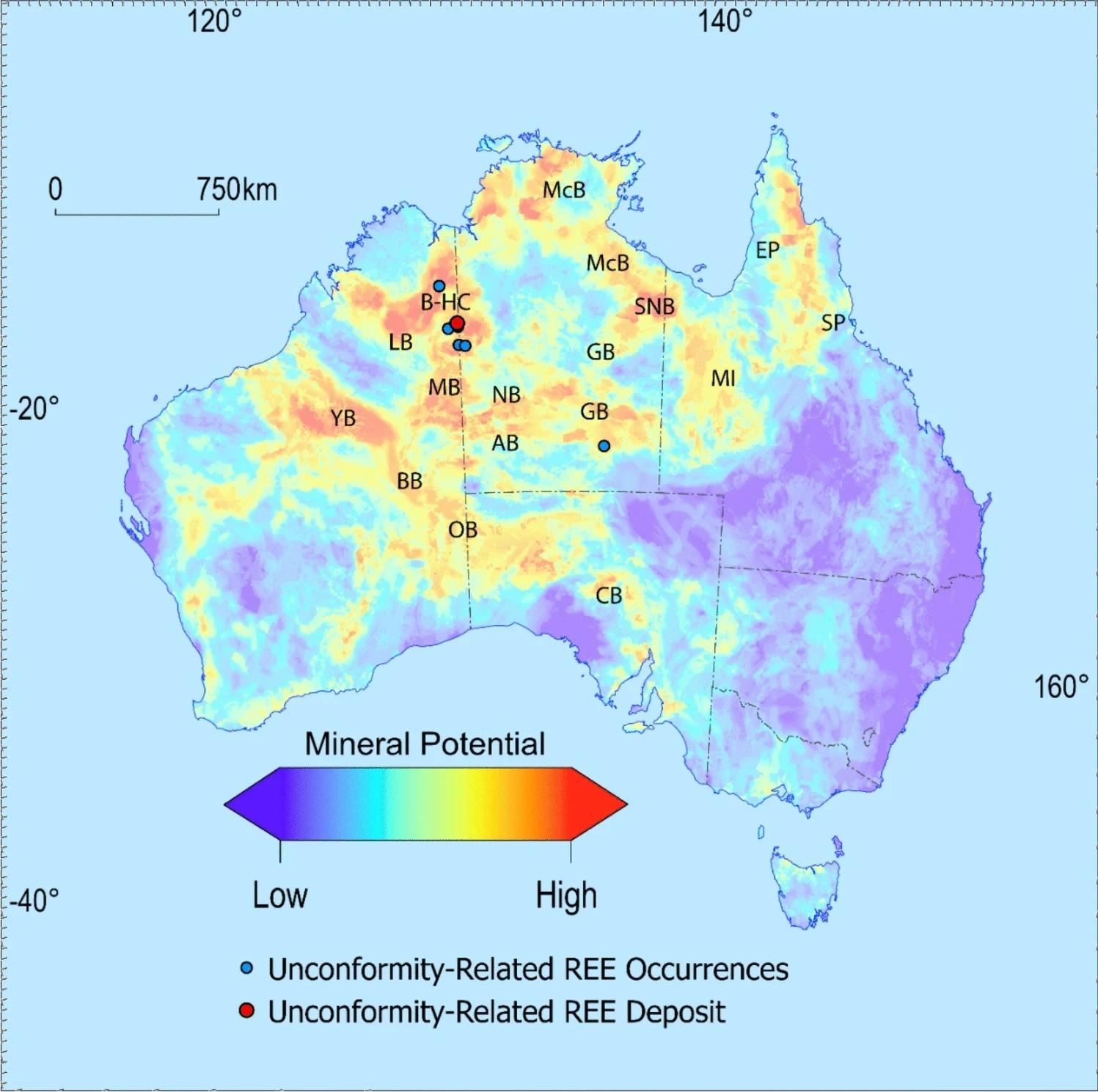
Map showing location of prospective Precambrian basins and provinces. OB–Officer Basin, BB–Bentley Basin, YB–Yeneena Basin, LB–Louisa Basin, B-HC–Birrindudu-Halls Creek region, MB–Murraba Basin, NB–Ngalia Basin, AB–Amadeus Basin, GB–Georgina Basin, SNB–South Nicholson Basin, McB–McArthur Basin, MI–Mount Isa region, EP–Etheridge Province, SP–Savannah Province, CB–Cariewerloo Basin
Heavy rare earth elements are essential for clean energy technologies and advanced electronics, but finding new sources remains a global challenge. A recent study published in the journal Natural Resources Research presented a national-scale mineral potential model to identify areas prospective for unconformity-related rare earth element mineral systems across Australia.
By combining geological models with extensive datasets from Geoscience Australia, the framework reduced the exploration search area by up to 95% while highlighting underexplored Precambrian sedimentary basins with high mineral potential. This broadens exploration beyond traditional magmatic models, such as carbonatites, toward low-temperature hydrothermal systems, which are recognized as complementary exploration targets due to their enrichment in heavy rare earth elements.
Significance of Heavy Rare Earth Elements
Modern clean energy technologies, advanced electronics, and defense systems rely heavily on a specific group of heavy rare earth elements, particularly dysprosium and terbium. These metals are essential for producing high-performance permanent magnets that retain their magnetic strength at high temperatures, making them essential for EV motors, wind turbines, aerospace equipment, and other advanced systems.
Methodology for Mapping Hydrothermal REE Potential
To map areas prospective for unconformity-related REE mineral systems, researchers developed a mineral prospectivity framework utilizing 21 precompetitive geoscience datasets. The model examined four key components: sources of rare earth elements; energy sources and fluid-flow drivers; geological structures that allow mineral-rich fluids to migrate; and favorable locations for deposition. Two prediction methods were compared: a knowledge-driven weighted sum model and a data-driven random forest model.
The study also reviewed existing radiation-damaged, metamict zircon spot analysis data from ancient Precambrian basement rocks, which can release rare-earth elements during hydrothermal alteration. Using data from the Sensitive High Resolution Ion Microprobe, it selected zircons that were at least 1,000 million years old, showed at least 20% age discordance, and contained more than 50 parts per million of uranium. These measurements helped identify areas where rare earth elements were likely released.
Furthermore, the geological framework incorporated three-dimensional (3D) chronostratigraphic surfaces with regional isochore data to locate Precambrian unconformities and basin boundaries. This framework helped map geological settings where acidic, phosphorus-bearing basin fluids may have mixed with metal-rich basement brines at temperatures between 150 and 300 °C. This created favorable conditions for the formation of xenotime-dominant mineralization with minor florencite, although the paper also notes an alternative model in which rare-earth elements and phosphorus may have originated from the same basement zircon source.
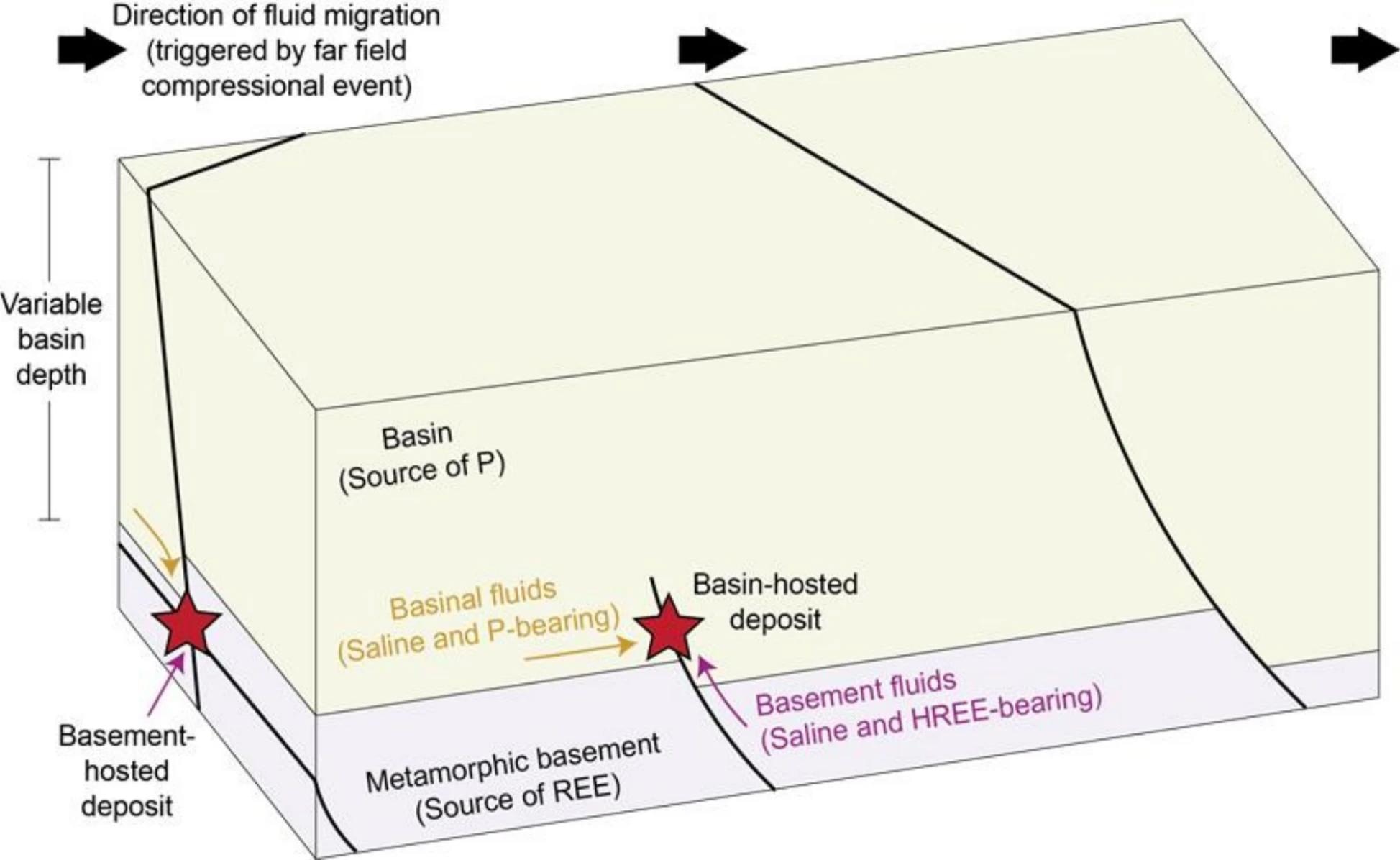
Simplified formation model for unconformity-related REE deposits. Based on the models of Nazari-Dehkordi et al. (2018) and Rabiei et al. (2017)
High-Prospectivity Zones for Future Exploration
The mineral prospectivity models successfully prioritized known URREE deposits and occurrences and identified areas with strong exploration potential. The knowledge-driven framework achieved an area under the curve (AUC) score of approximately 0.998. It also reduced the national search area by 95% while capturing 91.7% of known deposits within just 5% of the modeled area, with a moderate F1-score of 0.727 that reflects remaining classification uncertainty.
Although a random forest machine-learning model was tested, its apparently exceptional performance was interpreted cautiously, as sparse, highly clustered known deposits may have led to overfitting. Therefore, the knowledge-driven approach proved to be more robust for nationwide exploration.
The model highlighted established mineralized regions, including the Halls Creek-Birrindudu area along the Western Australia-Northern Territory border and Arthur Popes in the Northern Territory. This region contains the Wolverine deposit, with an estimated 7.3 million tonnes of mineral resources grading 0.96% total rare-earth oxides. Underexplored basins, such as the Yeneena, Officer, Bentley, South Nicholson, and McArthur basins, among others, were identified as promising targets for future exploration.
Enhancing Supply Chains Through New Discoveries
By identifying new areas prospective for hydrothermal rare earth deposits, the study highlights unconformity-related systems, which represent approximately 12.99% of Australia's identified rare earth resources, as an additional potential source of diversified supply. This could support advanced manufacturing by improving access to heavy rare earth elements, particularly those needed for high-performance magnet technologies.
A more reliable supply of dysprosium and terbium would support the production of high-performance permanent magnets used in EVs and wind turbines. This provides exploration companies and policymakers with detailed maps that can guide future mineral exploration and resource planning. Expanding domestic supplies of heavy rare earth elements would strengthen supply chains and help meet the growing demand for critical materials.
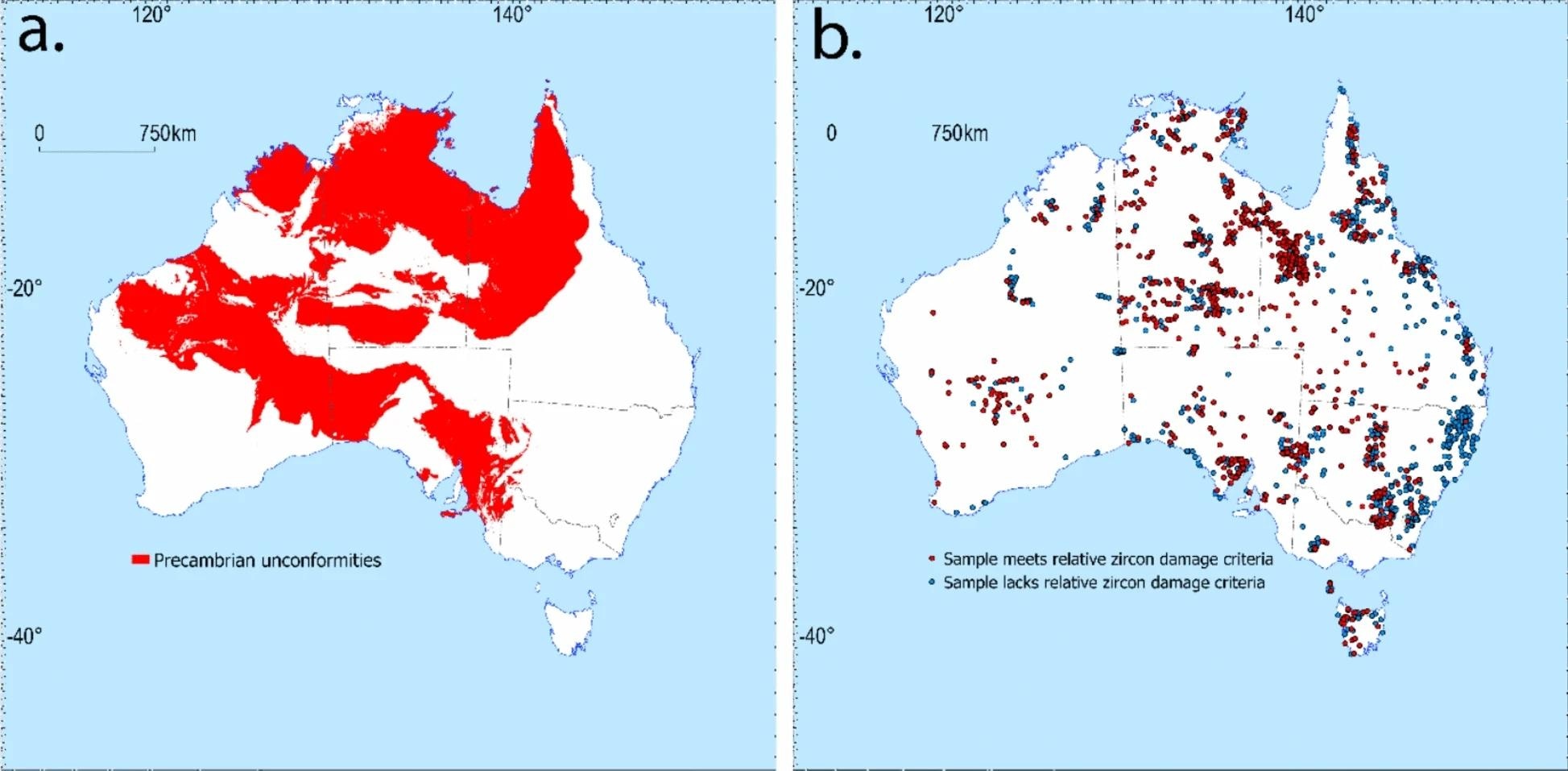
(a) Map of Precambrian unconformities derived from published 3D chronostratigraphic surfaces and their associated isochores (Vizy et al., 2024) and (b) map of individual zircon spot analyses from Geoscience Australia’s SHRIMP (Geoscience Australia, 2025) indicating which analyses demonstrate an age ≥ 1000 Ma, ≥ 20% discordance, and > 50 ppm U, used as a proxy for relative zircon damage (metamictization)
Future Directions in Hydrothermal Exploration
In summary, this study demonstrates that predictive mineral systems modeling can effectively identify areas of elevated geological potential for heavy rare-earth deposits across large areas. Integrating geological, geochemical, and geophysical datasets demonstrates that existing data can be used in new ways to enhance mineral exploration and reduce the area required for field surveys.
Future work should focus on refining regional fault maps to identify pathways that carried mineral-rich fluids during ore formation. Researchers also emphasized the need to improve underpinning national datasets, including mapped basins, layered geology, faults, geochemistry, and heavy-mineral data. Integrating these models with other rare-earth-element mineral-system models, re-mining potential, by-product opportunities, and techno-economic criteria could further improve exploration planning and support a reliable supply of the heavy rare-earth elements needed for future clean energy technologies.
Disclaimer: The views expressed here are those of the author expressed in their private capacity and do not necessarily represent the views of AZoM.com Limited T/A AZoNetwork the owner and operator of this website. This disclaimer forms part of the Terms and conditions of use of this website.
Source:
- Ford, A., Walsh, J., Doublier, M., Burnham, A., Cloutier, J., Fraser, G., Magee, C., & Czarnota, K. (2026). Unconformity-Related Rare Earth Element Mineral Potential of Australia. Nat Resour Res. DOI: 10.1007/s11053-026-10739-3, https://link.springer.com/article/10.1007/s11053-026-10739-3