A Li-air-inspired electrochemical system extracts lithium from simulated seawater and uses ambient CO2 to form high-purity carbonate, suggesting a low-reagent route for future battery material production.
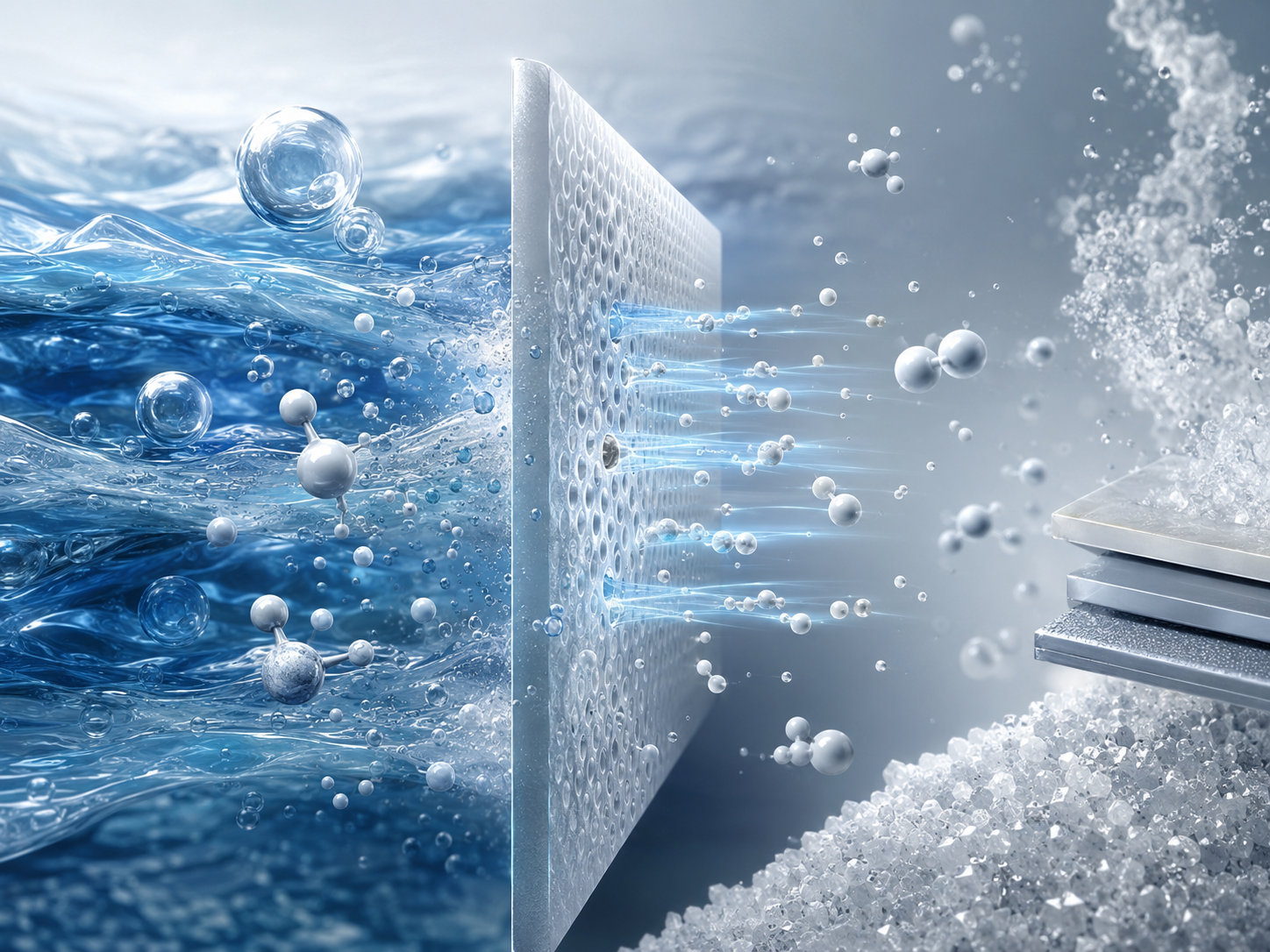
Paper: Li–air chemistry inspired electrodialysis for direct lithium carbonate production from seawater. Image credit: AI-generated image created using ChatGPT/OpenAI
In a recent research article accepted for publication as an 'Article in Press' in the journal Nature Communications, researchers developed an electrodialysis-based approach inspired by Li-air chemistry for the direct extraction of 93.8% purity lithium carbonate from simulated seawater using ambient carbon dioxide, offering a low-reagent, efficient alternative to conventional lithium production methods.
Challenges in Seawater Lithium Extraction
The rising demand for lithium-ion batteries, driven by the global transition to renewable energy sources, has underscored the need for sustainable lithium extraction methods. Traditional lithium production techniques, such as ore roasting and brine evaporation, are resource-intensive, geographically limited, and environmentally detrimental.
Seawater, which contains low concentrations of lithium amid a complex ionic matrix, offers a challenging yet vast alternative lithium resource. To tap this resource effectively, materials enabling selective lithium extraction and conversion under mild conditions are essential.
Solid-state lithium-conducting membranes, particularly non-porous Li1.5Al0.5Ge1.5(PO4)3 (LAGP), have emerged as promising candidates for ion-selective transport. Integrating these membranes with electrochemical systems inspired by Li-air battery chemistry could allow direct lithium carbonate (Li2CO3) production from seawater with reduced chemical inputs, energy demands, and process complexity.
Electrodialysis with Li-Air Chemistry
This study developed an electrodialysis system integrating a non-porous LAGP solid electrolyte membrane within a redox-flow cell to selectively extract lithium ions from simulated seawater. The cell comprises a simulated seawater-filled anodic compartment and an aprotic cathodic compartment containing an organic electrolyte of 0.1 M LiClO4 in tetraethylene glycol dimethyl ether (TEGDME).
Under an applied electric field (≤2 V), lithium ions migrate from seawater through the LAGP membrane into the catholyte, while competing cations such as Na+ and K+ are largely restricted by the membrane, although crossover may occur under some operating conditions. Ambient air, supplying oxygen and carbon dioxide, is bubbled in the catholyte.
Oxygen reduction occurs electrochemically at the cathode, facilitating reaction pathways driven by Li-air chemistry to form solid lithium carbonate directly within the cathodic compartment. A redox mediator, 2,5-di-tert-butyl-1,4-benzoquinone (DBBQ), assists electron transfer and promotes solution-mediated lithium carbonate crystallization, enhancing product collection efficiency.
An inline filter captures precipitated Li2CO3 for characterization. Characterization techniques, including FTIR, XRD, and Raman spectroscopy, confirmed the composition and crystallinity of the products.
Electrochemical measurements, current density variations, and post-extraction material analyses were conducted to assess performance. The purity of Li2CO3 and its suitability for laboratory-scale battery cathode synthesis were verified, along with preliminary techno-economic and environmental assessments to evaluate scalability and sustainability.
Lithium Carbonate Yield and Selectivity
The LAGP membrane demonstrated high lithium-ion selectivity, permitting efficient Li+ transport from simulated seawater into the catholyte, while substantially blocking competing ions (Na+, K+, Mg2+). Electrochemical oxygen reduction at the cathode coupled with Li+ migration enabled direct lithium carbonate formation without added precipitants, a significant departure from conventional multi-step extraction processes relying on chemical reagents such as sodium carbonate.
The Li-air chemistry, driven by thermodynamic favorability, promotes displacement reactions in which Li+ replaces Na+ and K+ in superoxide intermediates, thereby fostering chemical selectivity for lithium carbonate precipitation even amid high concentrations of competing cations. This reaction-driven selectivity provides a second separation mechanism that complements, but does not eliminate the need for, membrane selectivity.
The DBBQ redox mediator was instrumental in facilitating solution-mediated lithium carbonate formation, as evidenced by a shift in deposition patterns: 54.47% of Li2CO3 was captured on the filter membrane at 0.025 mA cm−2, contrasting with predominantly electrode-bound deposits in the absence of DBBQ. Additional nanoscale Li2CO3 particles escaped the inline filter, and when the catholyte solids were centrifuged, 83.84% of the theoretical yield was accounted for.
Spectroscopic analyses verified the presence of Li2CO3 via characteristic vibrational bands and diffraction peaks, affirming product identity despite relatively low crystallinity. The extracted Li2CO3, with a purity of approximately 93.8%, was successfully used as a precursor for LiCoO2 cathode synthesis, demonstrating stable electrochemical cycling performance in lithium-ion battery testing and validating the battery-relevant functional quality of the material.
Voltage profiles during galvanostatic operation displayed plateaus consistent with reduced cell overpotentials facilitated by the redox flow configuration. Anode reactions involved oxygen evolution and concurrent chlorine evolution from seawater, as confirmed by analytical methods, which contributed to the overall cell voltage characteristics. However, chlorine evolution may also contribute to local acidification, electrode corrosion, material degradation, and reduced energetic efficiency during extended operation.
Energy consumption associated with the electrodialysis process was estimated to be substantially lower than that of evaporation-precipitation methods, and the electrochemical system operated effectively at low voltages (<2 V).
The techno-economic evaluation revealed that while the energy cost contribution was minimal (~2%), the majority of operational expenses stemmed from replacing the solid electrolyte membrane, which currently has a limited operational lifetime (~1 month) due to degradation under high-salinity, electrochemical-bias conditions.
Surface etching, ion exchange, and phase transformations diminish membrane integrity and Li+ transport efficacy over time. Recent advances suggest potential mitigation pathways through TiO2 coatings and membrane vitrification, which could significantly extend membrane lifetimes and reduce costs. The cost estimates, therefore, remain conditional on improved membrane durability, stack design, product collection efficiency, and electricity pricing assumptions.
Scalability and Economic Viability
This work introduces a lithium-air chemistry-inspired electrodialysis method integrating a lithium-conducting LAGP solid electrolyte membrane for the direct, low-reagent production of battery-relevant lithium carbonate from simulated seawater.
By leveraging redox-mediated Li+ transport and in situ electrochemical oxygen reduction, this approach eliminates the need for traditional chemical precipitants and complex multi-step processing, markedly simplifying lithium extraction.
The extracted Li2CO3 exhibits high purity and is suitable for cathode material synthesis under laboratory conditions, underscoring its practical applicability. Preliminary techno-economic modeling suggests potentially competitive production costs and scalability potential, contingent upon advances in membrane durability and collection efficiency.
Additionally, the simultaneous carbonation with CO2 offers potential environmental benefits, as the process fixes CO2 within the carbonate product. The study estimates that one tonne of Li2CO3 could mineralize approximately 0.6 tonnes of CO2, although broader carbon benefits would depend on the use of renewable electricity and full system performance. This integrated materials and electrochemical strategy offers a promising pathway toward sustainable and decentralized lithium resource utilization, which is essential for global energy transitions.