
Organic Light-Emitting Diodes (OLEDs) have moved rapidly from the research lab to the fab. Their bright, ultra-thin, and dynamic characteristics make them appealing for many display applications, ranging from cell phones to TVs. The metrology of the many thin films that make up such displays is extremely important but may be too delicate for surface contact metrology, which can damage these relatively soft layers.
Image Credit: LIORIKI/Shutterstock.com
The Filmetrics® F20-UV and F40-UV instruments offer inexpensive, robust, and non-invasive metrology for simple prototype devices to fully pixelated displays. Because these instruments are spectroscopic, they can also detect chemical changes that can occur in these atmospherically sensitive materials.
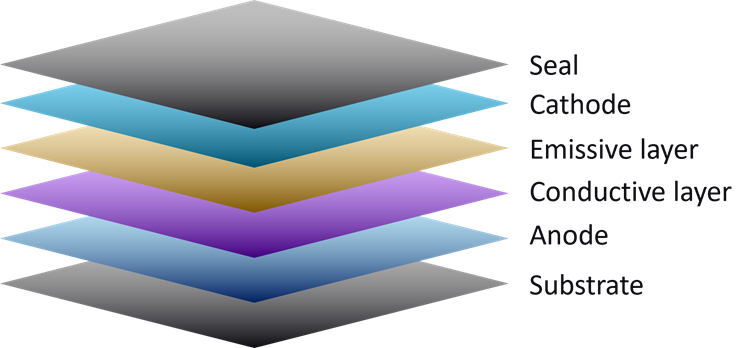
Simple OLED layer structure. Image Credit: KLA Instruments™
Measure Transparent Conductive Oxides
Whether one encounters Indium Tin Oxide (ITO), Zinc Oxide, or Poly (3,4-ethylenedioxythiophene), KLA Instruments' proprietary ITO optical model, coupled with its broadband UV-NIR instruments, can solve thickness and optical constants at a fraction of the cost and effort of a spectroscopic ellipsometer.
Measure Complicated Organic Materials
A typical OLED structure includes multiple specialized layers: Hole Injection Layers, Hole Transport Layers, and Recombination/ Emission layers. All these layers contain optically complex organic molecules (either small molecules and/or polymers). Dealing with such materials can be challenging for spectral reflectance due to their highly anomalous optical dispersion. However, the comprehensive Filmetrics materials database stretches back to the very beginnings of OLED and can deal with the high index dispersion and multiple UV features encountered with these molecules.
Films on Flexible Substrates
OLEDs enable truly flexible displays, which may require measurement on highly birefringent substrates such as polyethylene terephthalate (PET). This type of material poses a serious problem for metrologies such as ellipsometry: one must either model this additional optical complication or manually roughen the backside of the PET. Neither of these approaches is required for unpolarized spectral reflectance, yielding significant time savings for both user training and data generation.
Measurements Inside a Glove Box
OLED materials are extremely sensitive to water and oxygen. Many areas of research require measurements inside the controlled atmosphere of a dry glove box. The small form factor of our instruments and their modular, fiberoptic-based design easily allows real-time, “in-the-box” measurements of unencapsulated devices.
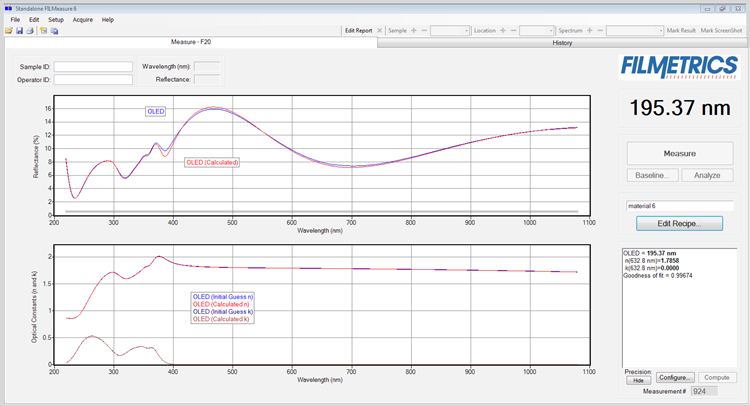
F20-UV measurement of OLED layer thickness and material properties. Image Credit: KLA Instruments™
This information has been sourced, reviewed, and adapted from materials provided by KLA Instruments™.
For more information on this source, please visit KLA Instruments™.