A survey of the rapidly expanding materials AI landscape reveals where today's foundation models concentrate their strengths and what researchers say must change before a single system can connect structures, experiments, physical laws, and industrial applications.
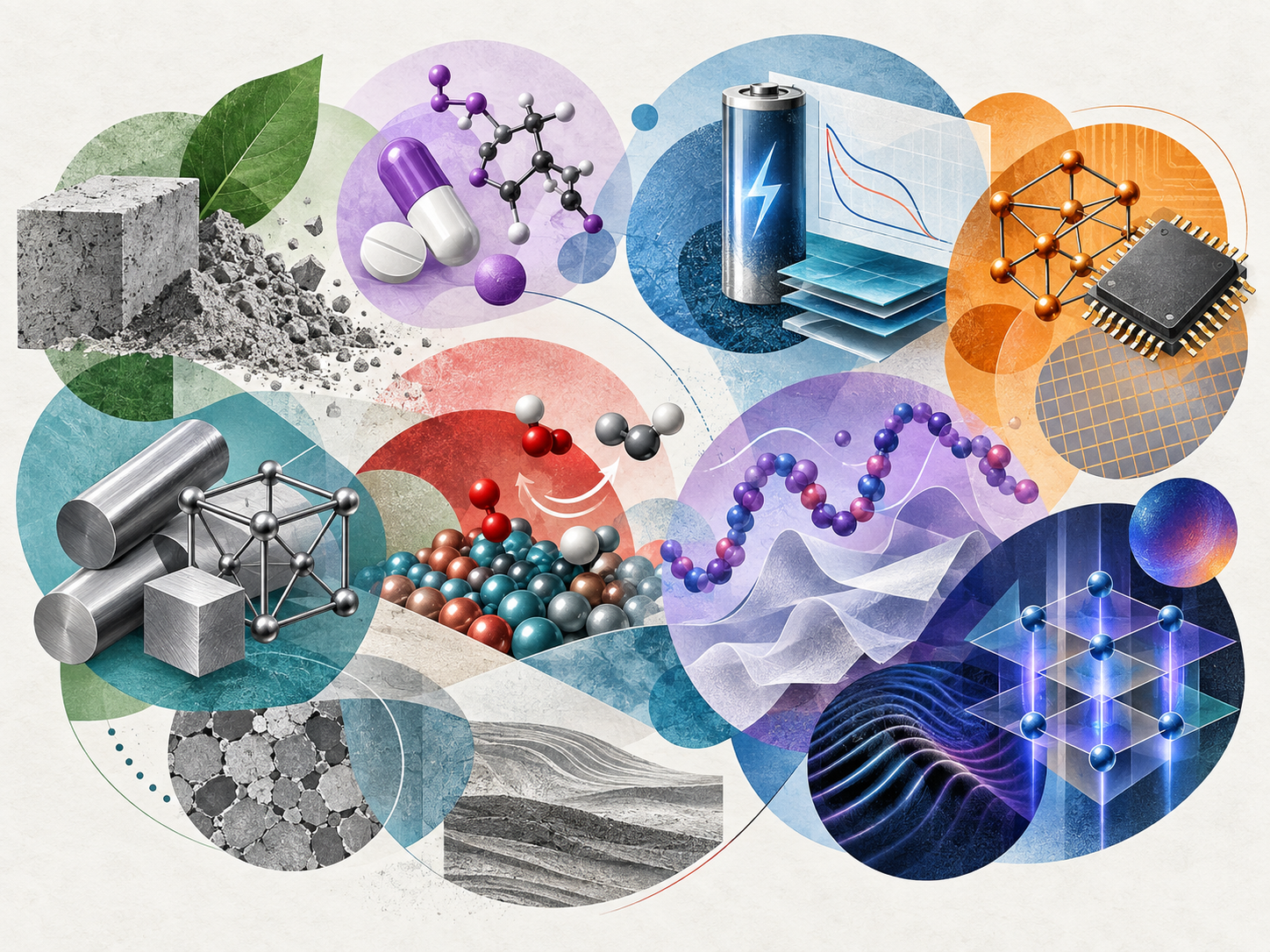
Paper: Domain-Informed AI Multimodal Foundation Model for Materials Science. AI-generated abstract conceptual image created using ChatGPT/OpenAI
Developing a genuinely new material from discovery to market has historically taken 15 to 20 years under traditional trial-and-error development. To shorten this process, researchers are increasingly exploring artificial intelligence (AI) for materials discovery and development.
A recent paper posted on the ChemRxiv preprint server examined the shift from narrow, task-specific machine learning (ML) models to broader foundation models that can be reused across a range of materials problems.
Transitioning to AI-Assisted Materials Research
Scientific research has progressed through empirical, theoretical, computational, and data-based approaches, with AI-assisted discovery now emerging as a fifth paradigm.
High-throughput computational screening and automated workflows have produced large collections of crystallographic and thermodynamic data that can be used to train predictive ML models. The demand for materials in clean energy, sustainable construction, and advanced electronics has increased the need for faster research methods.
Many existing ML approaches process different types of material data separately. A single material can be described through composition tables, atomic crystal structures, electron microscopy images, and spectroscopic time-series data. Treating these inputs independently makes it hard to capture relationships among physical properties.
This limitation has encouraged scientists to explore multi-modal models that can integrate diverse data sources and incorporate scientific knowledge into a unified representation.
Comprehensive Review of Foundation Models
To assess the development of foundation models for materials development, researchers conducted a bibliographic analysis of 557 records from the Web of Science Core Collection and supplemented this with an open literature search. They identified 58 new materials-science foundation models and 45 further publications discussing them, with publication activity rising steeply from 2022 to mid-2026.
The models were categorized by their main applications and data types. Inorganic crystals and atomistic materials accounted for 41 of the 58 models, a concentration consistent with the availability of standardized, machine-readable data from high-throughput density functional theory databases.
The study examined seven data modalities, including text, audio, video, images, graphs, tabular data, and time-series signals. Based on this analysis, researchers proposed a structure built around four core requirements for materials foundation models:
- Integrating and Harmonizing multi-modal Data: Bringing different materials measurements and representations into compatible datasets.
- Designing Physically Grounded multi-modal Architectures: Creating architectures that can process multiple modalities while incorporating scientific constraints.
- Implementing Parameter-Efficient Fine-Tuning: Allowing specialization for specific industrial applications without retraining the entire model.
- Validating and Improving Models: Testing accuracy and physical consistency and refining models as new data become available.
Identifying Gaps in Current Multi-Modal Models
The review identified significant gaps in existing materials informatics foundation models. Of the 58 models examined, 52 used a single data modality, while only 6 combined multiple data types. Among those six entries, three multi-modal models paired atomic or crystal representations with natural language text, while experimental characterization data were rare.
Under the review's criterion, 12 of the 58 models embedded physical knowledge through mechanisms such as rotational and translational invariance or equivariance and forces calculated as gradients of learned energy functions. All 12 physics-informed models were unimodal, while the six multi-modal entries did not impose explicit physical constraints.
The availability of open data also differed across modalities. Some computational resources contain well over 100 million calculations, while paired experimental datasets are much less common.
Spectroscopic time-series resources are orders of magnitude smaller than structural databases, and operando microscopy footage and acoustic-emission records are largely absent from open repositories. Different data types are rarely linked to the same physical sample, complicating current models' ability to learn relationships across experimental and computational measurements.
Industrial Applications of Unified Models
Addressing these gaps could support materials research across several sectors. A unified foundation model could facilitate the transfer of knowledge from data-rich theoretical domains to applications with limited experimental data.
In energy research, such a system could combine calculated structures with electrochemical measurements to support battery-material screening.
These examples describe proposed specializations rather than results from a model built in this review. Similar approaches could be applied to sustainable construction and pharmaceutical research. Parameter-efficient fine-tuning methods, such as Low-Rank Adaptation (LoRA), could adapt a foundation model to specific tasks using smaller labeled datasets.
For instance, a model could predict the compressive strength and hydration kinetics of low-carbon cementitious mixtures from limited experimental data.
In electronics, multi-modal models could combine theoretical band structures with measured device performance data to support materials screening and design.
Future Directions for Multi-Modal Models
The review concludes that current materials foundation models remain limited by the separation betweenmulti-modall learning and explicit physical grounding. Future development should focus on domain-informed multi-modal models that can process different types of material data while incorporating physical constraints.
Combining physics-based constraints with multi-modal data could help reduce physically unrealistic predictions and make better use of limited experimental datasets. No model in the surveyed corpus combined multiple modalities with explicit physical grounding, so the proposed model remains a research goal rather than a demonstrated system.
Further work is needed to harmonize datasets, handle missing modalities, develop multi-modal evaluation standards, validate predictions, and test these approaches in real research and industrial settings. Cross-sector transfer remains to be shown.
Disclaimer: The views expressed here are those of the author expressed in their private capacity and do not necessarily represent the views of AZoM.com Limited T/A AZoNetwork the owner and operator of this website. This disclaimer forms part of the Terms and conditions of use of this website.